
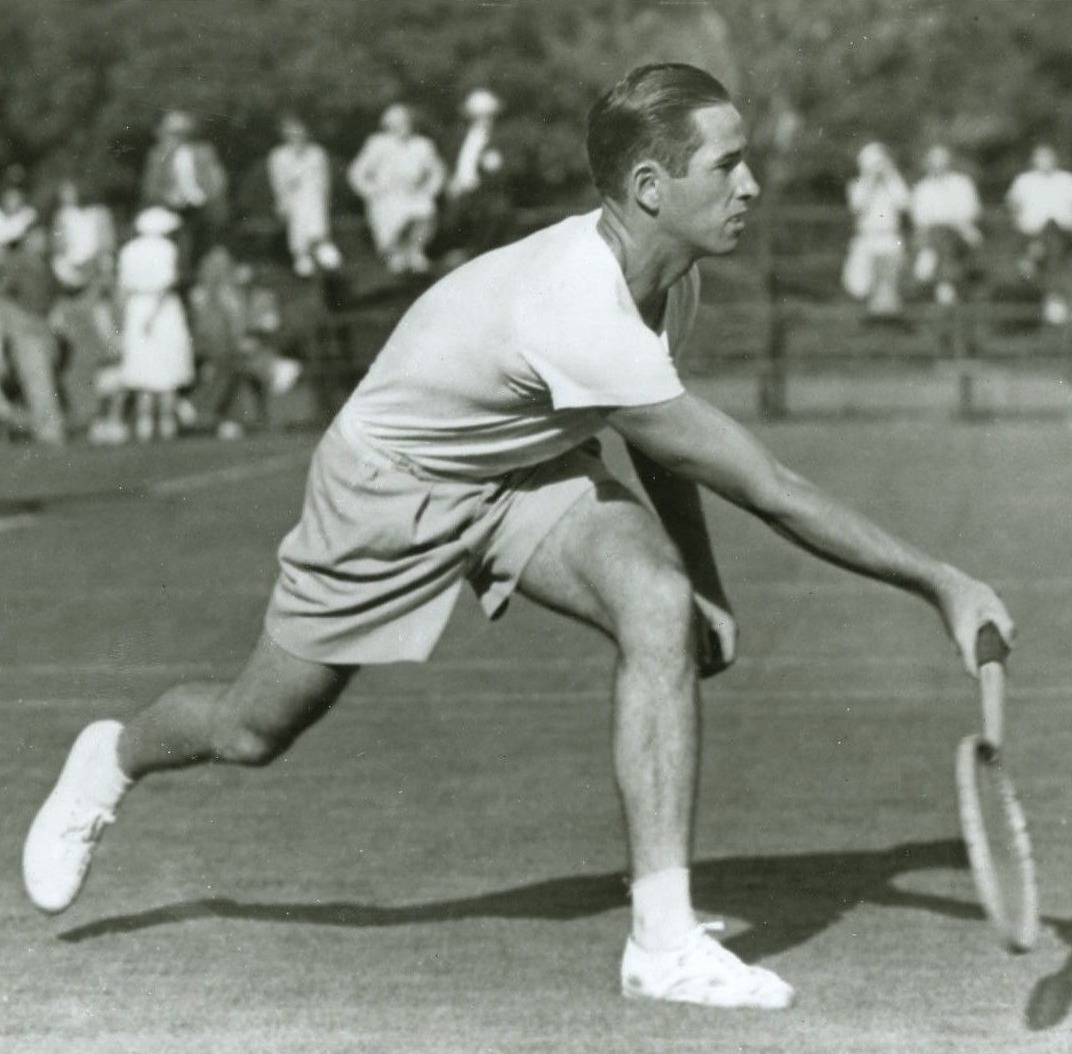
Bobby Riggs was one of the most colorful and controversial figures in the history of tennis. Born on February 25, 1918, in Los Angeles, California, Riggs would go on to become a world-renowned tennis player, known not only for his skills on the court but also for his larger-than-life personality and his role in the infamous “Battle of the Sexes” match against Billie Jean King in 1973.
Early Life and Introduction to Tennis
Growing up in the Lincoln Heights neighborhood of Los Angeles, Bobby Riggs was one of six children in the Riggs family. From an early age, Riggs showed an aptitude for sports, excelling particularly in table tennis. It wasn’t until he was 11 years old that Riggs began to take tennis seriously, a sport that would eventually bring him international fame.
Riggs was trained by Esther Bartosh, who recognized his talent early on. Despite being considered small and not particularly powerful by Perry T. Jones, a significant figure in the Los Angeles tennis community, Riggs demonstrated exceptional ball control and speed. His early training at the Los Angeles Tennis Club under Bartosh’s guidance helped him develop a playing style that relied heavily on tactical intelligence and precision, rather than brute force.
Rising Through the Ranks
By the age of 16, Bobby Riggs had already made a name for himself, ranking fifth among American tennis players in his age category. His first major victory came in 1935 when he won the National Championship by defeating Joe Hunt. This victory was not a one-off; Riggs and Hunt would face each other in 17 finals that year, with Riggs emerging victorious each time.
At 18, despite still being classified as a junior player, Riggs won the Southern California men’s title. Defying the skepticism of figures like Perry T. Jones, Riggs headed east to compete in grass-court tournaments, even though he had no prior experience on such surfaces. His adaptability was remarkable; he won the US Clay Court Championships in Chicago by defeating Frank Parker in the final and reached the finals in two other tournaments. By the end of the year, Riggs had climbed to fourth place in the U.S. men’s rankings.
Characteristics and Playing Style
Bobby Riggs was known for his impeccable technique and tactical intelligence. Despite his relatively short stature, Riggs was able to compete at the highest levels of tennis by mastering the art of placement and using his quick reflexes to outmaneuver opponents. His ability to read the game and his use of lobs and drop shots made him a formidable opponent. Riggs’s style was a study in contrasts—while many of his contemporaries relied on power, Riggs used finesse and cunning to win matches.
Dominance in the 1940s
In his early 20s, Bobby Riggs’s career took off. In 1939, he participated in the Davis Cup as an amateur, helping the United States win by defeating Adrian Quist in the final. The same year, Riggs won all three titles he competed for at Wimbledon—the men’s singles, men’s doubles with partner Elwood Cooke, and mixed doubles with Alice Marble. His victory at the US National Championships that year, where he defeated Welby van Horn in the final, cemented his status as the world’s top amateur player.
The 1940s saw Riggs continue his success. In 1940, he reached the final of the US National Championships again, but this time he was defeated by Donald McNeill. However, he consoled himself by winning the mixed doubles title with Alice Marble. The following year, Riggs won the US National Championships for the second time, defeating Frank Kovacs in the final.
Riggs turned professional after this victory, but his career was interrupted by World War II. Despite this, Riggs returned to the court after the war and won the US Pro Tennis Championships in 1946. He then embarked on a tour with Don Budge, one of the era’s greatest players, and achieved a remarkable record, winning 24 matches, drawing one, and losing 22. Riggs would go on to win the US Pro Tennis Championships again in 1947 and repeated his tour with Budge, who by then was hampered by a shoulder injury sustained during military training.
The “Battle of the Sexes”
Bobby Riggs is perhaps best known for his role in the “Battle of the Sexes” tennis matches in 1973. By this time, Riggs was 55 years old and had long retired from professional tennis. However, he remained in the public eye, often promoting tennis events and making bold statements about the state of the sport.
Riggs believed that the top female players of the time could not compete with a man, even one well past his prime. His first “Battle of the Sexes” match took place on May 13, 1973, against Margaret Court, one of the leading female players of the era. Riggs won the match decisively, losing only three games. The victory earned him widespread media attention, including covers on Time and Sports Illustrated.
Encouraged by his victory over Court, Riggs challenged Billie Jean King, another top female player. Initially reluctant, King eventually agreed to the match, which took place on September 20, 1973. Unlike the match against Court, Riggs was thoroughly outplayed by King, who won in straight sets. The match was a major cultural event, drawing massive television audiences and becoming a landmark moment in the history of women’s sports.
Riggs later commented on the match, saying, “Billie and I did wonders for women’s tennis. They owe me a piece of their checks.” This quote encapsulates Riggs’s blend of showmanship and genuine belief in his role as a promoter of tennis, regardless of the outcome.
Later Life and Legacy
After the “Battle of the Sexes,” Bobby Riggs retired from competitive tennis but continued to be involved in the sport through promotional events and exhibitions. His legacy is a complex one. On the one hand, he was an undeniably talented player, with a career that spanned both amateur and professional tennis. On the other hand, his role in the “Battle of the Sexes” and his public persona often overshadowed his on-court achievements.
Bobby Riggs passed away on October 25, 1995, in Encinitas, California, at the age of 77. His life story is a testament to the evolution of tennis and the enduring appeal of a player who was as much a showman as he was an athlete.
Riggs’s life and career have been the subject of various books and films, including the 2017 movie “Battle of the Sexes,” where Steve Carell portrayed Riggs and Emma Stone played Billie Jean King. The film highlighted not just the famous match, but also the cultural and social context of the 1970s, a time when gender equality was becoming an increasingly prominent issue in sports and society at large.
In retrospect, Bobby Riggs was more than just a tennis player. He was a symbol of an era, a man whose life intersected with significant moments in sports history. His matches, particularly the “Battle of the Sexes,” continue to be remembered as defining moments in the struggle for gender equality in sports.


