
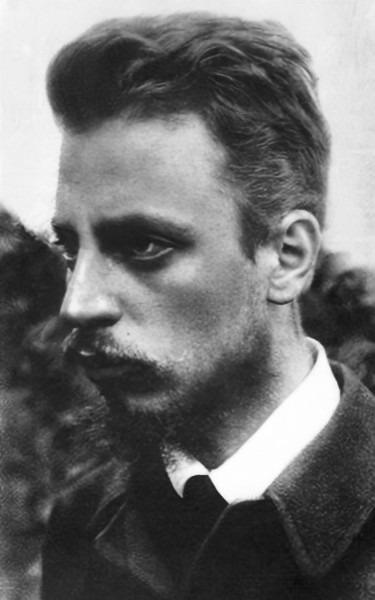
Rainer Maria Rilke, born René Maria Rilke on December 4, 1875, in Prague, is considered one of the most significant poets of the 20th century. His life, marked by personal challenges and profound intellectual pursuits, has contributed to his lasting fame in the literary world. Understanding Rilke’s life, work, and the impact he had on literature requires exploring not only his biographical details but also the socio-cultural context that shaped his poetry.
Early Life and Family Background
Rilke was born into a bourgeois Catholic family in Prague, which at the time was part of the Austro-Hungarian Empire. His early years were far from idyllic. The separation of his parents when he was just nine years old profoundly affected him. His father, a minor official in the Austro-Hungarian administration, had failed in his military career and projected his unfulfilled ambitions onto his son. As a result, Rilke was sent to a military academy between the ages of 11 and 16, a period he described as harsh and unhappy. This forced attempt to shape him into a military man was at odds with his sensitive and artistic nature.
After abandoning the military academy, Rilke enrolled at the university in Prague, later continuing his studies in Germany, first in Munich and then in Berlin. Despite these academic pursuits, it was Prague—its cultural vibrancy and historical depth—that provided the inspiration for Rilke’s earliest poetic works.
The Influence of Lou Andreas-Salomé
A turning point in Rilke’s life came in 1897 when he met Lou Andreas-Salomé, a remarkable woman who had a significant influence on his life and work. Andreas-Salomé, who had been a close associate of Friedrich Nietzsche and a respected confidante of Sigmund Freud, recognized the potential in Rilke. She suggested he change his name from René to Rainer, aligning it more closely with the German word “rein,” meaning pure. This was not just a linguistic shift but a symbolic transformation, marking Rilke’s deeper immersion into the German cultural and intellectual milieu.
The relationship between Rilke and Andreas-Salomé was intense and complex. Though she was older and more experienced, their connection was intellectually stimulating, and she became a muse for his poetry. Their relationship eventually evolved into a close friendship that lasted for many years, deeply influencing Rilke’s outlook on life and art.
Marriage to Clara Westhoff and Artistic Collaborations
In 1901, Rilke married Clara Westhoff, a sculptor and former student of the renowned French artist Auguste Rodin. The marriage, however, was short-lived. Shortly after the birth of their daughter, Ruth, the couple separated. Rilke’s restless spirit and his pursuit of artistic and spiritual fulfillment made the traditional roles of husband and father difficult for him to sustain.
During this period, Rilke traveled extensively, and his experiences deeply influenced his writing. His visit to Russia, where he encountered the vastness of the Russian landscape and the spirituality of its people, left a lasting impression on him. He met Leo Tolstoy and the father of Boris Pasternak, both of whom inspired Rilke’s work. These encounters culminated in his 1904 publication, Stories of God, a collection of tales that, while infused with gentle humor, also reflect his deep theological interests.
The Paris Years and the Influence of Auguste Rodin
Rilke’s time in Paris was another crucial phase in his life. Here, he collaborated closely with Auguste Rodin, whose work and approach to art had a profound impact on him. Paris, with its vibrant artistic avant-garde and intellectual ferment, provided the ideal environment for Rilke to develop his craft. It was during this period that he began to refine his prose style, leading to the publication of The Notebooks of Malte Laurids Brigge in 1910. This work, written in a new and original prose style, marks a significant departure from his earlier poetry and explores themes of existential anxiety and spiritual searching.
The Duino Elegies and Sonnets to Orpheus
Rilke’s most celebrated works, The Duino Elegies and Sonnets to Orpheus, were written in 1923 during a period of intense creative activity in Switzerland. These works are considered some of the most complex and challenging poetry of the 20th century, reflecting Rilke’s deep philosophical and existential concerns.
The Duino Elegies, written over a decade and completed in a burst of inspiration, are a series of ten elegies that explore the human condition, the nature of existence, and the role of the artist in society. They are marked by their lyrical intensity and profound depth, grappling with themes such as death, love, and the search for meaning in a seemingly indifferent universe.
The Sonnets to Orpheus, written simultaneously with the elegies, are a tribute to the mythical figure of Orpheus, the archetypal poet-musician. These sonnets celebrate the power of art and music to transcend the limitations of the human condition, offering a vision of spiritual renewal and artistic immortality.
Final Years and Legacy
In 1923, Rilke began to experience the first symptoms of leukemia, a disease that would eventually claim his life. Despite his declining health, he continued to write, producing some of his most profound and introspective work during this period. He died on December 29, 1926, in Valmont, Switzerland, leaving behind a legacy that would influence generations of poets and writers.
Today, Rilke is regarded as one of the most important German-language poets of the 20th century. His work is celebrated for its lyrical beauty, philosophical depth, and emotional intensity. His exploration of existential themes, his innovative use of language, and his ability to capture the nuances of the human experience have secured his place in the pantheon of literary greats.
Rilke’s Enduring Influence
Rainer Maria Rilke’s influence extends far beyond his own time, resonating with readers and writers across the world. His work has been translated into numerous languages, and his ideas have been explored and interpreted by scholars, philosophers, and artists alike.
Rilke’s exploration of the inner life, his sensitivity to the complexities of human emotion, and his philosophical inquiries into the nature of existence have made him a central figure in modernist literature. His work, characterized by a profound sense of spiritual searching, continues to speak to readers today, offering insights into the human condition that are as relevant now as they were in his own time.
In conclusion, Rainer Maria Rilke’s life and work represent a unique blend of personal struggle, artistic innovation, and intellectual inquiry. His journey from the troubled streets of Prague to the heights of literary fame is a testament to his enduring genius and his unrelenting pursuit of truth and beauty in a world that often seemed devoid of both. Rilke’s poetry and prose continue to inspire and challenge, inviting us to explore the depths of our own souls and the mysteries of the world around us.


