
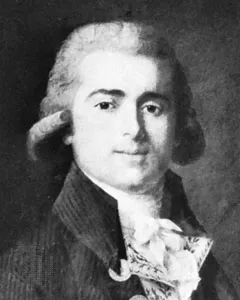
Antoine Rivaroli, often referred to as the self-proclaimed Count of Rivarol or Rivaroli, was born on June 26, 1753, in Bagnols-sur-Cèze, a small town in the Languedoc region of France. A man of Italian descent, Rivaroli became a prominent figure in 18th-century French intellectual circles. He was a brilliant writer, journalist, essayist, and polemicist, known for his sharp wit and incisive commentary, particularly during the tumultuous times of the French Revolution. Although his origins were modest, Rivaroli’s intellect and literary talents allowed him to carve out a significant place in the history of French literature and political thought.
Early Life and Education: Humble Beginnings and Intellectual Aspirations
Antoine Rivaroli was born into a family of modest means. His father, originally from Piedmont, Italy, was an innkeeper, a fact that young Antoine would later try to obscure as he sought to elevate his social standing in Parisian high society. Rivaroli was the eldest of sixteen children, a position that brought with it both responsibilities and challenges, especially given the family’s limited resources.
Despite his humble beginnings, Rivaroli demonstrated an early aptitude for learning. He was sent to a seminary for his education, where he received a classical education rooted in the humanities. His intellectual curiosity and ambition were evident from a young age, and he spent much of his early life studying a wide range of subjects, including language, literature, and history. His education took him to various locations, including Avignon, where he likely continued his studies.
Rivaroli’s early years were marked by a constant struggle to improve his social and economic standing. He took on various jobs, including that of a tutor, to support himself while continuing to nurture his intellectual pursuits. His keen mind and eloquence set him apart, and he began to dream of a future where his intellect would allow him to transcend the limitations of his birth.
Arrival in Paris: The Birth of an Intellectual and a Social Climber
In 1777, Antoine Rivaroli made a decisive move to Paris, the cultural and intellectual capital of France. Paris offered Rivaroli the opportunity to immerse himself in the vibrant intellectual life of the city and to mingle with the elite of French society. It was here that he adopted the title of “Count,” a self-bestowed honorific that he used to gain entry into the upper echelons of Parisian society. Although this title was not legitimate, it was a reflection of Rivaroli’s determination to reinvent himself and to be accepted among the aristocracy and intellectuals of his time.
In Paris, Rivaroli quickly gained a reputation as a sharp and witty conversationalist. He became a fixture in the city’s salons, where he dazzled with his eloquence and his ability to engage in lively debate on a wide range of topics. Despite his self-promotion and the occasional disdain of his detractors, Rivaroli was not just a social climber; he was a serious intellectual with deep interests in language, literature, and history.
Rivaroli’s intellectual pursuits were varied, but he had a particular passion for the French language. He admired its clarity, precision, and elegance, qualities he believed set it apart from other languages. His deep appreciation for the French language would later become the foundation for one of his most important works, the “Discours sur l’universalité de la langue française” (Discourse on the Universality of the French Language), published in 1784.
Literary and Intellectual Contributions: Satire, Linguistics, and Historical Commentary
Antoine Rivaroli’s literary career began in earnest in the early 1780s. His first significant work, “Le chou et le navet” (The Cabbage and the Turnip), published in 1782, was a satirical piece that poked fun at the “Jardins” (Gardens) by Jacques Delille, a popular poet of the time. This work showcased Rivaroli’s sharp wit and his ability to use satire as a tool for literary critique. The success of this piece established Rivaroli as a formidable satirist, a reputation he would continue to build throughout his career.
In 1784, Rivaroli published the “Discours sur l’universalité de la langue française,” a work that demonstrated his profound knowledge of the French language and its cultural significance. In this discourse, Rivaroli argued that the French language had become the universal language of diplomacy, science, and literature due to its clarity, rationality, and elegance. He celebrated the virtues of the French language, portraying it as a symbol of the Enlightenment ideals of reason and progress. This work was well-received and further solidified Rivaroli’s position as an intellectual force in French society.
Rivaroli’s admiration for classical literature also influenced his work. He was deeply influenced by the works of Tacitus, the Roman historian, and was often compared to him for his ability to chronicle and comment on the events of his time. This classical influence was evident in Rivaroli’s later works, where he blended historical commentary with sharp satire to critique contemporary figures and events.
In 1785, Rivaroli undertook the ambitious project of translating Dante Alighieri’s “Inferno” from the Divine Comedy. This was a bold endeavor, particularly in light of the fact that Voltaire, one of the leading intellectuals of the Enlightenment, had dismissed Dante’s work as outdated and irrelevant. Rivaroli’s translation was an attempt to reclaim the value of classical literature in an era dominated by Enlightenment thought. While the translation did not achieve widespread acclaim, it was a testament to Rivaroli’s deep respect for literary tradition and his willingness to challenge the prevailing intellectual currents of his time.
The French Revolution: Opposition and Exile
As the French Revolution began to take shape in the late 1780s, Antoine Rivaroli found himself increasingly at odds with the revolutionary movement. He was a staunch supporter of the monarchy and the established social order, and he viewed the revolution as a dangerous and destructive force. His opposition to the revolution was both ideological and personal, as he saw the upheaval as a threat to the cultural and intellectual values he held dear.
In 1788, Rivaroli co-authored “Petit almanach de nos grands hommes” (Little Almanac of Our Great Men) with Champcenetz, another satirist. This work was a biting satire that lampooned the leading figures of the time, including many of the revolutionaries who would soon come to power. The “Petit almanach” was emblematic of Rivaroli’s approach to political commentary: sharp, irreverent, and unafraid to challenge the status quo.
As the revolution progressed, Rivaroli became increasingly vocal in his opposition. He wrote for several publications, including the “Journal politique National” and “Actes des Apôtres,” where he continued to critique the revolution and its leaders. His writings during this period were marked by a tone of sarcasm and disdain for the revolutionary cause, which he saw as a threat to the cultural and intellectual heritage of France.
Rivaroli’s most direct attack on the revolution came in the form of “Le petit dictionnaire des grands hommes de la Révolution” (The Little Dictionary of the Great Men of the Revolution), published in 1790. In this work, Rivaroli took aim at revolutionary figures such as Maximilien de Robespierre, Jean-Paul Marat, and Georges Jacques Danton, ridiculing them in a style that was both scathing and incisive. Unlike some of his earlier works, “Le petit dictionnaire” was published under Rivaroli’s own name, a bold move that placed him in direct conflict with the revolutionary authorities.
By 1792, the situation in Paris had become increasingly dangerous for those who opposed the revolution. King Louis XVI, recognizing the perilous position of Rivaroli, advised him to leave the capital. Rivaroli reluctantly heeded this advice and fled to Brussels, marking the beginning of a period of exile that would last for the rest of his life.
Exile and Final Years: A Life in Decline
Antoine Rivaroli’s exile marked the beginning of a slow decline in both his intellectual activity and his health. Cut off from the vibrant intellectual life of Paris, Rivaroli found himself increasingly isolated. He moved from city to city, living in London and various locations in Germany, but never again found the same level of engagement and influence he had enjoyed in Paris.
In 1797, while living in Hamburg, Rivaroli completed one of his final works, the “Discours préliminaire sur le nouveau dictionnaire français” (Preliminary Discourse on the New French Dictionary). This work reflected Rivaroli’s continued interest in the French language and his desire to contribute to its preservation and development, even as he lived in exile.
Rivaroli’s final years were marked by ill health and financial difficulties. In 1801, while living in Berlin, he contracted a fever and died on April 11, at the age of 47. His death marked the end of a life that had been full of intellectual brilliance but also marred by the political and social turmoil of his time.
Legacy: A Complex Figure in French Intellectual History
Antoine Rivaroli’s legacy is a complex one. He was a man of contradictions: a self-proclaimed count of modest origins, a defender of monarchy who wielded satire as his weapon of choice, and an intellectual who revered classical literature while engaging in the polemics of his day. Rivaroli’s works, particularly his satirical writings, remain a testament to his sharp intellect and his commitment to the values he believed in.
Rivaroli’s life and career offer valuable insights into the intellectual and political currents of 18th-century France. His opposition to the French Revolution, while ultimately unsuccessful, reflects the deep divisions within French society during this period. His writings, marked by wit, irony, and a deep understanding of language, continue to be studied as examples of the power of satire in political discourse.
In the end, Antoine Rivaroli’s story is one of a man who sought to navigate the complexities of his time with both intellect and wit. His life serves as a reminder of the power of ideas and the importance of intellectual integrity in the face of political and social upheaval.


