
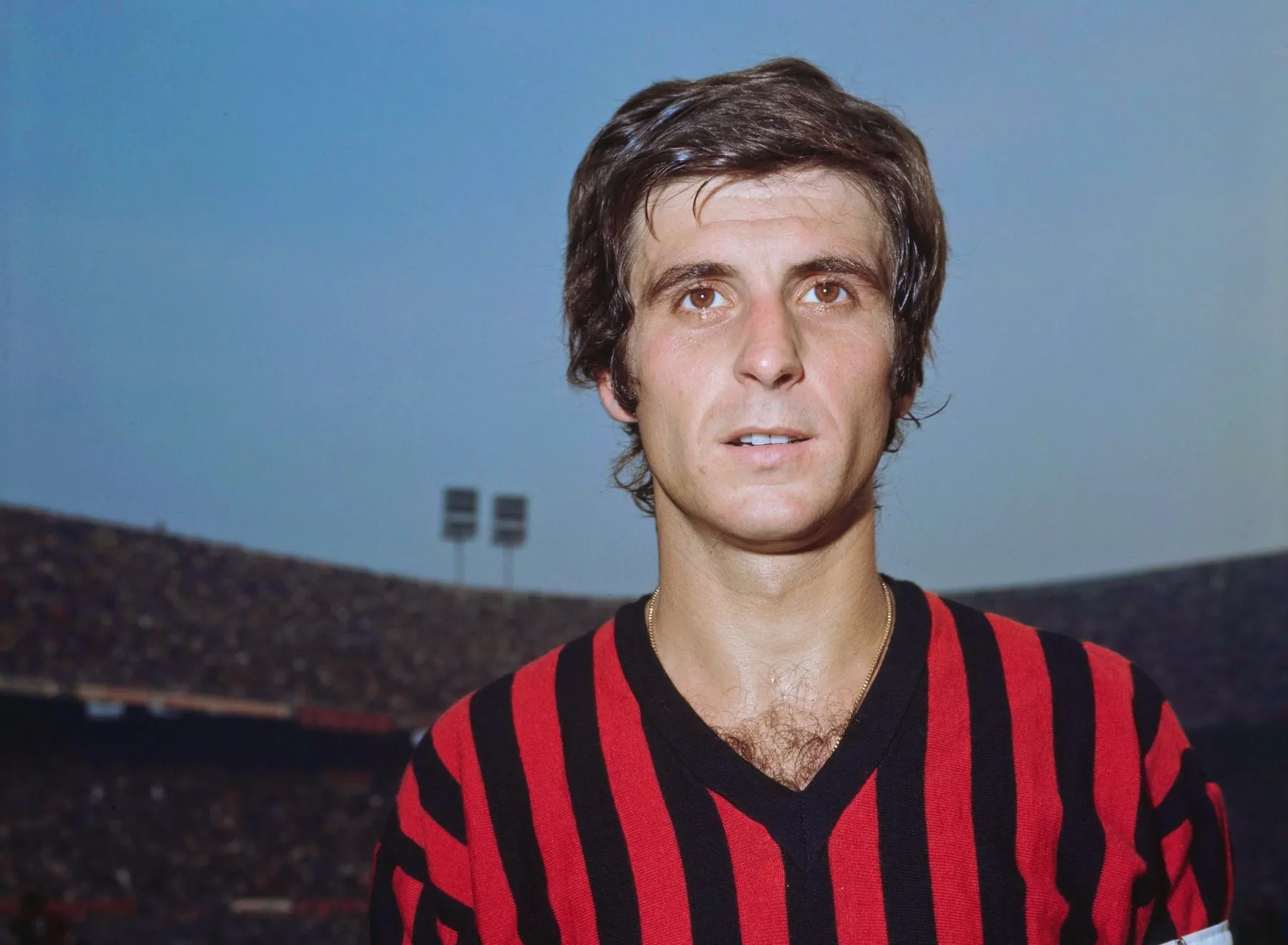
Gianni Rivera, born on August 18, 1943, in Alessandria, Italy, is a legendary figure in the world of football and a significant figure in Italian history. Known for his elegant playing style and exceptional football intelligence, Rivera was the first Italian footballer to win the prestigious Ballon d’Or in 1969. His career, spanning nearly two decades with AC Milan, is filled with numerous accolades and significant achievements, marking him as one of the most influential midfielders in football history. Rivera’s journey from a young prodigy to a football icon and later a politician reflects his multifaceted contributions to both sports and society.
Early Years and Rise to Prominence
Gianni Rivera’s journey into the limelight began in his hometown of Alessandria, where he joined the youth ranks of the local football club. He quickly demonstrated his natural talent and skill, earning the nickname “Golden Boy” from the famous Italian sports journalist Gianni Brera. His debut in Serie A, Italy’s top football league, came on June 2, 1959, when he was just 15 years old. In a match between Alessandria and Inter Milan, Rivera made his first appearance, marking the beginning of an illustrious career.
Rivera’s potential was clear from the start, and he soon became the second-youngest player in Serie A history to score a goal, just behind Amedeo Amadei. His performances caught the attention of Franco Pedroni, a former Milan player who was then the assistant coach at Alessandria. Pedroni was instrumental in Rivera’s move to AC Milan, where he would go on to spend the majority of his career. In his first trials with Milan, Rivera impressed Juan Alberto Schiaffino, a legendary Uruguayan player, who advocated for his signing despite concerns about Rivera’s slight frame and physical development.
The Golden Years at AC Milan
Rivera officially joined AC Milan in the 1960-61 season, beginning a 19-year tenure with the club that would see him become one of its most iconic figures. His first major achievement came in 1962 when, at just 18 years old, he helped Milan win the Serie A title, earning his first Scudetto. That same year, he made his debut for the Italian national team in a friendly match against Belgium, which Italy won 3-1.
Rivera’s talent was undeniable, and he quickly became a central figure in Milan’s midfield, known for his vision, passing ability, and tactical intelligence. By 1963, he had established himself as one of the brightest talents in Europe, finishing second in the Ballon d’Or voting, behind only Lev Yashin, the legendary Soviet goalkeeper. This period marked the beginning of Rivera’s rise to international stardom, culminating in Milan’s victory in the European Cup (now the UEFA Champions League) that same year, the first in the club’s history.
Dominance in the 1960s
The mid-1960s were a period of growth and success for Rivera and Milan. After some challenging years, Rivera returned to the spotlight in 1968, helping Milan win another Serie A title and leading the team to its second European Cup victory in 1969. That year proved to be a career-defining one for Rivera, as he also led the Italian national team to victory in the European Championship, securing Italy’s first major international trophy since the 1930s.
Rivera’s outstanding performances throughout these campaigns were recognized when he became the first Italian player to win the Ballon d’Or in 1969, further solidifying his status as one of the top players of his era. His ability to control the tempo of a game, coupled with his knack for scoring crucial goals, made him a revered figure in Italian football. He was often described as a classic “trequartista” or attacking midfielder, combining the roles of a playmaker and a forward, which allowed him to both create and score goals.
The 1970 World Cup and International Challenges
The 1970 FIFA World Cup in Mexico presented both a highlight and a controversy in Rivera’s career. Rivera was expected to play a significant role in Italy’s quest for the title, but his participation was marred by the infamous “staffetta” (relay) strategy implemented by Italy’s coach Ferruccio Valcareggi. This strategy involved alternating Rivera and his teammate Sandro Mazzola, which led to limited playing time for both players in critical moments.
Despite this, Rivera made a significant impact in one of the most memorable matches in World Cup history, the semifinal against West Germany, known as the “Game of the Century.” Rivera scored the decisive goal in a thrilling 4-3 victory after extra time, showcasing his knack for stepping up in big moments. However, the final against Brazil saw Rivera play only the last six minutes, a decision that has been heavily debated in Italian football history. Italy lost 4-1 to a Brazil team led by Pelé, and many believed Rivera’s limited role in the final contributed to the defeat.
Later Years and Leadership at Milan
Rivera continued to be a pivotal figure for Milan throughout the 1970s, becoming the team’s captain and a symbol of leadership and resilience. Despite challenges, including injuries and a period of decline for the club, Rivera’s influence never waned. Under his captaincy, Milan won its tenth Serie A title in 1979, earning the right to wear a star above their crest, a symbol of winning ten league titles. This victory marked the culmination of Rivera’s playing career, as he retired from professional football at the end of the season.
During his career, Rivera played a total of 658 matches for AC Milan, scoring 164 goals, a remarkable record for a midfielder. He also won four Coppa Italia titles and two UEFA Cup Winners’ Cups, in addition to his domestic and international successes. His longevity and consistency at the top level of football are a testament to his skill, intelligence, and professionalism.
Transition to Management and Politics
After retiring from playing, Rivera did not step away from the game entirely. He transitioned to a managerial role, becoming the vice-president of AC Milan, where he applied his deep knowledge of football to the administrative side of the sport. His influence extended beyond the club, as he became involved in broader football governance and advocacy.
Rivera’s post-football career took a new direction in 1987 when he entered Italian politics. He was elected to the Italian Parliament as a member of the Christian Democracy party, where he aimed to leverage his experience and public appeal to make a positive impact on Italian society. Over the years, Rivera served in various political roles, including as a member of the European Parliament and as a consultant for sports policy in Rome. His political career was marked by a commitment to public service and a desire to contribute to his country in a new capacity.
Legacy and Influence on Football
Gianni Rivera’s impact on football extends far beyond his playing days. As a player, he was renowned for his elegance, vision, and technical ability, attributes that made him a standout in a golden era of Italian football. Rivera was often compared to other greats of his time, but his unique style and approach to the game set him apart. He was a pioneer of the attacking midfielder role, blending playmaking skills with a goal-scoring instinct, which influenced how the position is viewed and played today.
Rivera’s influence also extends to the culture of football in Italy and beyond. He was one of the first footballers to transcend the sport, becoming a cultural icon and a symbol of a particular era in Italian history. His contributions to Milan’s successes in the 1960s and 1970s helped establish the club as a European powerhouse, and his role in Italy’s national team brought pride and recognition to Italian football on the global stage.
A Life Beyond Football
Rivera’s journey from football to politics and public life showcases his versatility and dedication to making a difference. Despite the challenges he faced both on and off the field, Rivera remained committed to his principles and values, using his platform to advocate for positive change. His legacy is one of excellence, leadership, and service, attributes that continue to inspire future generations of footballers and public figures.
Reflecting on Rivera’s Philosophy
Gianni Rivera’s approach to football was characterized by a deep understanding of the game and a commitment to playing it with integrity and passion. He was not just a player but a thinker of the game, someone who viewed football as an art form that required creativity, intelligence, and finesse. His style of play reflected his personality—graceful, thoughtful, and always looking to elevate the performance of those around him.
Rivera once remarked on the importance of understanding the game beyond the physical aspects, emphasizing the mental and emotional dimensions that make football truly compelling. This philosophy resonated with fans and players alike, who saw in Rivera not just a great athlete but a role model for how to approach both sports and life.
Conclusion
Gianni Rivera remains a towering figure in the annals of football history, a player whose skill, intelligence, and dedication set new standards for the sport. His contributions to AC Milan and the Italian national team helped shape the future of football in Italy and established him as one of the game’s greats. Rivera’s legacy, however, extends beyond the pitch; his foray into politics and public service demonstrates his commitment to making a broader impact on society.
As we reflect on Rivera’s life and career, we are reminded of the importance of passion, leadership, and vision in all endeavors. Gianni Rivera exemplifies these qualities, making him not just a legend in football but a significant figure in Italian cultural and political life. His story is one of talent, perseverance, and a relentless pursuit of excellence, qualities that continue to inspire and resonate with people around the world.


