
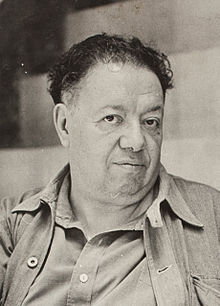
Diego Rivera, born on December 8, 1886, in Guanajuato, Mexico, was one of the most influential and celebrated artists of the 20th century. Known for his large-scale murals that depict social and political themes, Rivera’s work is a testament to his deep commitment to the Mexican people and their history. His contributions to the world of art extend far beyond his home country, making him a global icon of artistic expression and political activism.
Early Life and Background
Diego María de la Concepción Juan Nepomuceno Estanislao de la Rivera y Barrientos Acosta y Rodríguez—known simply as Diego Rivera—was born into a middle-class family in Guanajuato, a city rich in cultural history. His father, a teacher, recognized Rivera’s artistic talents early on and supported his development as an artist. By the age of ten, Rivera was already enrolled in the Academy of San Carlos in Mexico City, where he studied under some of the most prominent artists of the time.
Rivera’s early exposure to art education and his encounters with influential figures like José María Velasco, a renowned landscape painter, helped shape his burgeoning career. In 1905, at the age of 19, Rivera received a scholarship from the Mexican government to study in Spain. This opportunity allowed him to immerse himself in the European art scene, where he would eventually meet and befriend some of the most significant artists of the 20th century, including Pablo Picasso and Amedeo Modigliani.
Artistic Development in Europe
Rivera’s time in Europe was instrumental in the development of his unique style. He traveled extensively across the continent, absorbing influences from various artistic movements. His stay in Madrid allowed him to study with Eduardo Chicharro, and later, he moved to Paris, where he became part of the city’s vibrant avant-garde scene. It was during this period that Rivera encountered Cubism, a movement led by Picasso, which profoundly influenced his early work.
However, Rivera’s commitment to his Mexican roots and his desire to create art that resonated with the broader public led him to move away from the abstract forms of Cubism. Instead, he began to develop a style that combined elements of European modernism with the rich cultural heritage of Mexico. This fusion of styles would become a hallmark of Rivera’s work, allowing him to create powerful, politically charged murals that spoke directly to the people.
Return to Mexico and Muralism
Rivera returned to Mexico in the early 1920s, a period marked by significant social and political upheaval following the Mexican Revolution. The revolution, which lasted from 1910 to 1920, sought to address the deep-seated inequalities in Mexican society, and it left a profound impact on Rivera’s artistic vision. He joined the Mexican Communist Party in 1922, solidifying his commitment to using art as a tool for social change.
Rivera’s return to Mexico coincided with the rise of the Mexican Muralism movement, a government-sponsored initiative aimed at promoting public art that reflected the ideals of the revolution. Rivera, along with fellow artists José Clemente Orozco and David Alfaro Siqueiros, became one of the leading figures of this movement. His murals, which adorned the walls of public buildings, depicted the struggles of the Mexican people, their rich cultural history, and their fight for social justice.
One of Rivera’s most famous works from this period is the series of murals he created for the National Palace in Mexico City. These murals, collectively titled The Epic of the Mexican People, are a sweeping portrayal of Mexican history, from pre-Columbian times to the post-revolutionary period. Through these works, Rivera sought to educate the Mexican people about their heritage and inspire them to continue the struggle for a more just society.
Personal Life and Relationships
Rivera’s personal life was as colorful and complex as his art. He was known for his passionate relationships, many of which were with fellow artists. His first marriage was to the Russian painter Angelina Beloff, with whom he had a son. Tragically, their son died at a young age, and Rivera’s relationship with Beloff ended in separation.
Rivera’s second marriage was to Guadalupe “Lupe” Marín, with whom he had two daughters. This marriage, too, ended in divorce, but not before Rivera had begun a relationship with Frida Kahlo, a young artist who would later become one of the most famous painters in the world. Rivera and Kahlo married in 1929, and their relationship was marked by both intense love and frequent turmoil. The couple shared a deep intellectual and artistic bond, but their marriage was fraught with infidelities and personal challenges.
Despite the difficulties in their marriage, Rivera and Kahlo remained deeply connected until Kahlo’s death in 1954. Rivera often credited Kahlo with having a profound influence on his work, and their relationship has become one of the most legendary in the history of art.
Controversy and Political Involvement
Rivera’s political beliefs were a central part of his identity, and they often brought him into conflict with those in power. His commitment to communism and his outspoken criticism of capitalism made him a polarizing figure, particularly in the United States, where he spent several years in the 1930s.
One of the most controversial episodes of Rivera’s career occurred in 1933 when he was commissioned to create a mural for the Rockefeller Center in New York City. The mural, titled Man at the Crossroads, was intended to depict the possibilities of the future, but Rivera’s inclusion of a portrait of the Soviet leader Vladimir Lenin sparked outrage. Despite Rivera’s protests, the mural was destroyed before it could be completed, leading to a major public scandal.
This incident did not deter Rivera, who continued to create politically charged art throughout his life. His murals in the United States, including those at the Detroit Institute of Arts, remain some of the most significant works of public art in the country, blending themes of industrialization with a deep respect for the working class.
Later Years and Legacy
Rivera’s later years were marked by continued artistic productivity and a deepening commitment to his political beliefs. In 1936, he played a key role in securing asylum in Mexico for the exiled Soviet leader Leon Trotsky, who became a close friend. However, Rivera later distanced himself from Trotsky, reflecting the complex and often contradictory nature of his political alliances.
In the 1940s and 1950s, Rivera continued to produce significant works, including a series of murals at the National Institute of Cardiology in Mexico City. His health, however, began to decline, and in 1955, he traveled to the Soviet Union for medical treatment. Despite these challenges, Rivera remained active in both art and politics until his death on November 24, 1957, just shy of his 71st birthday.
Rivera’s legacy is immense. He is remembered not only as one of Mexico’s greatest artists but also as a pioneer of public art and a champion of social justice. His murals continue to inspire new generations of artists and activists, and his influence can be seen in the work of countless muralists and painters around the world.
Rivera’s commitment to creating art that was accessible to all, and his belief in the power of art to effect social change, have made him a lasting symbol of artistic integrity and political courage. His work remains a powerful reminder of the role that art can play in shaping society and challenging the status quo.
Diego Rivera in the Context of Mexican Art
To fully appreciate Rivera’s contributions, it’s important to understand the broader context of Mexican art during his lifetime. The Mexican Revolution, which began in 1910, was a period of profound social upheaval that sought to address the deep inequalities in Mexican society. This revolutionary spirit deeply influenced Rivera and his contemporaries, leading to the emergence of the Mexican Muralism movement.
Muralism was not just an artistic movement but a social one, aimed at bringing art out of the galleries and into public spaces where it could be seen and appreciated by the masses. Rivera, Orozco, and Siqueiros were the leading figures of this movement, and their work helped to forge a new national identity for Mexico, one that was rooted in its indigenous heritage and revolutionary ideals.
Rivera’s murals, with their bold colors, dynamic compositions, and powerful social messages, are quintessential examples of this movement. They reflect not only his artistic genius but also his deep commitment to the Mexican people and their history.
Conclusion
Diego Rivera’s life and work are a testament to the power of art to reflect and shape society. Through his murals, Rivera sought to tell the story of Mexico, from its ancient civilizations to its modern struggles. His work continues to resonate today, reminding us of the enduring relevance of art in the fight for social justice and the importance of preserving cultural heritage.
Rivera’s influence extends far beyond the borders of Mexico, making him a global figure in the world of art. His legacy is one of artistic innovation, political activism, and a deep love for his country and its people. As we look back on his life and career, it is clear that Diego Rivera was not just a great artist, but a visionary who used his talent to make the world a better place.


