
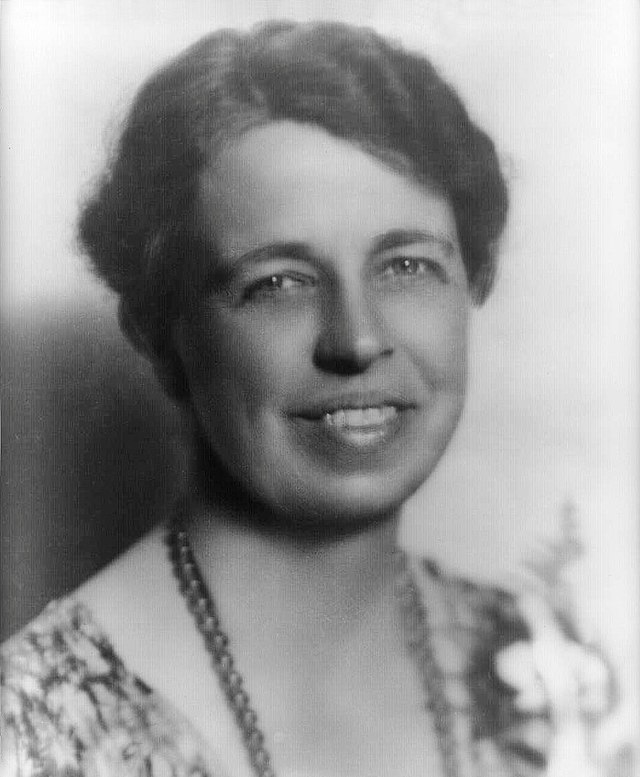
Eleanor Roosevelt, born Anna Eleanor Roosevelt on October 11, 1884, in New York City, remains one of the most influential women in American history. Known for her role as First Lady of the United States during the presidency of her husband, Franklin D. Roosevelt, she redefined the position by becoming an active and vocal participant in the political and social issues of her time. Eleanor’s life was marked by tragedy, resilience, and a relentless commitment to human rights, making her a towering figure in the 20th century.
Early Life and Education
Eleanor Roosevelt was born into a prominent family. Her father, Elliott Roosevelt, was the younger brother of President Theodore Roosevelt, and her mother, Anna Hall Roosevelt, came from a distinguished lineage, with connections to William Livingston, a signer of the U.S. Constitution. Despite her privileged background, Eleanor’s early life was fraught with difficulties. She lost both parents at a young age—her mother when she was eight, and her father when she was ten—leaving her in the care of her maternal grandmother.
Eleanor’s childhood was marked by a sense of insecurity and self-doubt, exacerbated by her grandmother’s stern and emotionally distant upbringing. Despite these challenges, Eleanor found solace in education. In 1899, at the age of 15, she was sent to Allenswood Academy, a prestigious finishing school near London, where she was mentored by the headmistress, Marie Souvestre. Souvestre was a progressive thinker who exposed Eleanor to liberal ideas and instilled in her a passion for social justice. This period abroad was transformative, helping Eleanor develop self-confidence and a sense of independence that would shape her future endeavors.
Marriage and Family Life
Upon returning to the United States, Eleanor reconnected with her distant cousin, Franklin Delano Roosevelt, who was then a student at Harvard University. The two became engaged in 1903, despite opposition from Franklin’s mother, Sara Delano Roosevelt, who believed Eleanor was too timid and not suitable for her son. Nevertheless, the couple married on March 17, 1905, in a ceremony where President Theodore Roosevelt gave away the bride.
The marriage between Eleanor and Franklin was both a personal and political partnership. The couple had six children, although their third child, Franklin Delano Jr., died in infancy. Eleanor’s early years as a wife and mother were challenging, as she struggled to balance her duties with her own emerging sense of self. Complicating matters was the dominating presence of Sara Roosevelt, who insisted on living close to the young couple and exerted significant control over their lives.
Eleanor’s marriage faced a significant crisis in 1918 when she discovered that Franklin had been unfaithful, having an affair with her social secretary, Lucy Mercer. This revelation nearly led to a divorce, but the couple ultimately remained together, with Eleanor setting the terms for the continuation of their marriage. From this point on, their relationship became more of a political partnership than a traditional marriage.
A New Role: First Lady of New York and the United States
Franklin Roosevelt’s political career advanced rapidly in the 1920s, culminating in his election as Governor of New York in 1928. During this time, Eleanor began to carve out a role for herself as a public figure. She became increasingly involved in social issues, particularly those related to women’s rights, and began writing and speaking on topics of social reform. Her activities were initially met with skepticism, as it was unusual for a political wife to take such an active role in public life.
Eleanor’s influence expanded dramatically when Franklin was elected President of the United States in 1932. As First Lady, she broke new ground by holding regular press conferences, writing a daily newspaper column titled “My Day,” and traveling extensively to meet with Americans across the country. Her activism was instrumental in promoting the New Deal policies that sought to alleviate the hardships of the Great Depression. She used her platform to advocate for labor rights, women’s rights, and the rights of African Americans, often pushing her husband and his administration to take more progressive stances.
Championing Civil Rights and Social Justice
Eleanor Roosevelt’s commitment to civil rights was a hallmark of her tenure as First Lady. She was a vocal advocate for racial equality at a time when segregation and discrimination were deeply entrenched in American society. One of her most famous acts of defiance came in 1939 when she resigned from the Daughters of the American Revolution after the organization refused to allow African American singer Marian Anderson to perform at Constitution Hall in Washington, D.C. Eleanor arranged for Anderson to sing at the Lincoln Memorial instead, in a concert that drew a crowd of 75,000 and was broadcast to millions of radio listeners.
Her efforts extended beyond symbolic gestures. Eleanor lobbied for the inclusion of African Americans in New Deal programs and was instrumental in establishing the National Youth Administration, which provided job training and educational opportunities to young people, including those from minority communities. Her advocacy often put her at odds with southern Democrats, who were a crucial part of her husband’s political coalition, but she remained steadfast in her beliefs.
World War II and the Birth of the United Nations
The outbreak of World War II brought new challenges and responsibilities for Eleanor Roosevelt. As the U.S. mobilized for war, she took an active role in supporting the troops and boosting morale on the home front. She traveled extensively, visiting military bases, hospitals, and factories to meet with soldiers and workers. Her visits were not just symbolic; she often used them to gather information and bring concerns directly to her husband, influencing policy decisions.
One of Eleanor’s most significant contributions during and after the war was her involvement in the creation of the United Nations. After Franklin’s death in 1945, President Harry Truman appointed her as a delegate to the United Nations General Assembly. In this role, she became the chairperson of the UN Commission on Human Rights, where she played a pivotal role in drafting the Universal Declaration of Human Rights, which was adopted by the General Assembly on December 10, 1948. The declaration, which Eleanor described as “the Magna Carta of all humankind,” remains one of the most important documents in the history of human rights.
Later Years and Legacy
Even after Franklin Roosevelt’s death, Eleanor remained active in public life. She continued to advocate for human rights, civil rights, and social justice, and she wrote and spoke extensively on these issues. Her work with the United Nations was particularly significant, as she helped lay the groundwork for international human rights standards that continue to influence global policy.
Eleanor Roosevelt’s legacy is multifaceted. She is remembered as a trailblazing First Lady who redefined the role of women in American politics and society. Her tireless work for social justice and human rights has inspired generations of activists and leaders. In recognition of her contributions, President Harry Truman famously called her the “First Lady of the World,” a title that reflects her impact not just on the United States, but on the global stage.
Eleanor passed away on November 7, 1962, at the age of 78. Her death marked the end of an era, but her influence lives on. Numerous schools, organizations, and awards have been named in her honor, and her writings and speeches continue to be studied by those who seek to understand the principles of leadership, compassion, and advocacy.
Historical Context and Influence
Understanding Eleanor Roosevelt’s life also requires an appreciation of the broader historical context in which she lived. Born during the Gilded Age, she witnessed the rapid industrialization of the United States, the social upheavals of the Progressive Era, and the profound challenges of the Great Depression and World War II. These experiences shaped her worldview and her approach to the issues of her time.
Eleanor’s work on civil rights was particularly groundbreaking, as it came at a time when the struggle for racial equality was gaining momentum but had not yet achieved the significant victories of the 1960s. Her advocacy for African Americans, women, and the poor was ahead of its time, laying the groundwork for future social movements.
Her role in the creation of the Universal Declaration of Human Rights also had far-reaching implications. The declaration has served as a foundational document for human rights advocacy around the world, influencing international law and the policies of numerous countries. Eleanor’s insistence on the universality of human rights—a belief that all people, regardless of nationality, race, or gender, deserve the same fundamental freedoms—remains a cornerstone of global human rights discourse.
Conclusion
Eleanor Roosevelt’s life is a testament to the power of compassion, resilience, and unwavering commitment to justice. From her early days as a shy and insecure young woman to her emergence as one of the most respected and influential figures of the 20th century, Eleanor’s journey was marked by her determination to make the world a better place. Her legacy continues to inspire and challenge us to strive for a more just and equitable society.
As the “First Lady of the World,” Eleanor Roosevelt’s impact extends far beyond the years she spent in the White House. Her work with the United Nations, her advocacy for civil rights, and her efforts to promote social justice have left an indelible mark on history. In a world that still grapples with issues of inequality and injustice, Eleanor’s life serves as a reminder of what is possible when we commit ourselves to the service of others.


