
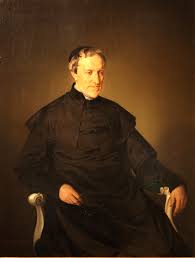
Antonio Rosmini, born Antonio Francesco Davide Ambrogio Rosmini Serbati on March 24, 1797, in Rovereto, then part of the Austro-Hungarian Empire, was an Italian philosopher, theologian, and priest. His life and work have left a profound impact on the intellectual and spiritual landscape of the 19th century. Rosmini is best known for his philosophical and theological writings, as well as for founding the Institute of Charity, also known as the Rosminians. His ideas, often controversial, challenged the prevailing intellectual currents of his time and continue to influence Catholic thought today.
Early Life and Education
Antonio Rosmini was born into a well-off and devout Catholic family. His father, Pier Modesto Rosmini, and mother, Giovanna dei Conti Formenti di Biacesa, provided him with a solid foundation in both faith and education. Growing up with his younger brother Giuseppe and older sister Margherita (who later became a nun), Rosmini was surrounded by a family committed to both religious and intellectual pursuits.
From an early age, Rosmini showed an exceptional aptitude for learning. He attended the Imperial Regio Ginnasio in his hometown of Rovereto, where he excelled in his studies. His academic journey continued at the University of Padua, where he pursued studies in theology and law. These formative years were critical in shaping his intellectual outlook, as he was exposed to the major philosophical and theological debates of the time.
In 1821, at the age of 24, Rosmini was ordained a priest in Chioggia. His ordination marked the beginning of a life dedicated to both pastoral work and rigorous intellectual inquiry. It was during these early years of his priesthood that Rosmini began to develop his philosophical ideas, particularly his opposition to the Enlightenment philosophies of sensationalism and materialism, which he believed undermined the spiritual and moral foundations of society.
Philosophical and Theological Contributions
Rosmini’s intellectual journey was deeply intertwined with his religious vocation. Encouraged by Pope Pius VII, Rosmini delved into philosophical studies with the aim of defending the Christian faith against the prevailing secular ideologies of his time. His works sought to reconcile faith with reason, and he was particularly critical of the Enlightenment’s emphasis on human reason at the expense of divine revelation.
One of Rosmini’s central philosophical concerns was the defense of the inalienable rights of the individual, including the right to private property. He envisioned an ideal state where government intervention was minimal, allowing for the full expression of individual freedoms. This perspective placed him at odds with both the socialist and communist ideologies emerging in Europe during the 19th century.
In 1826, Rosmini moved to Milan, where he formed a close friendship with the renowned Italian writer Alessandro Manzoni. Manzoni, who would later write the seminal novel I Promessi Sposi (The Betrothed), described Rosmini as “one of the minds that most honor humanity.” Their friendship was a meeting of two great minds, both deeply concerned with the moral and spiritual well-being of society.
Despite his growing reputation, Rosmini faced significant opposition from within the Church, particularly from the Austrian bishop of Trento, Giovanni Nepomuceno de Tschiderer. The bishop’s hostility towards Rosmini, due to his anti-Austrian political views, eventually forced Rosmini to leave his native Trentino. In 1828, Rosmini founded the Institute of Charity at Sacro Monte Calvario in Domodossola. The Rosminians, as his followers came to be known, dedicated themselves to charitable works and the education of the clergy.
Key Writings and Controversies
Antonio Rosmini was a prolific writer, producing numerous works that covered a wide range of topics in philosophy, theology, and politics. His writings often stirred controversy, particularly within the Catholic Church.
Among his most significant works is Il nuovo saggio sull’origine delle idee (New Essay on the Origin of Ideas), published in 1830. In this work, Rosmini argued against the empiricist notion that all knowledge comes from sensory experience. Instead, he proposed that certain fundamental ideas, such as the concept of being, are innate to the human mind and form the basis of all knowledge.
Rosmini’s Principi della scienza morale (Principles of Moral Science) and Filosofia della Morale (Philosophy of Morality), published in the 1830s, further developed his ethical theories, emphasizing the importance of moral principles grounded in the objective reality of being. He argued that moral knowledge is not merely a matter of subjective opinion but is rooted in the inherent structure of reality itself.
In the political realm, Rosmini’s Filosofia della politica (Philosophy of Politics) and Filosofia del diritto (Philosophy of Law) articulated his vision of a just society. He advocated for a political order based on the principles of natural law, where the rights of individuals are respected, and the role of the state is limited to protecting these rights.
However, it was his 1848 work Le cinque piaghe della Santa Chiesa (The Five Wounds of the Holy Church) that brought Rosmini into direct conflict with the Vatican. In this book, Rosmini identified five critical problems, or “wounds,” afflicting the Catholic Church: the separation of clergy from the laity in public worship, inadequate education of the clergy, disunity among bishops, lay control over the appointment of bishops, and the excessive involvement of the Church in secular affairs.
Rosmini’s criticisms were bold, and they did not go unnoticed. The book was soon placed on the Index of Forbidden Books by the Church, leading to a major controversy known as the “Rosminian Question.” Rosmini’s ideas, which were seen as too progressive and critical of the Church’s structure, were suppressed for many years. It was not until the Second Vatican Council in the 1960s that his ideas began to be re-evaluated and appreciated within the Church.
Despite the censure, Rosmini continued to write and contribute to philosophical and theological debates. His later works, including Logica (1853) and Psicologia (1855), further developed his philosophical system, which sought to reconcile faith and reason in a comprehensive framework.
Legacy and Beatification
Antonio Rosmini’s legacy is complex and multifaceted. His philosophical system, often referred to as Rosminianism, represents a significant contribution to Catholic thought, particularly in its emphasis on the compatibility of faith and reason. His ideas influenced many later thinkers and were a precursor to some of the reforms and theological developments that emerged in the 20th century, particularly during the Second Vatican Council.
Rosmini’s influence extended beyond philosophy and theology. His vision of a just society, grounded in respect for individual rights and the rule of law, resonated with the liberal movements of his time. However, his unwavering commitment to the Church and his belief in the importance of spiritual values set him apart from the secular liberalism that characterized much of 19th-century European thought.
Rosmini’s death on July 1, 1855, in Stresa, marked the end of a life dedicated to intellectual and spiritual pursuits. He was attended on his deathbed by Alessandro Manzoni, who would later reflect on Rosmini’s life and work with great admiration.
The controversy surrounding Rosmini’s writings did not end with his death. For decades, his works remained under scrutiny, and his followers, the Rosminians, faced challenges in promoting his ideas. However, the tide began to turn in the 20th century, particularly with the theological openness of the Second Vatican Council.
In 2001, the Vatican began the process of re-evaluating Rosmini’s writings, and in 2007, he was beatified by the Catholic Church. Pope Benedict XVI, in recognizing Rosmini’s contributions, emphasized his role in the renewal of Catholic thought and his commitment to the Church. Rosmini’s beatification was a significant moment, signaling the Church’s recognition of his intellectual and spiritual legacy.
The Rosminian School of Thought
Rosmini’s philosophical system is characterized by its emphasis on the concept of being as the foundation of all knowledge and morality. He sought to develop a philosophical framework that could address the challenges posed by modern secular thought while remaining faithful to Catholic doctrine.
At the core of Rosmini’s philosophy is the idea of being as the first and most fundamental idea that the human intellect apprehends. This idea of being, according to Rosmini, is innate and forms the basis of all other knowledge. It is through the idea of being that the human mind can perceive the reality of the world and make moral judgments.
Rosmini’s approach to ethics and politics was similarly grounded in the idea of being. He argued that moral principles are objective and universal, derived from the inherent structure of reality. In his view, the role of the state is to protect these moral principles and the rights of individuals, rather than to impose its own will on society.
Rosmini’s thought was a response to the intellectual currents of his time, particularly the Enlightenment’s emphasis on human reason and the emerging ideologies of socialism and communism. He sought to offer an alternative vision that respected the dignity of the individual and the importance of spiritual values.
Conclusion: A Life of Intellectual and Spiritual Influence
Antonio Rosmini’s life was marked by his dedication to both intellectual inquiry and spiritual devotion. His contributions to philosophy, theology, and political thought have left a lasting impact on Catholic thought and the broader intellectual landscape of the 19th century.
Rosmini’s ideas, once controversial and suppressed, have now been recognized as ahead of their time, offering insights that are still relevant in contemporary debates about faith, reason, and society. His beatification in 2007 was not just a recognition of his personal holiness but also an acknowledgment of his contributions to the renewal of Catholic thought.
As a philosopher, theologian, and priest, Antonio Rosmini exemplified the integration of faith and reason, demonstrating that intellectual rigor and spiritual commitment are not mutually exclusive but can and should complement each other. His legacy continues to inspire those who seek to navigate the complex relationship between religion and modernity, offering a path forward that is both faithful to tradition and open to new ideas.


