
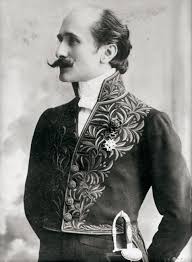
Edmond Eugène Alexis Rostand, born on April 1, 1868, in Marseille, France, was a poet and playwright whose name is immortalized by his masterpiece, Cyrano de Bergerac. Rostand’s life and works are a fascinating journey through the world of French literature, where romanticism, historical depth, and a flair for the dramatic combined to create some of the most memorable theatrical works of the late 19th and early 20th centuries.
Early Life and Education
Rostand was born into a well-to-do family in Marseille, a city known for its vibrant culture and artistic heritage. His father, a wealthy economist and poet, encouraged Edmond’s early interest in literature. This nurturing environment played a crucial role in shaping Rostand’s literary ambitions. He was well-educated, attending the Collège Stanislas in Paris, where he developed a deep appreciation for the arts, particularly drama and poetry.
Rostand initially pursued a law degree, following the traditional path laid out by his bourgeois family. However, his passion for writing was undeniable, and after completing his legal studies, he chose to focus on his literary career instead of practicing law.
Early Literary Career
Rostand’s first published work was a collection of poems titled Les Musardises (The Idlenesses) in 1890. Although it did not gain much attention, it marked the beginning of Rostand’s journey into the literary world. He followed this with his first play, Le Gant Rouge (The Red Glove), a one-act piece that was produced in 1888 but did not achieve significant success.
Rostand’s early career was marked by experimentation and learning. He wrote several plays during this period, including Les Romanesques (The Romantics) in 1894. This play, a light-hearted romantic comedy, was his first significant success and was performed at the Comédie Française. Les Romanesques later served as the inspiration for the musical The Fantasticks, showcasing Rostand’s influence beyond his immediate era.
Rise to Fame with Cyrano de Bergerac
Rostand’s career reached unprecedented heights with the premiere of Cyrano de Bergerac on December 28, 1897, at the Théâtre de la Porte Saint-Martin in Paris. The play was a triumph, and it quickly established Rostand as one of the leading playwrights of his time. Cyrano de Bergerac is a romantic drama set in 17th-century France, centered around the character Cyrano, a nobleman known for his wit, poetry, and, most notably, his large nose. Cyrano is in love with his cousin, Roxane, but he fears that his appearance makes him unworthy of her love. Instead, he helps another man, Christian, woo her by supplying him with eloquent love letters and words of affection.
The play’s success was immediate and overwhelming. The audience and critics alike were captivated by Rostand’s ability to blend romantic idealism with humor, pathos, and heroic action. Cyrano de Bergerac became one of the most performed plays in French theater and remains a staple in the repertoire of theaters worldwide.
The character of Cyrano, with his large nose and eloquent speech, became a symbol of the romantic ideal of the time—a figure of wit, bravery, and unrequited love. Rostand’s portrayal of Cyrano’s inner struggle and his ultimate nobility in the face of adversity struck a chord with audiences, and the play’s themes of love, honor, and sacrifice continue to resonate today.
The Success of L’Aiglon and Chantecler
After the monumental success of Cyrano de Bergerac, Rostand continued to write, though none of his subsequent works would match the acclaim of Cyrano. In 1900, he premiered L’Aiglon, a historical drama about the life of Napoleon Bonaparte’s son, the Duke of Reichstadt. The play, performed by the legendary actress Sarah Bernhardt, was another major success. L’Aiglon portrayed the young duke’s tragic life, caught between his heritage and the political machinations of the time. Bernhardt’s performance, where she played the role of the young male protagonist, was highly praised, adding to the play’s popularity.
Rostand’s work often delved into the historical and the romantic, and L’Aiglon was no exception. The play’s themes of lost potential and the burden of legacy reflected the French public’s mood at the turn of the century, still grappling with the aftermath of the Franco-Prussian War and the loss of Alsace-Lorraine.
In 1910, Rostand presented Chantecler, another ambitious work that diverged from his previous romantic and historical dramas. Chantecler is a symbolic play set in a barnyard, where the characters are animals, and the protagonist is a rooster named Chantecler, who believes that his crowing causes the sun to rise. The play is an allegory that explores themes of idealism, self-delusion, and the clash between reality and illusion.
Despite its imaginative premise and Rostand’s reputation, Chantecler did not achieve the same level of success as his earlier works. The play was considered too complex and obscure by many, and its reception was lukewarm. Nevertheless, Chantecler is now appreciated for its originality and the depth of its allegorical content.
Personal Life and Later Years
Rostand’s personal life was as dramatic as his plays. He married Rosemonde Gérard, a poet, in 1890, and the couple had two sons, Maurice and Jean. Maurice Rostand would go on to become a writer himself, while Jean Rostand became a noted biologist and philosopher. The Rostand family was deeply embedded in the cultural life of France, and their home became a gathering place for artists, writers, and intellectuals.
However, Rostand’s marriage to Rosemonde eventually deteriorated, and in 1915, he left her for Mary Marquet, an actress with whom he had a passionate affair. This personal upheaval coincided with a period of declining health for Rostand, who suffered from chronic respiratory problems, exacerbated by the damp climate of Paris.
In 1901, Rostand was elected to the Académie Française, an honor that cemented his status as one of France’s literary greats. However, his later years were marked by a retreat from public life. The pressures of fame, coupled with his health issues, led him to withdraw to his country estate in Cambo-les-Bains in the Basque region of France.
During World War I, Rostand’s health continued to decline, and he passed away on December 2, 1918, at the age of 50, shortly after the end of the war. His death was widely mourned in France, where he was celebrated as a national literary hero.
Legacy and Influence
Edmond Rostand’s legacy is firmly anchored in the world of French literature, with Cyrano de Bergerac standing as a towering achievement that continues to be performed and adapted around the world. The play’s themes of love, honor, and the tension between appearance and reality have universal appeal, ensuring its relevance across generations.
Rostand’s work bridged the gap between the Romantic and modern eras of French literature. While his style was rooted in the Romantic tradition, characterized by its emphasis on emotion, individualism, and the sublime, Rostand also foreshadowed the more symbolic and introspective tendencies of 20th-century literature. His plays often grappled with questions of identity, self-perception, and the conflict between ideals and the harsh realities of life.
Cyrano de Bergerac has inspired countless adaptations, including films, television productions, and even musicals. The character of Cyrano has become an archetype in literature and popular culture, embodying the tragic hero who hides his vulnerability behind wit and bravado. The story of Cyrano’s unrequited love for Roxane and his sacrifice for her happiness continues to resonate with audiences today, making it one of the most enduring love stories in literature.
Rostand’s other works, though less well-known, also contribute to his legacy as a versatile and imaginative playwright. L’Aiglon and Chantecler are notable for their exploration of historical and symbolic themes, reflecting Rostand’s deep engagement with the cultural and political issues of his time.
Conclusion
Edmond Rostand was a playwright whose works captured the imagination of his contemporaries and continue to enchant audiences today. His ability to blend romance, heroism, and deep philosophical questions within the framework of poetic drama made him one of the most celebrated figures in French literature. While Cyrano de Bergerac remains his crowning achievement, Rostand’s entire body of work reflects his genius for storytelling and his profound understanding of the human condition.
Rostand’s life, marked by both triumph and tragedy, mirrors the themes of his plays—honor, love, sacrifice, and the eternal struggle between ideals and reality. As we continue to explore his works, Edmond Rostand’s legacy as a master dramatist and poet endures, reminding us of the timeless power of the written word to capture the complexities of the human spirit.


