
Henri Rousseau, born Henri Julien Félix Rousseau on May 21, 1844, in Laval, France, is one of the most enigmatic figures in the history of modern art. His life and work have fascinated art historians, critics, and enthusiasts for over a century. A self-taught artist, Rousseau was often dismissed during his lifetime as a naive or “primitive” painter. However, his unique style and imaginative approach to painting have since earned him recognition as a pivotal figure in the development of modern art.
Early Life and Career
Henri Rousseau’s journey into the art world is as unconventional as his art itself. Born into a modest family, Rousseau did not initially pursue a career in art. Instead, he followed a more traditional path, serving in the military and later working as a toll collector in Paris—a job that earned him the nickname “Le Douanier” (The Customs Officer). It was not until his later years, approaching retirement, that Rousseau began to seriously devote himself to painting.
Rousseau’s lack of formal training in art has been both a point of criticism and a badge of honor. His work is characterized by a childlike simplicity and a disregard for the established rules of perspective and proportion. Critics during his time often derided his work as amateurish and unsophisticated, but this very naivety is what later critics and artists would come to admire as a mark of his authenticity and originality.
The Artistic Journey: From Portraits to Exotic Fantasies
Rousseau’s early works primarily consisted of portraits and urban scenes of Paris. These paintings, while showing glimpses of his later style, were relatively conventional compared to the works that would eventually define his career. It was in the 1890s that Rousseau began to explore the themes and motifs that would make him famous—lush, fantastical jungle scenes populated by exotic animals, dreamlike landscapes, and mysterious figures.
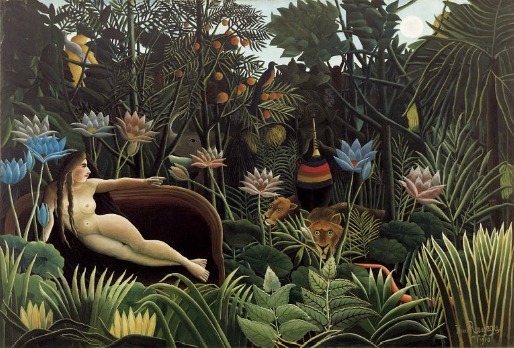
One of the most striking aspects of Rousseau’s jungle paintings is the fact that he never left France. His depictions of tropical landscapes and wild animals were entirely the product of his imagination, inspired by visits to botanical gardens, zoos, and the accounts of soldiers returning from colonial campaigns in Mexico. These vivid, otherworldly scenes are among his most celebrated works, including masterpieces such as “The Dream” (1910) and “The Sleeping Gypsy” (1897).
In “The Dream,” Rousseau presents a surreal image of a nude woman reclining on a sofa in the middle of a dense, colorful jungle. The painting is a masterful blend of the real and the imaginary, with meticulously detailed plants and animals surrounding the serene, almost otherworldly figure. Similarly, “The Sleeping Gypsy” depicts a woman asleep in a barren desert, observed by a curious lion—an image that is both tranquil and subtly unsettling.
Critical Reception and Legacy
During his lifetime, Rousseau’s work was met with a mix of ridicule and admiration. Many critics dismissed him as an untrained amateur, a “naive” artist whose work lacked sophistication. However, Rousseau’s persistence and belief in his vision eventually earned him the respect of some of the most influential artists of his time. Notable figures such as Pablo Picasso, Paul Gauguin, and Georges Seurat recognized the originality and emotional depth of his work.
Picasso, in particular, became an admirer of Rousseau after encountering his work at the Salon des Indépendants in Paris, where Rousseau regularly exhibited from 1886 onward. Picasso even hosted a now-legendary banquet in Rousseau’s honor, celebrating the older artist’s unique contribution to modern art. Although the banquet was somewhat ironic in nature, it marked a turning point in Rousseau’s posthumous reputation.
Today, Henri Rousseau is regarded as one of the most important and innovative figures in modern art. His work has been re-evaluated and celebrated for its originality, emotional intensity, and the way it challenges traditional artistic conventions. Rousseau’s influence can be seen in the work of later artists, particularly those associated with Surrealism, who admired his ability to convey a dreamlike, fantastical vision of reality.
The Naive Artist and the Modernist Movement
Rousseau’s status as a “naive” or “primitive” artist is a significant aspect of his legacy. In the context of modern art, these terms are not derogatory but rather descriptive of his untrained, instinctual approach to painting. Unlike academically trained artists who adhered to established techniques and theories, Rousseau painted with an intuitive sense of composition and color, unburdened by the rules of academic art.
This naivety, however, is what made Rousseau’s work so revolutionary. At a time when the art world was becoming increasingly concerned with abstraction and the breaking down of traditional forms, Rousseau’s paintings offered a different kind of escape from reality—one that was rooted in the imagination and the subconscious. His work prefigures the Surrealist movement in its exploration of dreams, the exotic, and the bizarre.
Rousseau’s “primitive” style also resonated with the growing interest in non-Western art forms during the early 20th century. As European artists began to look beyond the classical traditions of the West, they found inspiration in the art of Africa, Oceania, and the Americas—art that, like Rousseau’s, was often labeled as “primitive” but was increasingly appreciated for its raw, expressive power.
The Man Behind the Art
Beyond his art, Henri Rousseau was a man of contradictions. Despite his unassuming profession as a toll collector, he was deeply engaged in the cultural and political life of his time. He participated in the revolutionary movements that swept through France in the late 19th and early 20th centuries and was known for his modest, almost humble demeanor. Yet, Rousseau harbored grand ambitions for his art, believing firmly in his talent and the importance of his work.
Rousseau’s personal life was marked by both triumph and tragedy. He married twice and had several children, though most of them died young, a fact that profoundly affected him. His later years were spent in relative poverty, and he died on September 2, 1910, largely unrecognized by the general public. However, in the years following his death, his work gained the recognition it deserved, and today Rousseau is celebrated as a pioneer of modern art.
The Enduring Legacy of Henri Rousseau
Henri Rousseau’s legacy endures not only in the history of art but also in the broader cultural imagination. His work continues to inspire artists, writers, and filmmakers who are drawn to his unique blend of fantasy and reality. Rousseau’s paintings, with their vibrant colors, intricate details, and mysterious atmospheres, invite viewers to step into a world that is at once familiar and strange—a world where the boundaries between the real and the imaginary are blurred.
In the context of art history, Rousseau is often credited with paving the way for later developments in modern art, particularly in the areas of Surrealism and Abstract Expressionism. His work challenges the viewer to see the world not as it is, but as it could be—a place of wonder, mystery, and endless possibility.
Today, Rousseau’s paintings can be found in some of the most prestigious museums around the world, including the Museum of Modern Art in New York, the Musée d’Orsay in Paris, and the Tate Modern in London. His work is celebrated not only for its aesthetic qualities but also for its ability to transcend the limitations of reality and offer a glimpse into the boundless potential of the human imagination.
In conclusion, Henri Rousseau was a man who, despite the odds, pursued his passion for art with unwavering determination. His journey from an untrained, self-taught artist to a celebrated figure in the history of modern art is a testament to the power of imagination and the enduring appeal of his work. Rousseau’s life and art remind us that creativity knows no boundaries and that true innovation often comes from those who dare to see the world differently.


