
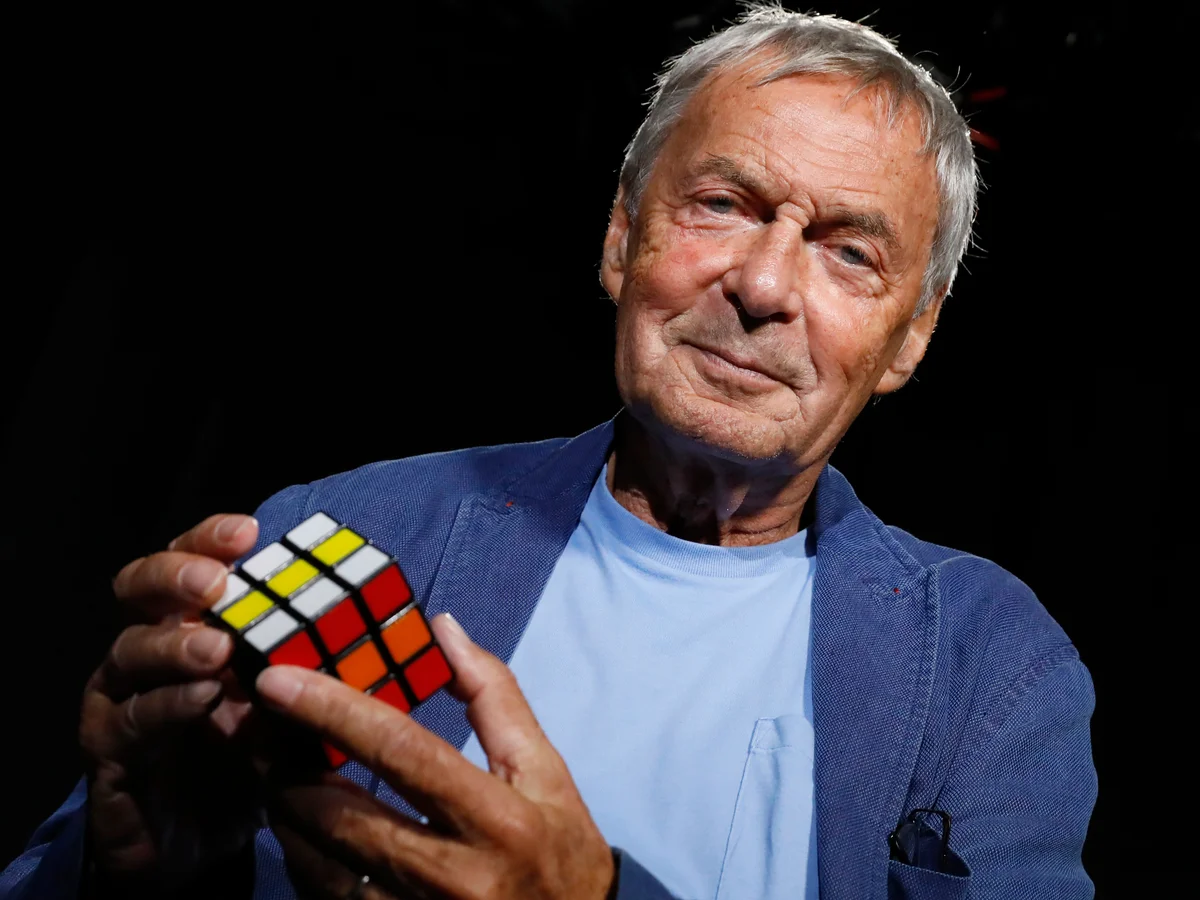
Erno Rubik, the ingenious mind behind the world-famous Rubik’s Cube, was born on July 13, 1944, in Budapest, Hungary. A man of many talents, Rubik is not just an inventor but also a sculptor, architect, and designer. His invention, the Rubik’s Cube, became one of the most iconic and enduring puzzles in modern history, captivating the minds of millions around the globe. This article will explore Erno Rubik’s life, his rise to fame, and the significant highlights of his career.
Early Life and Education
Erno Rubik was born into a family deeply rooted in the arts and sciences. His father, an aerospace engineer, founded a factory for glider production, while his mother was a poet. This unique combination of technical skill and creative expression undoubtedly influenced Rubik’s own career path. Growing up in Hungary during the turbulent years of World War II, Rubik was surrounded by a culture of resilience and innovation.
Rubik pursued his education in engineering, earning a degree in Civil Engineering from Budapest’s University of Technology in 1967. His interest in the intersection of art and science led him to further studies at the Academy of Applied Arts and Design in Budapest. During the early 1970s, Rubik worked as an architect, but his passion for teaching brought him back to the Academy of Applied Arts, where he eventually became a professor.
The Birth of the Rubik’s Cube
The Rubik’s Cube was born out of Erno Rubik’s desire to help his students understand three-dimensional geometry. In 1974, Rubik created the first prototype of what would become the Rubik’s Cube, initially intending it as a teaching tool. The puzzle was a simple yet complex mechanism consisting of 26 smaller cubes, which rotated around a central axis. The objective of the puzzle was to align all faces of the cube so that each side displayed a single color.
At first, the Rubik’s Cube was not intended for commercial use. It was shared among a small circle of mathematicians and academics in Hungary, who were intrigued by its challenge. However, it didn’t take long for the puzzle’s appeal to spread beyond academic circles.
The Rubik’s Cube Goes Global
The turning point for the Rubik’s Cube came in the late 1970s when it caught the attention of an English mathematician who wrote an article about it. This article effectively introduced the Rubik’s Cube to the world outside Hungary, sparking a wave of interest in the puzzle. By the early 1980s, the Rubik’s Cube had become a global phenomenon, with millions of units sold across Europe and the United States.
The Rubik’s Cube quickly transcended its status as a mere puzzle to become a cultural icon. In 1980, the puzzle was officially registered internationally under the name “Rubik’s Cube,” and it became the best-selling puzzle of all time. By 1982, over 100 million Rubik’s Cubes had been sold, making Erno Rubik one of Hungary’s wealthiest individuals.
The Mechanics of the Rubik’s Cube
What makes the Rubik’s Cube so captivating is its simple yet profound complexity. The puzzle consists of 26 smaller cubes, with an internal mechanism that allows for rotation in multiple directions. The challenge lies in the fact that the cube can be scrambled into over 43 quintillion possible configurations, but only one of these configurations solves the puzzle, aligning each face of the cube to a single color.
Solving the Rubik’s Cube requires systematic thinking and problem-solving skills. It is not a puzzle that can be solved by chance; it demands a methodical approach. Interestingly, even Erno Rubik himself took about a month to solve his own puzzle when he first created it.
The Rise of Speedcubing and the Rubik’s Cube in Popular Culture
The Rubik’s Cube has not only endured as a popular puzzle but has also given rise to an entire subculture known as speedcubing. Speedcubing is the competitive practice of solving the Rubik’s Cube in the shortest possible time. The first World Rubik’s Cube Championship was held in Budapest in 1982, and since then, speedcubing has grown into a global phenomenon with competitions held regularly around the world.
The record for the fastest Rubik’s Cube solve has continually been broken over the years, with the current record standing at just under 4 seconds. The Rubik’s Cube has also found its way into popular culture, appearing in movies, television shows, and even art exhibitions. Its influence extends beyond the realm of puzzles, symbolizing intellectual challenge, creativity, and perseverance.
Erno Rubik’s Later Career and Contributions
After the global success of the Rubik’s Cube, Erno Rubik continued to innovate and contribute to various fields. In 1983, he founded the Rubik Studio, a design studio focused on creating furniture and puzzles. His work extended beyond the Rubik’s Cube, and he developed several other puzzles and games, although none reached the iconic status of his first invention.
In 1990, Rubik became the president of the Hungarian Engineering Academy. In this role, he founded the Rubik Foundation, which aims to support young engineers and designers by providing scholarships and resources. The foundation reflects Rubik’s lifelong commitment to education and the development of young talent in the fields of science and design.
Erno Rubik’s interests also extended into the burgeoning field of video games in the 1990s. He provided consultancy services for game development, recognizing the potential of digital technology in the realm of puzzles and problem-solving.
The Legacy of Erno Rubik and His Cube
Erno Rubik’s legacy is intrinsically tied to the Rubik’s Cube, but his influence extends far beyond this single invention. The Rubik’s Cube has inspired generations of thinkers, problem-solvers, and artists. It has become a symbol of intellectual challenge and has found applications in various fields, including mathematics, computer science, and psychology.
The puzzle has also had a significant educational impact, being used in classrooms around the world to teach concepts of geometry, algorithms, and critical thinking. The Rubik’s Cube’s continued popularity, decades after its invention, is a testament to its timeless appeal and the brilliance of its creator.
In recent years, Erno Rubik has embraced his role as a cultural icon and ambassador for creativity and education. He has participated in numerous interviews, documentaries, and public appearances, sharing his insights on creativity, problem-solving, and the importance of persistence.
Conclusion
Erno Rubik’s life and career are a fascinating blend of art, science, and education. His invention, the Rubik’s Cube, has not only become a global phenomenon but has also left an indelible mark on popular culture and intellectual pursuits. Rubik’s journey from a professor in Budapest to an international icon is a story of creativity, innovation, and the power of an idea.
As we reflect on Erno Rubik’s contributions, it is clear that his impact goes far beyond the Rubik’s Cube itself. He has inspired countless individuals to think differently, approach problems with curiosity, and persist in the face of challenges. The Rubik’s Cube may have been his most famous creation, but Erno Rubik’s true legacy lies in his ability to inspire and educate, reminding us that the most profound ideas often come from the simplest of concepts.
In a world where the fast pace of technology often overshadows the value of thoughtful problem-solving, Erno Rubik’s life work serves as a reminder of the enduring power of creativity, persistence, and intellectual curiosity.


