
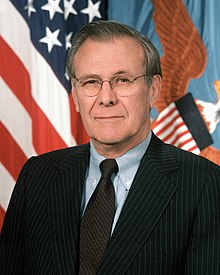
Donald Rumsfeld was one of the most prominent and controversial figures in American politics, particularly known for his role as the U.S. Secretary of Defense under two different administrations. Born on July 9, 1932, in Evanston, Illinois, Rumsfeld’s career spanned over six decades, during which he played a pivotal role in shaping U.S. military and foreign policy, especially during the post-9/11 era. This article provides a comprehensive exploration of Rumsfeld’s life, his rise to fame, and the key highlights that defined his career.
Early Life and Education
Donald Henry Rumsfeld was born into a middle-class family of German descent. His grandfather emigrated from Bremen, Germany, which influenced the values and work ethic that were instilled in Rumsfeld from a young age. He attended Princeton University, where he graduated in 1954 with a degree in political science. During his time at Princeton, Rumsfeld was an accomplished wrestler, a sport that would later be symbolic of his combative style in politics.
After graduating, Rumsfeld joined the U.S. Navy as a pilot and flight instructor, serving from 1954 to 1957. His time in the military further shaped his worldview, reinforcing his belief in the importance of a strong national defense, a belief that would underpin his later political career.
Entry into Politics: The Nixon Administration
Rumsfeld’s political career began in earnest when he was elected to the U.S. House of Representatives in 1962, representing Illinois. He was re-elected in 1964, 1966, and 1968, quickly establishing himself as a rising star in the Republican Party. His legislative work during this period focused on issues related to defense and government reform, reflecting his interest in national security.
In 1969, Rumsfeld resigned from Congress to join the Nixon administration, where he took on various roles, including Director of the Office of Economic Opportunity and Counselor to the President. His work in the Nixon administration earned him a reputation as a skilled administrator and a loyal party operative, qualities that would serve him well in his future endeavors.
NATO and the Ford Administration
Rumsfeld’s career took a significant turn in 1973 when he was appointed U.S. Ambassador to NATO. In this role, he was responsible for representing American interests in Europe during a particularly tense period of the Cold War. His tenure at NATO was marked by his efforts to strengthen the alliance and ensure the security of Western Europe against the Soviet threat.
In 1974, following Nixon’s resignation, Rumsfeld returned to Washington to serve as Chief of Staff under President Gerald Ford. His effectiveness in this role was such that Ford appointed him as Secretary of Defense in 1975, making Rumsfeld the youngest person ever to hold the position. During his first tenure as Secretary of Defense, Rumsfeld focused on modernizing the U.S. military and advocating for increased defense spending, laying the groundwork for the military build-up that would occur under subsequent administrations.
Corporate Leadership and Continued Public Service
After leaving the Defense Department in 1977, Rumsfeld transitioned into the private sector, where he held several high-level executive positions. From 1977 to 1985, he served as CEO and later President of G.D. Searle & Company, a pharmaceutical company known for developing the artificial sweetener aspartame. Under his leadership, the company underwent significant restructuring and became highly profitable, further cementing Rumsfeld’s reputation as a capable and effective leader.
Despite his success in the corporate world, Rumsfeld remained involved in public service. In the early 1980s, President Ronald Reagan appointed him as a special envoy to the Middle East, where he played a crucial role in U.S. relations with countries in the region. Notably, Rumsfeld met with Iraqi leader Saddam Hussein in 1983, at a time when the U.S. was supporting Iraq in its war against Iran. This meeting would later become a point of controversy as U.S. policy toward Iraq shifted dramatically in the following decades.
From 1990 to 1993, Rumsfeld served as CEO of General Instrument Corporation, a leading manufacturer of electronics for the cable and satellite television industries. His work in the private sector during this period was marked by his focus on innovation and technological advancement, which would later influence his approach to defense policy.
The Project for the New American Century and Return to Government
In 1997, Rumsfeld co-founded the Project for the New American Century (PNAC), a think tank that advocated for a more assertive U.S. foreign policy. The organization’s members, many of whom would later hold key positions in the George W. Bush administration, argued for the necessity of American global leadership and the importance of military strength in maintaining it. PNAC’s influence would become particularly significant after the events of September 11, 2001, when the U.S. embarked on a series of military interventions that aligned closely with the group’s recommendations.
Rumsfeld returned to government service in 2001 when President George W. Bush appointed him as Secretary of Defense, making him one of only a few individuals to serve in that role twice. His second tenure as Secretary of Defense was marked by the 9/11 attacks and the subsequent U.S. military responses, including the wars in Afghanistan and Iraq.
The War on Terror and Iraq
Rumsfeld’s role in the War on Terror and the invasion of Iraq are perhaps the most defining aspects of his career. In the immediate aftermath of 9/11, Rumsfeld was instrumental in shaping the U.S. military response, advocating for a strategy that emphasized speed, technology, and flexibility. His approach to the war in Afghanistan, which began in October 2001, focused on utilizing special forces and air power to quickly overthrow the Taliban regime. This initial success bolstered Rumsfeld’s standing within the administration and the broader public.
However, it was the invasion of Iraq in 2003 that would come to dominate Rumsfeld’s legacy. The decision to invade Iraq was justified by the belief that Saddam Hussein possessed weapons of mass destruction (WMDs) and that his regime posed a direct threat to the United States. Rumsfeld was a key advocate for the invasion, arguing that the removal of Hussein would lead to a more stable and democratic Middle East.
The Iraq War initially appeared to be a success, with the rapid fall of Baghdad and the toppling of Hussein’s regime. However, the subsequent insurgency, the failure to find WMDs, and the widespread instability that followed the invasion led to significant criticism of Rumsfeld’s leadership. His handling of the war, particularly his decisions regarding troop levels and post-invasion planning, became the subject of intense scrutiny. The controversy reached its peak with the revelations of prisoner abuse at Abu Ghraib, which further damaged Rumsfeld’s reputation.
Resignation and Later Life
In the wake of the 2006 midterm elections, which saw significant losses for the Republican Party, Rumsfeld resigned as Secretary of Defense. His resignation was widely seen as a response to the growing unpopularity of the Iraq War and the mounting criticism of his leadership. He was succeeded by Robert Gates, who sought to implement a different strategy in Iraq and address some of the shortcomings of Rumsfeld’s tenure.
After leaving office, Rumsfeld remained active in public life, writing his memoir Known and Unknown (2011), in which he defended his record and offered his perspective on the key events of his career. He also established the Rumsfeld Foundation, which focuses on leadership development and public service initiatives.
Rumsfeld’s post-political career was marked by continued involvement in national security discussions, often providing commentary on defense issues and foreign policy. Despite the controversies that surrounded his time as Secretary of Defense, he remained a significant figure in the Republican Party and a symbol of the assertive foreign policy approach that characterized the Bush administration.
Legacy and Impact
Donald Rumsfeld’s legacy is a complex and contested one. He is widely recognized for his intellect, strategic thinking, and leadership abilities, which enabled him to navigate some of the most challenging periods in modern American history. His contributions to U.S. defense policy, particularly during the Cold War and the War on Terror, have left a lasting impact on the country’s military strategy and its role in global affairs.
However, Rumsfeld’s legacy is also marked by significant controversy, particularly regarding the Iraq War. The failure to find WMDs, the prolonged insurgency, and the human and financial costs of the war have led many to view his tenure as a cautionary tale about the dangers of overconfidence and the unintended consequences of military intervention. The debates over Rumsfeld’s legacy continue to reflect broader discussions about U.S. foreign policy, the limits of military power, and the challenges of nation-building.
Conclusion
Donald Rumsfeld was a figure of immense influence and complexity. His career, spanning over six decades, was characterized by a deep commitment to public service, a belief in the importance of American leadership, and a willingness to take bold, sometimes controversial, actions. While his legacy remains a subject of debate, there is no denying the significant role he played in shaping U.S. policy during some of the most critical moments of the late 20th and early 21st centuries.
As we reflect on Rumsfeld’s life and career, it is clear that his impact on American politics and global affairs will continue to be felt for years to come. His story serves as a reminder of the challenges and complexities of leadership in a rapidly changing world, and of the enduring importance of strategic vision and decisive action in the face of uncertainty.


