
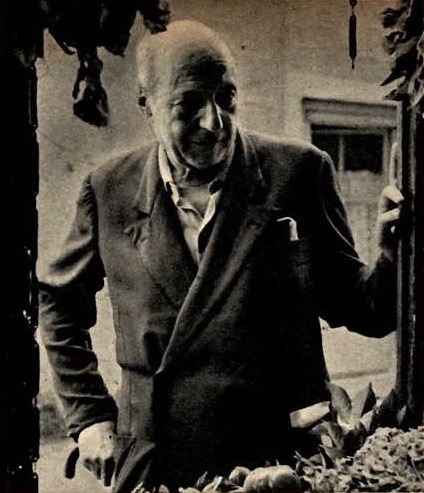
Umberto Saba, born Umberto Poli on March 9, 1883, in Trieste, Italy, is widely regarded as one of the most significant Italian poets of the 20th century. His works, deeply personal and reflective, provide a window into the complexities of his life, characterized by emotional turmoil, intellectual rigor, and a profound connection to his cultural roots. This article delves into the life, fame, and highlights of Umberto Saba, offering detailed insights into his journey as a poet and the historical context that shaped his work.
Early Life and Influences
Umberto Saba was born into a complex and challenging environment. His mother, Felicita Rachele Cohen, was of Jewish descent and came from a family of merchants operating within Trieste’s Jewish ghetto. His father, Ugo Edoardo Poli, was a Venetian nobleman who had converted to Judaism to marry Felicita but abandoned her when she was pregnant with Umberto. This abandonment had a profound impact on Saba’s early life, leaving him to be raised in a melancholic atmosphere, devoid of a paternal figure.
For the first three years of his life, Saba was cared for by Peppa Sabaz, a Slovenian nurse who had lost her own child. The affection and nurturing provided by Peppa left an indelible mark on young Umberto, who later referred to her as his “mother of joy” in his writings. This early experience of loss and substitute maternal care would become a recurring theme in Saba’s poetry, where he often explored the dynamics of love, loss, and longing.
Saba’s formal education was irregular and marked by a lack of direction. He attended the “Dante Alighieri” gymnasium and later the Academy of Commerce and Nautical Studies, but he abandoned his studies midway. During this period, Saba developed a keen interest in music, influenced by his friendships with Ugo Chiesa, a violinist, and Angelino Tagliapietra, a pianist. Although he attempted to learn the violin, it was poetry that captured his true passion. Writing under the pseudonym “Umberto Chopin Poli,” his early works were heavily influenced by Italian literary giants such as Giuseppe Parini, Ugo Foscolo, Giacomo Leopardi, and Francesco Petrarca.
The Formative Years: Poetry and Personal Struggles
In 1903, Saba moved to Pisa to continue his education. He initially attended lectures in Italian literature by Professor Vittorio Cian but soon shifted his focus to archaeology, Latin, and German. However, his studies were again disrupted by personal difficulties, including a falling out with his friend Ugo Chiesa, which led to a period of severe depression. This emotional crisis prompted Saba to return to Trieste, where he became a regular at the “Caffè Rossetti,” a popular meeting place for young intellectuals. It was here that he formed a friendship with the future poet Virgilio Giotti, marking the beginning of his deeper engagement with the literary world.
In 1905, Saba left Trieste for Florence, where he spent two years immersed in the city’s vibrant artistic circles, particularly those associated with the “vociani,” a group of writers linked to the literary magazine La Voce. However, despite his interactions with these influential literary figures, Saba remained somewhat of an outsider, never fully integrating into their circles.
During one of his occasional visits back to Trieste, Saba met Carolina Wölfler, the woman who would become his wife and the subject of much of his poetry, often referred to as “Lina” in his works. Their relationship was a central element in Saba’s life, providing both inspiration and turmoil, as reflected in his poetry.
In 1907, Saba was drafted into the Italian military, serving in Salerno. His experiences during this period inspired the “Versi militari” (Military Verses), a collection of poems that reflected his observations and feelings about military life. These poems were characterized by their straightforward, unadorned language, a hallmark of Saba’s style that would continue to define his work.
Upon returning to Trieste in 1908, Saba entered into a business partnership with his future brother-in-law, managing two shops that sold electrical goods. On February 28, 1909, he married Lina in a Jewish ceremony, and in the following year, their daughter Linuccia was born.
Literary Success and the Birth of the Canzoniere
In 1911, under the pseudonym “Umberto Saba,” he published his first book, Poesie. The choice of the pseudonym “Saba” is believed to be a tribute either to his beloved nurse Peppa Sabaz or to his Jewish heritage, as the word “saba” means “grandfather” in Hebrew. This marked the beginning of Saba’s literary career, which would eventually lead to his recognition as one of Italy’s greatest poets.
Saba’s early works, including Trieste e una donna (Trieste and a Woman), demonstrated his commitment to a style of poetry that was both sincere and unpretentious. In contrast to the ornate and elaborate verse of his contemporaries, such as Gabriele D’Annunzio, Saba advocated for a more straightforward and honest poetic expression. This approach is encapsulated in his 1911 essay “Quello che resta da fare ai poeti” (What Is Left for Poets to Do), in which he proposed a poetic style that was free of artifice and closer to the realities of everyday life. Although this essay was rejected for publication by the vociani, it was later recognized as a seminal piece in Saba’s oeuvre and was finally published in 1959.
The period following the publication of his first book was marked by personal difficulties, including the betrayal of his wife, which led to a profound emotional crisis. In an attempt to escape these troubles, Saba moved with his family to Bologna, where he worked for the newspaper Il Resto del Carlino. In 1914, he relocated to Milan, where he managed the café at the Teatro Eden.
With the outbreak of World War I in 1914, Saba was called back into military service. He was initially stationed at a camp for Austrian prisoners of war in Casalmaggiore and later worked as a typist in a military office. In 1917, he was transferred to the Taliedo Airfield near Milan, where he was responsible for inspecting wood used in the construction of aircraft. This period of military service deepened Saba’s philosophical reflections, as he immersed himself in the works of Friedrich Nietzsche, a reading that coincided with a reemergence of his psychological struggles.
Post-War Life and the Canzoniere
After the war, Saba returned to Trieste, where he briefly managed a cinema owned by his brother-in-law and wrote advertising texts for the Leoni Films company. In 1921, with financial assistance from his aunt Regina, he acquired the Mayländer antiquarian bookstore, which became both his business and a haven for intellectual and literary activity.
The 1920s and 1930s were a productive period for Saba. In 1922, he published the first edition of Il Canzoniere, a collection that would grow over the years to encompass his entire poetic output. Il Canzoniere is considered Saba’s magnum opus, a work that chronicles his life experiences, emotional struggles, and reflections on love, identity, and human existence. The collection is notable for its clarity of expression and emotional depth, qualities that distinguish Saba from many of his contemporaries.
During this time, Saba also became associated with the literary circles around the magazine Solaria, which dedicated an entire issue to him in 1928. However, the late 1920s also brought renewed personal difficulties, including a severe nervous breakdown that led Saba to seek psychoanalytic treatment from Dr. Edoardo Weiss, a disciple of Sigmund Freud, in Trieste. This experience had a profound impact on Saba’s later work, infusing his poetry with themes of introspection and psychological exploration.
The Impact of Fascism and World War II
The rise of Fascism in Italy and the implementation of racial laws in 1938 posed significant challenges for Saba, who was of Jewish descent. To protect himself and his family, Saba was forced to formally relinquish ownership of his bookstore and flee to Paris. However, he returned to Italy before the outbreak of World War II, eventually seeking refuge in Rome with the help of his friend and fellow poet Giuseppe Ungaretti.
After the armistice of September 8, 1943, Saba and his family were forced to go into hiding in Florence, moving frequently to avoid detection by Fascist and Nazi authorities. During this time, Saba found solace in the friendships of Carlo Levi and Eugenio Montale, the latter of whom risked his life to visit Saba in his various hiding places.
Despite the hardships of the war, Saba continued to write, and in 1945, his collection Ultime cose (Last Things) was published in Lugano, Switzerland. This collection was later incorporated into the definitive edition of Il Canzoniere, published by Einaudi in Turin that same year.
Post-War Recognition and Final Years
Following the war, Saba lived in Rome for nine months before moving to Milan, where he spent the last decade of his life. During this time, he contributed to the Corriere della Sera and published Scorciatoie (Shortcuts), his first collection of aphorisms, with Mondadori.
Saba’s work began to receive widespread recognition in the post-war years. In 1946, he was awarded the Premio Viareggio for poetry, and in 1951, he received the Premio dell’Accademia dei Lincei. In 1953, the University of Rome honored him with a laurea honoris causa.
However, the final years of Saba’s life were marked by illness and personal loss. In 1955, overwhelmed by his own deteriorating health and the illness of his wife Lina, Saba was admitted to a clinic in Gorizia. On November 25, 1956, Lina passed away, a blow from which Saba never fully recovered. Less than a year later, on August 25, 1957, Umberto Saba died, leaving behind a legacy as one of Italy’s greatest poets.
Conclusion
Umberto Saba’s life and work are a testament to the power of poetry as a means of exploring the human condition. His writings, deeply personal and often marked by emotional pain, offer a window into the struggles and triumphs of a man who sought to understand himself and the world around him. Il Canzoniere, his most significant work, remains a landmark in Italian literature, celebrated for its clarity, sincerity, and emotional depth.
Saba’s legacy is that of a poet who refused to conform to the literary trends of his time, instead forging a path that was uniquely his own. His work continues to resonate with readers today, offering insights into the complexities of love, identity, and human existence.


