
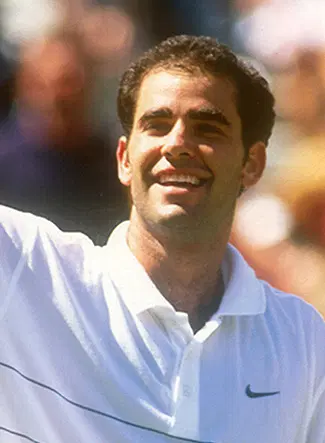
Pete Sampras, widely regarded as one of the greatest tennis players in the history of the sport, was born on August 12, 1971, in Washington, D.C. Known for his powerful serve, precise volleys, and mental toughness, Sampras dominated men’s tennis during the 1990s, leaving an indelible mark on the sport. In this detailed exploration of his life and career, we delve into the key aspects that shaped his journey to becoming a tennis legend, from his early years and rise to fame to the nuances of his playing style and his legacy in the world of tennis.
Early Life and Introduction to Tennis
Pete Sampras was born into a Greek-American family as the third of four children to Sam and Georgia Sampras. His early years were marked by a natural athleticism and an affinity for sports. At the age of seven, Sampras discovered a tennis racket in the basement of his family’s home, and this serendipitous find sparked what would become a lifelong passion for the game.
Sampras quickly developed into a tennis prodigy, demonstrating a remarkable talent for the sport at a young age. His early training under coach Peter Fischer played a crucial role in shaping his aggressive playing style. Fischer transformed Sampras from a baseline player into a serve-and-volley specialist, a strategy that would become his trademark on the court. By the time he was 16, Sampras had turned professional, marking the beginning of an illustrious career.
Rise to Fame: The Making of a Champion
Sampras’ ascent to the top of the tennis world was swift and marked by several significant milestones. In 1988, at just 16 years old, he made his professional debut, quickly establishing himself as a formidable competitor on the ATP tour. His breakthrough came in 1990 when, at the age of 19, he won his first Grand Slam title at the US Open, defeating the legendary Andre Agassi in the final. This victory made Sampras the youngest-ever US Open champion, a record that still stands today.
The rivalry between Sampras and Agassi would become one of the most iconic in tennis history, with the two players’ contrasting styles captivating fans around the world. While Agassi was known for his flashy baseline play and charismatic personality, Sampras was the epitome of quiet efficiency, relying on his powerful serve and clinical volleys to dismantle opponents.
Playing Style and Technique
Sampras’ playing style was characterized by his exceptional serve-and-volley game, a strategy that involved serving powerfully and then charging the net to volley away any returns. His serve was particularly lethal, earning him the nickname “Pistol Pete” due to its speed and accuracy. Sampras regularly served at speeds exceeding 215 kilometers per hour (134 miles per hour), making it one of the most feared weapons in tennis.
One of the defining features of Sampras’ game was his ability to perform under pressure. His calm demeanor and mental toughness were key factors in his success, allowing him to win critical points in high-stakes situations. Sampras’ serve-and-volley approach was complemented by a powerful forehand, which he used to dictate rallies and keep opponents on the defensive.
However, Sampras’ game was not without its weaknesses. His backhand, particularly on clay courts, was often cited as a vulnerability. Unlike his contemporaries who favored a two-handed backhand, Sampras used a one-handed backhand, which, while elegant, lacked the power and consistency of his other strokes. This limitation was most evident on clay, a surface on which he struggled throughout his career. Despite his dominance on grass and hard courts, Sampras never won the French Open, the only Grand Slam title to elude him.
Dominance in the 1990s
The 1990s were undoubtedly the decade of Pete Sampras. During this period, he cemented his status as the world’s best player, finishing six consecutive years (1993-1998) as the ATP’s year-end No. 1 ranked player. This achievement was a testament to his consistency and ability to perform at the highest level across various surfaces.
Sampras’ Grand Slam record during the 1990s was unparalleled. He won a total of 14 Grand Slam singles titles, a record at the time, including seven Wimbledon titles, five US Open titles, and two Australian Open titles. His dominance at Wimbledon was particularly remarkable; he won the prestigious tournament seven times between 1993 and 2000, becoming synonymous with the grass courts of the All England Club.
One of Sampras’ most memorable matches was the 1999 Wimbledon final against Agassi, where he delivered a masterclass in serve-and-volley tennis to win in straight sets. This victory was not only a demonstration of his technical prowess but also highlighted his ability to rise to the occasion in the sport’s biggest moments.
The Rivalries: Agassi and Rafter
Throughout his career, Sampras was involved in several high-profile rivalries, with his battles against Andre Agassi and Patrick Rafter standing out as some of the most intense. The Sampras-Agassi rivalry was particularly significant, as it pitted two of the era’s best players against each other in numerous Grand Slam finals and crucial matches. Their contrasting styles—Sampras’ serve-and-volley against Agassi’s baseline brilliance—made for some of the most exciting and memorable matches in tennis history.
Sampras’ rivalry with Australian Patrick Rafter was another highlight of his career. The two players clashed in several important matches, most notably at the US Open and Wimbledon. In 1998, after losing to Rafter in the Cincinnati Masters final, Sampras famously remarked, “Ten Grand Slams,” a pointed reminder of his superior achievements in the sport. This rivalry was characterized by a mix of respect and animosity, with Rafter often criticizing Sampras for what he perceived as a lack of respect for other players.
The Final Years and Retirement
As the new millennium approached, Sampras’ dominance began to wane as younger players like Roger Federer emerged on the scene. Despite this, he continued to compete at a high level, adding one more Grand Slam title to his collection before retiring. In 2002, at the age of 31, Sampras won his final Grand Slam title at the US Open, defeating Agassi in a fitting end to their storied rivalry. This victory was particularly poignant as it marked Sampras’ 14th Grand Slam title, a record that would stand for several years until it was broken by Roger Federer.
After his US Open triumph, Sampras decided to retire from professional tennis, officially announcing his retirement in 2003. His decision to retire at the top of his game, rather than fade away, was in keeping with his understated and dignified approach to the sport.
Legacy and Impact on Tennis
Pete Sampras’ impact on tennis extends far beyond his impressive statistics. He is widely credited with popularizing the serve-and-volley style, particularly on faster surfaces like grass and indoor courts. His dominance at Wimbledon, where he won seven titles, helped redefine the standards of excellence on grass courts.
Sampras’ career also set the stage for the next generation of tennis stars. Players like Roger Federer, who idolized Sampras as a child, were inspired by his achievements and sought to emulate his success. Federer’s win over Sampras in the 2001 Wimbledon fourth round is often cited as a symbolic passing of the torch from one great champion to another.
Off the court, Sampras was known for his humility and professionalism. Unlike some of his more flamboyant peers, he preferred to let his racket do the talking. This reserved demeanor earned him respect from both fans and fellow players, and he remains a beloved figure in the tennis world.
Personal Life and Beyond Tennis
In addition to his tennis career, Pete Sampras’ personal life has also been of interest to fans. In 2000, he married actress Bridgette Wilson, known for her roles in films such as “Mortal Kombat” and “Billy Madison.” The couple has two sons, Christian Charles, born in 2002, and Ryan Nikolaos, born in 2005.
Sampras has largely stayed out of the public eye since his retirement, focusing on his family and personal life. He has made occasional appearances at tennis events and exhibitions but has generally preferred to maintain a low profile. His decision to avoid the spotlight is consistent with the understated manner in which he conducted his tennis career.
Sampras has also been open about his battle with beta-thalassemia minor, a genetic blood disorder that causes mild anemia. Despite this condition, he managed to compete at the highest level for many years, further highlighting his resilience and determination.
Conclusion
Pete Sampras’ legacy in tennis is one of unparalleled success, consistency, and professionalism. His achievements, particularly in Grand Slam tournaments, set new benchmarks for excellence in the sport. With 14 Grand Slam titles, six consecutive year-end No. 1 rankings, and a style of play that combined power with finesse, Sampras will always be remembered as one of the all-time greats of tennis.
His influence on the game continues to be felt, not only through the records he set but also through the players he inspired. Sampras’ approach to tennis, characterized by a relentless pursuit of perfection and a calm, focused demeanor, serves as a model for aspiring athletes.
As we reflect on the career of Pete Sampras, we are reminded of the qualities that define true greatness: talent, hard work, and an unwavering commitment to excellence. His story is one of a champion who, through sheer determination and skill, reached the pinnacle of his sport and left a lasting legacy that will inspire future generations.


