
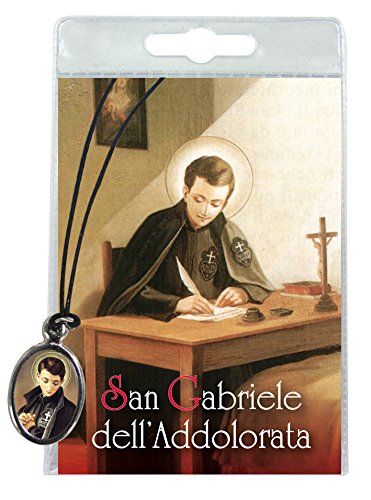
San Gabriele dell’Addolorata, born Francesco Possenti on March 1, 1838, in Assisi, Italy, is a figure of profound religious significance, particularly revered within the Catholic Church. His life, though tragically short, is marked by deep spirituality, dramatic personal transformation, and an enduring legacy that continues to inspire the faithful across the world.
Early Life and Family Background
Francesco Possenti was born into a prominent family. His father, Sante Possenti, was a nobleman and a governor under Pope Gregory XVI, responsible for overseeing various cities, including the birthplace of St. Francis of Assisi. His mother, Agnese Frisciotti, hailed from Civitanova Marche, a town in the Marche region of Italy. Francesco was one of thirteen siblings, a fact that underlines the traditional large family structure of the era.
The Possenti family’s life was one of constant movement due to Sante’s responsibilities, which took them to different cities. However, tragedy struck early in Francesco’s life with the death of his mother in 1842 when he was just four years old. This event marked the beginning of a period of great upheaval for the young Francesco, who, despite the challenges, received a solid Christian education, primarily under the Jesuits in Spoleto.
Youth and Early Influences
Francesco’s youth was, in many ways, typical for a boy of his status and time. He was known for his charm and popularity, particularly among the young women of Spoleto. However, his early life was also punctuated by significant events that would shape his spiritual journey. Notably, a serious hunting accident nearly cost him his life, and a prolonged illness led him to make a solemn promise to God: if he recovered, he would dedicate his life to religious service. Although he recovered, the youthful Francesco did not immediately follow through on this vow.
The Call to Religious Life
The turning point in Francesco’s life came on August 22, 1856, during a procession in honor of the Virgin Mary in Spoleto. It was here that he experienced what is often referred to as a “Marian locution”—a mystical experience where he believed he heard the voice of the Virgin Mary calling him to renounce his worldly life and join the Passionist order. This was a pivotal moment that set him on the path to becoming San Gabriele dell’Addolorata.
Despite initial resistance from his father, who had other plans for his son’s future, Francesco was resolute in his decision. He joined the Passionists, a religious order known for its deep devotion to the Passion of Christ. Upon taking his vows, he assumed the name Gabriele dell’Addolorata, in honor of the Madonna of Sorrows, a figure that held deep significance in his spiritual life, as it did for many Passionists.
Life as a Passionist
After taking his vows, Gabriele spent the next six years of his life in the Passionist community, primarily in the regions of Marche and Abruzzo. His life as a Passionist was characterized by intense devotion, rigorous theological study, and a deepening of his spiritual life. He lived in relative seclusion, dedicating himself to prayer, study, and the Passionist mission.
One of the key aspects of Gabriele’s spirituality was his profound devotion to the Virgin Mary, particularly under the title of Our Lady of Sorrows. This devotion was not only a personal comfort but also a central element of his religious practice, as reflected in his writings and the way he lived his life.
Illness and Death
In 1859, at the age of 21, Gabriele was diagnosed with tuberculosis, a disease that was often fatal in the 19th century. Despite his declining health, he continued to live according to the strictures of the Passionist order, participating in communal prayers, theological studies, and other religious activities as much as his condition would allow.
Remarkably, even as his illness progressed, Gabriele maintained a serene and cheerful disposition. His fellow Passionists noted his unwavering faith and calmness, even as he approached death. This serenity, in the face of immense physical suffering, was seen as a testament to his deep spiritual conviction and his belief in the afterlife.
Gabriele dell’Addolorata died on February 27, 1862, just a few days shy of his 24th birthday. His death came before he could be ordained as a priest, a goal he had fervently hoped to achieve. However, his life, though short, left an indelible mark on those who knew him and on the broader Catholic community.
Beatification and Canonization
The process of recognizing Gabriele dell’Addolorata’s holiness began almost immediately after his death. His reputation for sanctity and the miracles attributed to his intercession led to his beatification by Pope Pius X on May 31, 1908. This recognition was a formal acknowledgment by the Catholic Church of Gabriele’s holiness and his ability to intercede on behalf of those who pray to him.
Twelve years later, on May 13, 1920, Gabriele was canonized by Pope Benedict XV, making him an official saint of the Catholic Church. His canonization was a moment of great celebration, particularly in Italy, where he had become a beloved figure, especially among the youth.
Pope Pius XI later declared San Gabriele dell’Addolorata the patron saint of Catholic youth in Italy, a role that underscores his enduring appeal to young people and his significance as a model of youthful holiness and devotion.
Patronage and Miracles
San Gabriele dell’Addolorata is venerated not only in Italy but also in other parts of the world where Italian immigrants settled, including the United States, Canada, and various countries in Central and South America. His feast day is celebrated on February 27, the anniversary of his death.
One of the most well-known miracles attributed to San Gabriele is the healing of Saint Gemma Galgani, a young Italian woman who suffered from a serious illness. According to her testimony, she prayed for the intercession of San Gabriele and experienced a miraculous recovery. This and other miracles have contributed to his reputation as a powerful intercessor, particularly for young people and those suffering from serious illnesses.
The Legacy of San Gabriele dell’Addolorata
San Gabriele dell’Addolorata’s legacy is one of deep faith, youthful zeal, and unwavering devotion to the Virgin Mary. His life story continues to inspire countless people, particularly the young, who see in him a model of how to live a life of holiness and commitment to God, even in the face of suffering and adversity.
In the region of Abruzzo, where he spent the final years of his life, San Gabriele is especially revered. The Sanctuary of San Gabriele, located in Isola del Gran Sasso, is a major pilgrimage site, attracting thousands of visitors each year who come to honor the saint and seek his intercession.
The devotion to San Gabriele is also marked by annual celebrations, particularly among Italian Catholic youth. One of the unique traditions associated with him involves students who, 100 days before their final exams, make a pilgrimage to his sanctuary to pray for success. This ritual highlights the enduring connection between San Gabriele and the aspirations and struggles of young people.
Conclusion
San Gabriele dell’Addolorata is a saint whose life, though brief, was filled with profound spiritual insights and an unwavering commitment to his faith. His story is a testament to the power of divine calling, the strength of personal conviction, and the enduring impact one life can have on countless others.
As a model of youthful piety and a powerful intercessor, San Gabriele remains a beloved figure in the Catholic Church, especially among the young and those facing challenges in their lives. His life and legacy continue to resonate, offering hope, inspiration, and a path to spiritual fulfillment for all who seek his guidance.


