
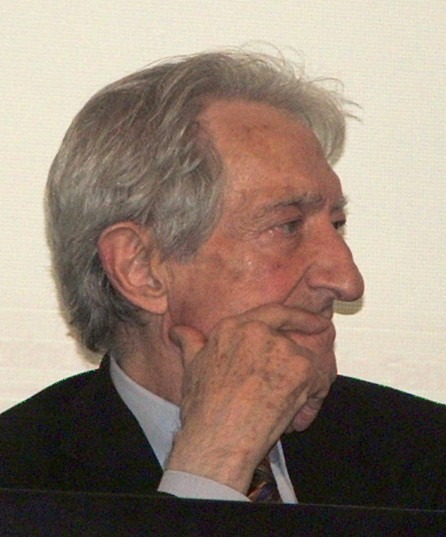
Edoardo Sanguineti, born on December 9, 1930, in Genoa, Italy, was a renowned poet, writer, critic, and translator who played a pivotal role in the Italian literary scene of the 20th century. Sanguineti’s work, deeply rooted in modernist and avant-garde traditions, pushed the boundaries of literature and criticism, making him one of the most influential figures in Italian letters. His life and career reflect a constant engagement with literature, politics, and culture, making him a towering figure in both Italian and international literary circles.
Early Life and Education
Edoardo Sanguineti’s early years were shaped by his family’s relocation to Turin when he was just four years old. His father, Giovanni, worked as a bank clerk, and his mother, Giuseppina Cocchi, played a significant role in his upbringing. However, Sanguineti’s childhood was not without challenges. He was misdiagnosed with a severe heart condition, which led to a period of limited physical activity. This diagnosis, later proven incorrect, had a lasting impact on his psyche and outlook on life.
In Turin, Sanguineti was exposed to the intellectual milieu through his uncle, Luigi Cocchi, a musicologist who had connections with prominent figures like Piero Gobetti and Antonio Gramsci. This early exposure to intellectual discourse would later influence Sanguineti’s literary and political leanings.
Sanguineti attended the prestigious Liceo Classico D’Azeglio in Turin, where his passion for literature began to take shape. It was during this time that he encountered Luigi Vigliani, his Italian literature teacher, who encouraged Sanguineti to pursue his poetic aspirations. Sanguineti began writing what would eventually become “Laborintus,” his first major work, in 1951.
The Birth of a Literary Career
The 1950s were a formative period for Sanguineti. In 1953, his mother passed away, an event that profoundly affected him. Around the same time, he met Luciana, who would become his wife in 1954. That year marked the beginning of his long and fruitful relationship with Luciano Anceschi, a literary critic who recognized the potential in Sanguineti’s early writings. Anceschi’s decision to publish “Laborintus” in 1956 marked the official launch of Sanguineti’s literary career.
“Laborintus,” a complex and experimental work, is emblematic of Sanguineti’s approach to literature. It defied conventional narrative structures and embraced a fragmented, almost chaotic style that mirrored the uncertainties and tensions of the post-war world. The publication of this work positioned Sanguineti as a leading voice in the avant-garde literary movement in Italy.
The Rise of Gruppo 63
Sanguineti’s literary activities in the early 1960s were closely tied to the formation of Gruppo 63, a collective of writers, poets, and critics who sought to challenge traditional literary forms and promote experimental literature. Founded in Palermo in 1963, Gruppo 63 was instrumental in redefining Italian literature by rejecting neorealism and embracing a more fragmented, polyphonic approach to writing.
As one of the key figures in Gruppo 63, Sanguineti played a significant role in shaping the group’s direction and ideology. His works during this period, including “Triperuno” (1960) and “Capriccio Italiano” (1963), further solidified his reputation as a leading avant-garde writer. These works, characterized by their linguistic experimentation and intertextual references, were reflective of the group’s broader aims to disrupt conventional literary norms.
In addition to his creative writing, Sanguineti also engaged in literary criticism, producing essays that explored the intersections of literature, ideology, and language. His critical work during this period, such as “Ideologia e linguaggio” (1965), highlighted his belief in the inseparability of literature and politics, a theme that would continue to permeate his work throughout his career.
Academic and Political Engagement
Parallel to his literary career, Sanguineti pursued an academic path, earning a degree in literature and eventually becoming a professor of Italian literature. His academic career began at the University of Turin, where he was appointed as a professor of modern and contemporary Italian literature in 1965. His scholarly work, particularly his studies on Dante and other medieval poets, earned him recognition as a leading Dante scholar.
Sanguineti’s academic pursuits were always intertwined with his political beliefs. A committed Marxist, Sanguineti believed in the power of literature to effect social change. His political engagement extended beyond the classroom and the written word; in 1968, he ran for the Italian Parliament as a candidate for the Italian Communist Party (PCI). Though he did not win a seat at that time, he remained an active participant in the political discourse of the era.
In 1976, Sanguineti was elected as a city councilor in Genoa, a position he held until 1981. During this time, he also served as a member of the Italian Parliament from 1979 to 1983, representing the PCI as an independent candidate. His political career was marked by his advocacy for cultural and educational policies that reflected his Marxist beliefs.
Literary Contributions and Global Influence
Sanguineti’s literary output was prolific, spanning several decades and encompassing a wide range of genres, including poetry, essays, plays, and translations. His poetry, known for its dense and often challenging language, reflected his deep engagement with both classical and contemporary literary traditions. Works such as “Wirrwarr” (1972) and “Postkarten” (1978) showcased his ability to blend avant-garde techniques with classical references, creating a body of work that was both innovative and deeply rooted in literary history.
In addition to his poetry, Sanguineti was a respected translator, bringing the works of important international writers to Italian audiences. His translations included works by James Joyce, Bertolt Brecht, and Samuel Beckett, among others. These translations not only broadened the horizons of Italian readers but also demonstrated Sanguineti’s versatility and deep understanding of global literary trends.
Sanguineti’s influence extended beyond Italy, as he became a prominent figure in the international literary community. He was a founding member of the European Academy of Poetry in Luxembourg and served as a consultant for the Poetry International festival in Rotterdam. His global travels, which took him to the Soviet Union, China, the United States, and many other countries, further enhanced his reputation as a cultural ambassador for Italian literature.
Awards and Recognition
Throughout his career, Sanguineti received numerous accolades for his contributions to literature and culture. In 1996, he was awarded the title of Knight Grand Cross of the Order of Merit of the Italian Republic, one of the highest honors in Italy. This recognition reflected not only his literary achievements but also his contributions to Italian culture and education.
Sanguineti’s work was also recognized internationally. He received the Golden Wreath Award at the Struga Poetry Evenings, a prestigious international poetry festival in Macedonia, and the Librex Montale Prize in 2006, named after the famous Italian poet Eugenio Montale. These awards underscored Sanguineti’s stature as one of the leading poets of his generation.
Later Years and Legacy
In 2000, Sanguineti retired from his position at the University of Genoa, marking the end of his formal academic career. However, he continued to write, lecture, and engage with the literary and cultural community until his death on May 18, 2010. His later works, such as “Mikrokosmos” (2004) and “Varie ed eventuali” (2010), continued to explore the themes of language, memory, and identity that had characterized his earlier work.
Sanguineti’s legacy is evident in the continued study and appreciation of his work both in Italy and abroad. His contributions to literature, particularly his role in the avant-garde movement, have left a lasting impact on Italian culture. His belief in the power of literature to challenge and transform society remains an inspiration to writers and scholars alike.
Conclusion
Edoardo Sanguineti was more than just a poet; he was a cultural force who reshaped the landscape of Italian literature. His work, characterized by its linguistic innovation, political engagement, and deep intellectual rigor, continues to resonate with readers and scholars. As a poet, critic, translator, and politician, Sanguineti embodied the idea that literature is not just a reflection of the world but a means of changing it.
Sanguineti’s life and career offer a powerful example of the intersection between art and politics, showing how literature can be both a personal expression and a tool for social change. His influence on Italian and global literature is undeniable, and his legacy continues to inspire new generations of writers, thinkers, and activists.


