
Sant’Antonio Abate, also known as Saint Anthony the Great, is a revered figure in Christian history, particularly known for his role as the founder of monasticism. Born on January 12, 251, in Qumans, Egypt, and living until January 17, 356, Sant’Antonio Abate reached the remarkable age of 105. His life, filled with spiritual devotion and a dedication to asceticism, has made him an iconic figure in both religious and cultural contexts.
Early Life and Background
Sant’Antonio Abate was born into a wealthy Christian family of farmers. His early life, however, was marked by tragedy as he became an orphan during his adolescence. Despite the responsibility of caring for a younger sister and managing a substantial inheritance, Antonio was profoundly moved by the teachings of the Gospel, particularly the call to give away all worldly possessions and follow Christ. This pivotal moment led him to distribute his wealth to the poor and embark on a path of solitude and spiritual discipline.
The Founding of Monasticism
Antonio’s decision to live a life of chastity, poverty, and prayer in the Egyptian desert was the beginning of what would become the monastic movement. His lifestyle was not entirely unique, as other hermits had also chosen to live in seclusion in the nearby deserts. However, Antonio’s influence and the community he eventually gathered around him solidified his reputation as the “Father of Monasticism.”
During his time in the desert, Antonio experienced several visions, one of which involved seeing a fellow hermit weaving a rope while praying. This vision underscored the importance of balancing spiritual practice with physical labor, a principle that would become a cornerstone of monastic life. Antonio took up basket weaving, both as a means of self-sustenance and as an activity to keep himself from idleness.
Struggles and Temptations
Throughout his life, Sant’Antonio Abate faced numerous temptations and struggles, particularly those posed by the devil. These temptations, often depicted in various works of art, are central to his story. One of the most famous episodes involves Antonio retreating into a tomb near his village, where he was attacked by demons. He was found unconscious and later recovered in a village church, only to continue his life of extreme asceticism.
Antonio’s battles with the devil were not only spiritual but also physical. He relocated to Mount Pispir, near the Red Sea, where he lived in isolation for 20 years. His sustenance came from the occasional bread brought to him, and his focus was on purification and spiritual warfare against the devil’s torments.
The Expansion of Anachoretic Monasticism
Despite his desire for solitude, Antonio’s reputation as a spiritual leader attracted many followers. These individuals sought to emulate his lifestyle, leading to the spread of anachoretic monasticism— a form of monastic life that emphasizes withdrawal from society to live in solitude. In 307, Antonio received a visit from Hilarion, a monk who sought to establish a monastic community in Gaza. This meeting further contributed to the spread of monastic ideals across the Christian world.
Later Years and Legacy
In the later years of his life, Antonio briefly returned to Alexandria in response to the persecution of Christians under Emperor Maximinus Daia. Although not personally targeted, Antonio sought to comfort and support those who were suffering. He also supported Athanasius of Alexandria in his fight against Arianism, a significant theological controversy of the time.
Sant’Antonio Abate spent his final years in the desert of Thebes, tending to a small garden and continuing his practice of prayer. He passed away on January 17, 357, and was buried in a secret location by his disciples. This date, January 17, is now celebrated as his feast day.
Iconography and Cultural Significance
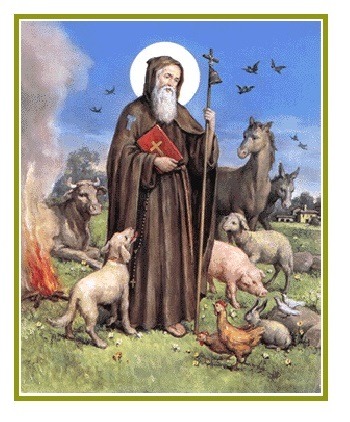
The iconography of Sant’Antonio Abate is rich with symbolism. He is often depicted with a small “tau” cross, a bell, and a pig or wild boar at his feet. The “tau” cross, usually red, represents his connection to the monastic tradition, while the bell and pig are symbols of his patronage over animals, particularly livestock. The fire depicted in some images references the “Fire of Saint Anthony,” a term historically used to describe ergotism, a disease caused by eating contaminated grains.
Antonio’s struggles against the devil have inspired numerous works of art throughout history. One of the most famous modern interpretations is Salvador Dalí’s 1946 painting “The Temptation of Saint Anthony,” which portrays the saint’s spiritual battle in a surrealist style.
Beyond his religious significance, Sant’Antonio Abate has also left a mark on popular culture and language. The expression “Troppa grazia, Sant’Antonio!” (Too much grace, Saint Anthony!) is a well-known Italian saying that reflects the story of a merchant and his horse, where an excess of good fortune becomes overwhelming.
Patronage and Feast Day Celebrations
Sant’Antonio Abate is venerated as the patron saint of various groups and professions, including farmers, livestock breeders, butchers, and brush makers— the latter owing to the traditional use of pig bristles in brush making. His association with animals, particularly pigs, has led to his patronage over livestock, and he is often invoked for the protection of animals and against diseases such as shingles, commonly known as “the fire of Saint Anthony.”
His feast day, January 17, is celebrated with various rituals and customs, especially in rural communities. In many places, animals are blessed, and processions are held in his honor. These celebrations are not only religious but also serve as a reminder of the close relationship between humans and animals in agricultural societies.
Historical Context and Influence
The life of Sant’Antonio Abate must be understood within the broader context of early Christian asceticism and the development of monastic traditions. During Antonio’s lifetime, the Roman Empire was undergoing significant changes, including the spread of Christianity and the rise of ascetic practices as a response to the decadence of urban life. The deserts of Egypt, where Antonio and other hermits chose to live, became symbolic of the struggle between the spiritual and the material worlds.
Antonio’s influence extended beyond his immediate followers. His life and teachings were documented by Athanasius of Alexandria, whose “Life of Anthony” became a key text in Christian hagiography. This work not only preserved Antonio’s legacy but also inspired generations of monks and ascetics across the Christian world.
In conclusion, Sant’Antonio Abate’s life is a testament to the power of spiritual conviction and the enduring influence of monasticism in Christian history. His legacy continues to be celebrated not only in religious contexts but also in art, culture, and language. The story of his life, filled with trials, temptations, and unwavering faith, remains a source of inspiration for many, reflecting the timeless struggle between the spiritual and the worldly.


