
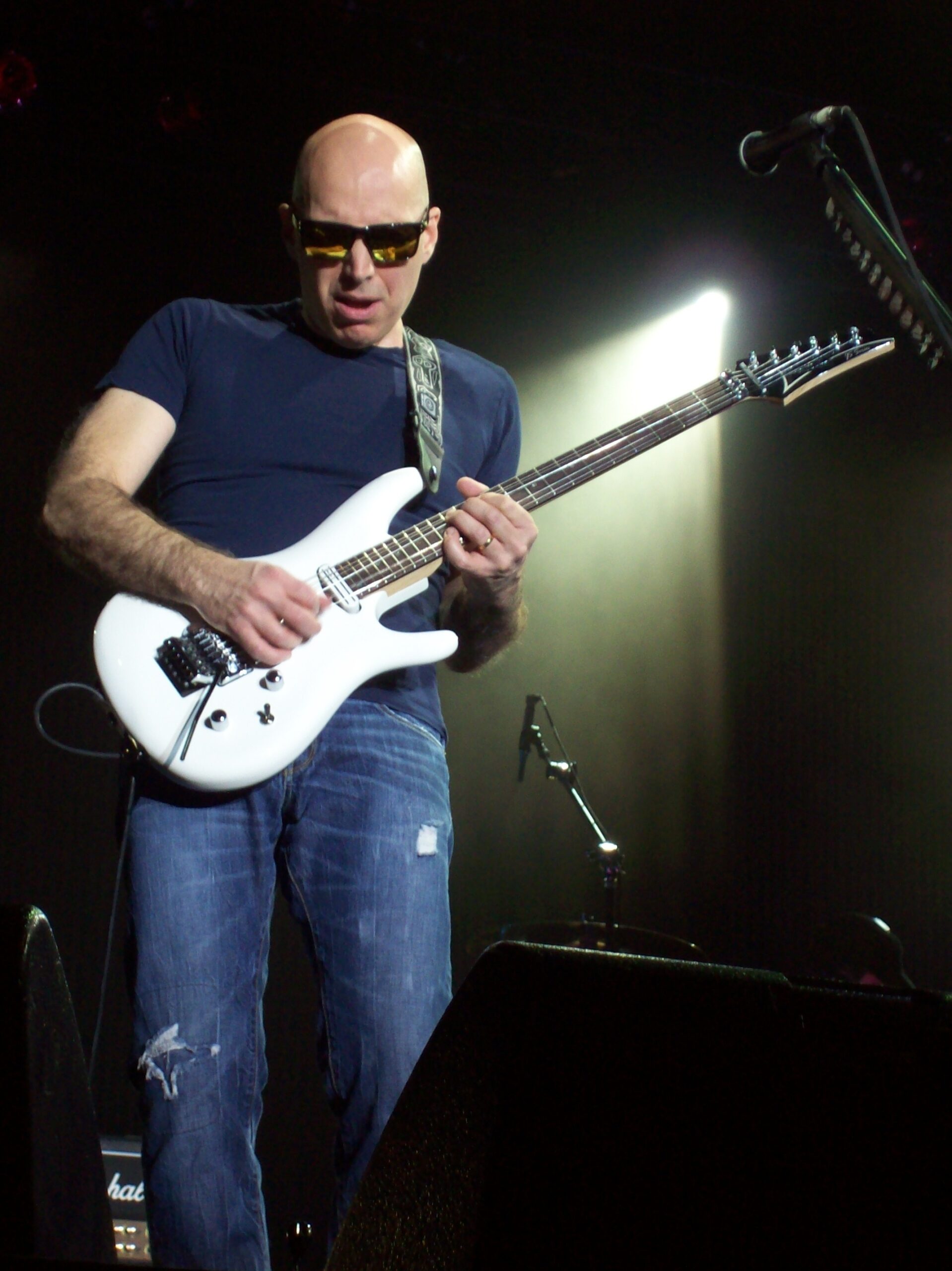
Joe Satriani, born on July 15, 1956, in Westbury, New York, is an iconic figure in the world of rock and instrumental guitar music. Over the decades, Satriani has carved out a unique niche for himself as one of the most technically proficient and innovative guitarists of the modern era. His contributions to the music industry go far beyond his virtuosic playing, extending into teaching, collaboration, and pushing the boundaries of guitar-based music.
Early Life and Musical Beginnings
Satriani’s journey into music began at the age of 14, inspired by the legendary Jimi Hendrix. Hendrix’s revolutionary approach to the guitar electrified young Satriani, prompting him to dive headfirst into mastering the instrument. This initial burst of inspiration set him on a path of intense practice and study, where he rapidly developed a formidable technical skill set. Unlike many of his peers, Satriani showed an extraordinary ability to learn and apply complex guitar techniques, often mastering concepts in a fraction of the time it would take others.
This early mastery didn’t go unnoticed. By his late teens, Satriani was already giving guitar lessons, a role that would become a significant part of his early career. Among his students was another future guitar legend, Steve Vai, who would go on to achieve fame in his own right. The bond between teacher and student would evolve into a lifelong friendship, with Vai often citing Satriani as a crucial influence on his career.
Rise to Fame: From Teacher to Global Guitar Hero
Satriani’s move to California in the late 1970s marked the beginning of a new chapter in his life. In addition to teaching, he began to make a name for himself as a live performer. His technical prowess and unique approach to guitar playing soon caught the attention of the music community. By the early 1980s, Satriani was performing with the Greg Kihn Band, which provided him with valuable exposure and experience on the road.
In 1984, Satriani took a bold step by releasing his first EP, a self-titled project funded out of his own pocket. This was followed by his first full-length album, Not of This Earth, in 1986. The album was a critical success, showcasing Satriani’s innovative approach to instrumental rock guitar music. However, it was his next release, Surfing with the Alien (1987), that truly catapulted him to fame. The album was a groundbreaking work that combined complex guitar solos with accessible melodies, earning him widespread acclaim and establishing him as one of the premier guitarists of his generation.
Major Career Milestones
The late 1980s and early 1990s were a period of rapid growth and success for Satriani. His third album, Flying in a Blue Dream (1989), marked his debut as a vocalist and included some of his most iconic tracks. The album’s success was further bolstered by the inclusion of one of its tracks in the soundtrack of Cameron Crowe’s film Say Anything. This period also saw Satriani embark on several high-profile tours, including a stint as the lead guitarist for Mick Jagger’s solo tour in 1988, where he gained international exposure.
In the early 1990s, Satriani’s influence extended beyond his solo work. He launched the now-legendary G3 Tour in 1996, a concert series that brought together some of the world’s greatest guitarists. The original lineup included Satriani, Steve Vai, and Eric Johnson, and the tour quickly became a fan favorite. Over the years, the G3 Tour has featured numerous guitar legends, including John Petrucci of Dream Theater and Yngwie Malmsteen, solidifying Satriani’s status as a central figure in the guitar community.
Evolution as an Artist
Satriani’s musical output throughout the 1990s and 2000s reflected his constant desire to evolve and explore new sounds. His 1992 album The Extremist and the subsequent Time Machine (1993) demonstrated his ability to blend heavy rock with intricate, melodic solos. This period also saw Satriani developing his signature line of Ibanez guitars, which have become a favorite among guitarists worldwide.
The turn of the millennium brought new challenges and opportunities. In 2000, Satriani released Engines of Creation, an album that incorporated electronic elements into his music, earning him a Grammy nomination. The following year, he released Live in San Francisco, a double live album that captured the energy and precision of his live performances. Throughout the 2000s, Satriani continued to release new music, including Strange Beautiful Music (2002), Is There Love in Space? (2004), and Super Colossal (2006), each album showcasing his ability to innovate within the instrumental rock genre.
Legacy and Influence
Joe Satriani’s influence on the world of guitar music cannot be overstated. As a teacher, he has shaped the careers of some of the most influential guitarists in rock and metal, including Steve Vai, Kirk Hammett (Metallica), Larry LaLonde (Primus), and David Bryson (Counting Crows). His teaching legacy is as significant as his recording career, with many of his students going on to become legends in their own right.
As a performer and composer, Satriani has consistently pushed the boundaries of what can be done with a guitar. His innovative use of techniques such as legato, tapping, and harmonics, combined with his melodic sense and ability to craft memorable compositions, has inspired countless guitarists around the world. His albums have been nominated for multiple Grammy Awards, and his tours have attracted legions of fans across the globe.
Recent Work and Continued Impact
In the 2010s and 2020s, Satriani has continued to be a prolific artist. Albums like Black Swans and Wormhole Wizards (2010), Unstoppable Momentum (2013), Shockwave Supernova (2015), and What Happens Next (2018) have shown that Satriani is far from resting on his laurels. Each album has brought something new to the table, whether it’s exploring different genres, incorporating new technologies, or simply refining his already formidable technique.
Beyond his recorded work, Satriani has remained an active live performer, constantly touring and participating in various musical projects. His ability to connect with audiences through his guitar playing remains as strong as ever, and his live performances are celebrated for their energy, precision, and emotional depth.
Conclusion
Joe Satriani is more than just a guitarist; he is a pioneer, an innovator, and a mentor. His contributions to the world of music are immense, and his influence will be felt for generations to come. Whether through his groundbreaking albums, his role as a teacher, or his unforgettable live performances, Satriani has left an indelible mark on the world of rock music. As he continues to create and perform, there’s no doubt that Satriani’s legacy will only continue to grow, inspiring new generations of guitarists to pick up the instrument and explore the limitless possibilities it offers.


