
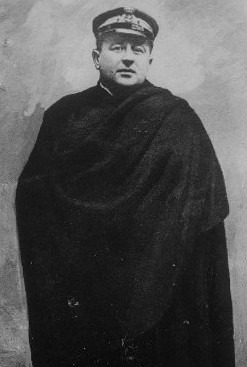
Nazario Sauro, born on September 20, 1880, in Capodistria (now Koper, Slovenia), was an Italian military officer, patriot, and one of the most prominent figures of the Italian irredentist movement. His life, marked by daring naval exploits and a steadfast commitment to the Italian cause, remains emblematic of the struggle for Italian unification and the fight against the Austro-Hungarian Empire. Sauro’s dedication to his homeland ultimately led to his capture and execution, solidifying his place as a martyr in Italian history.
Early Life and Background
Nazario Sauro was born into a family of Italian origin in Capodistria, a city then part of the Austro-Hungarian Empire but with strong Italian cultural ties. From an early age, Sauro was deeply influenced by the nationalist sentiments that were pervasive in his community. The desire for the unification of all Italian-speaking territories under the Kingdom of Italy was a cause that resonated deeply with him, shaping his future path.
As a young man, Sauro developed a passion for the sea, which led him to command small steamships that traversed the Adriatic Sea. His extensive knowledge of the Adriatic coastline, particularly the Dalmatian coasts, was honed during these years. This expertise would later prove invaluable during World War I, when his intimate familiarity with the region’s waters became a crucial asset in naval operations.
The Irredentist Movement and World War I
The irredentist movement, which sought the annexation of Italian-speaking regions of the Austro-Hungarian Empire to Italy, was a significant force in the late 19th and early 20th centuries. Sauro, driven by a fervent sense of patriotism, became an active participant in this movement. The outbreak of World War I provided an opportunity for him to take direct action in support of the Italian cause.
When Italy declared war on Austria-Hungary in 1915, Sauro wasted no time in offering his services to the Italian military. He traveled to Venice and enlisted in the Regia Marina (Royal Navy) as a volunteer, quickly rising to the rank of Lieutenant of the Vessel of Complement. His deep knowledge of the Adriatic Sea, coupled with his daring spirit, made him an invaluable asset to the Italian naval forces.
Sauro’s naval career during World War I was marked by a series of audacious missions that have since become the stuff of legend. He was assigned as a pilot on various surface and submarine torpedo boats, participating in over 60 naval operations within a span of just 14 months. These missions often involved navigating the treacherous waters of the Adriatic under the constant threat of enemy forces.
One of Sauro’s most famous missions occurred on July 30, 1916, when he embarked on the submarine Pullino for an incursion into Fiume (now Rijeka, Croatia). The operation was fraught with danger, as the submarine encountered strong currents and thick fog, leading to its eventual grounding on the rocky islet of Galiola. Despite numerous attempts to free the vessel, it became clear that the Pullino was beyond recovery. Sauro, along with the rest of the crew, was forced to abandon ship after destroying all sensitive equipment and documents.
In a final act of bravery, Sauro voluntarily left the submarine alone in a small boat, hoping to escape capture. However, he was soon apprehended by the Austro-Hungarian destroyer Satellit, bringing his storied naval career to an abrupt and tragic end.
Capture, Trial, and Execution
Nazario Sauro’s capture marked the beginning of a tragic final chapter in his life. He was taken to Pola (now Pula, Croatia), where he faced trial by an Austro-Hungarian military tribunal. Charged with high treason due to his service in the Italian navy against his native Austro-Hungarian Empire, Sauro was found guilty and sentenced to death by hanging.
On August 10, 1916, at 5:45 PM, Nazario Sauro faced his execution with remarkable courage and composure. As he mounted the gallows, he reportedly uttered the words “Viva l’Italia!” (“Long live Italy!”), a final declaration of his unwavering loyalty to the Italian cause. Sauro was just 35 years old at the time of his death.
Legacy and Posthumous Honors
Nazario Sauro’s martyrdom had a profound impact on the Italian people and the broader irredentist movement. His death became a powerful symbol of the struggle for Italian unification and the sacrifices made by those who fought for the nation’s independence and unity. Sauro’s legacy was further cemented by the posthumous awards and honors he received.
In recognition of his bravery and dedication, Nazario Sauro was awarded the Gold Medal of Military Valor, Italy’s highest military decoration. The citation for his medal reads:
“Dichiarata la guerra all’Austria, venne subito ad arruolarsi volontario sotto la nostra bandiera per dare il contributo del suo entusiasmo, della sua audacia ed abilità alla conquista della terra sulla quale era nato e che anelava a ricongiungersi all’Italia. Incurante del rischio al quale si esponeva, prese parte a numerose, ardite e difficili missioni navali di guerra, alla cui riuscita contribuì efficacemente con la conoscenza pratica dei luoghi e dimostrando sempre coraggio, animo intrepido e disprezzo del pericolo. Fatto prigioniero, conscio della sorte che ormai l’attendeva, serbò, fino all’ultimo, contegno meravigliosamente sereno, e col grido forte e ripetuto più volte dinnanzi al carnefice di «Viva l’Italia!» esalò l’anima nobilissima, dando impareggiabile esempio del più puro amor di Patria.”
This citation highlights Sauro’s unwavering commitment to the Italian cause and his extraordinary courage in the face of certain death. His story has inspired generations of Italians and continues to be commemorated in various ways, including monuments, naval vessels, and schools named in his honor.
Historical Context and Impact on Italian Identity
Nazario Sauro’s life and legacy are deeply intertwined with the broader history of the Italian unification movement, known as the Risorgimento. The Risorgimento was a period of intense nationalist activity in the 19th century, aimed at unifying the various states and territories of the Italian peninsula into a single nation. Although the process of unification was largely completed by 1871, the irredentist movement sought to extend Italian control to territories with significant Italian-speaking populations that remained under foreign rule, such as parts of the Austro-Hungarian Empire.
Sauro’s actions during World War I were a direct continuation of this irredentist struggle. His commitment to the cause of Italian unification, even at the cost of his life, made him a hero of the movement and a symbol of the broader Italian nationalist aspirations. The sacrifice of figures like Sauro helped to galvanize public support for the annexation of these territories, which was eventually achieved after the war.
The impact of Sauro’s legacy extends beyond his own time, influencing Italian national identity in the decades that followed. His story is often invoked in discussions of patriotism, sacrifice, and the defense of national sovereignty. In the years after his death, particularly during the fascist era in Italy, Sauro was celebrated as a national hero, and his life was used to promote the ideals of loyalty and devotion to the nation.
Commemoration and Cultural Legacy
Nazario Sauro’s legacy has been preserved through numerous commemorations and cultural references. In Italy, streets, schools, and public buildings are named in his honor, ensuring that his memory remains alive in the national consciousness. Monuments dedicated to Sauro can be found in various cities, serving as reminders of his sacrifice and the ideals he embodied.
One of the most notable commemorations is the naming of the Italian Navy’s submarine, the Nazario Sauro, in his honor. This submarine served as a powerful symbol of Sauro’s enduring influence on Italy’s naval traditions and his contribution to the nation’s military history.
In addition to physical memorials, Sauro’s life has been the subject of books, documentaries, and historical studies, further solidifying his place in the annals of Italian history. His story continues to be taught in Italian schools, where students learn about his contributions to the nation and the values he stood for.
Conclusion: A Hero for the Ages
Nazario Sauro’s life and legacy are a testament to the power of conviction and the enduring impact of individual actions on the course of history. His unwavering commitment to the Italian cause, his bravery in the face of danger, and his ultimate sacrifice have made him a symbol of Italian patriotism and a hero for the ages.
As Italy continues to evolve and its national identity continues to be shaped by both historical and contemporary influences, the story of Nazario Sauro remains a powerful reminder of the values of courage, sacrifice, and loyalty to one’s homeland. His legacy, honored and remembered in countless ways, continues to inspire new generations of Italians and serves as a beacon of what it means to live—and die—for one’s country.


