
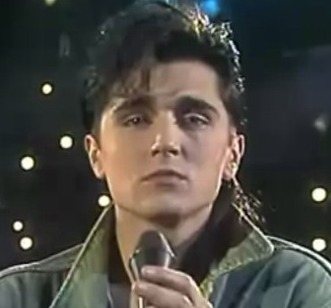
Early Life and Musical Beginnings
Giovanni Scialpi, known by his stage name Scialpi, was born on May 14, 1962, in Parma, Italy. From a young age, Scialpi demonstrated a natural talent for music, which would eventually lead him to become one of the most recognizable pop stars in Italy during the 1980s. His journey to fame began in his early twenties, when he made a striking debut in the Italian music scene, capturing the attention of both the public and the industry with his unique style and voice.
Scialpi’s first major breakthrough came in 1983 with the release of his single “Rocking Rolling.” This song was an immediate success, winning the “Discoverde” section of the prestigious Festivalbar, an influential Italian music festival that launched the careers of many artists. “Rocking Rolling” not only topped the charts but also established Scialpi as a fresh and exciting new artist in the Italian pop music landscape.
Following this initial success, Scialpi released his first album, Es-tensioni, which featured several tracks written by the renowned Italian singer-songwriter Pino Mango. The album was well-received, and Scialpi was awarded the Telegatto, a prestigious Italian television award, as the “Revelation of the Year.” This recognition further solidified his place in the music industry, marking the beginning of a career that would span several decades.
Rise to Fame: The 1980s
The 1980s were a pivotal decade for Scialpi, during which he enjoyed widespread fame and success. His musical style, characterized by a blend of pop rock with new wave influences, resonated with the youth of the time. Scialpi’s image, with his distinctive look and charismatic stage presence, also contributed to his popularity, making him a favorite among fans and media alike.
In 1984, Scialpi released the single “Cigarettes and Coffee,” a song he had written when he was just 14 years old. The track became an instant hit, earning him second place at the Festivalbar and later being covered by the legendary Italian singer Mina in her album Sorelle Lumière. This was a significant achievement, as it highlighted Scialpi’s songwriting talent and established him as a versatile artist capable of crafting timeless hits.
Scialpi continued to build on his success with the release of the mini-album Animale in 1985, which included the popular single “Ti piacerà.” His momentum carried him to the Sanremo Music Festival in 1986, where he performed the song “No East No West.” Although the song did not win, it became one of his signature tracks and was featured on his self-titled album Scialpi. The album also included the song “Cry (La voce dentro),” which was another hit that he performed at the Festivalbar.
In 1987, Scialpi returned to the Sanremo stage with “Bella età,” and the following year, he achieved one of his biggest career milestones by winning the Festivalbar with the duet “Pregherei,” performed alongside Scarlett Von Wollenmann. The song, which was part of the album Un morso e via, became one of the defining tracks of the 1980s in Italy and solidified Scialpi’s status as a leading figure in Italian pop music.
Transition and Challenges: The 1990s
As the music industry evolved in the 1990s, Scialpi faced new challenges in maintaining his relevance and adapting to changing musical tastes. Despite these challenges, he remained a prominent figure in Italian entertainment, not only as a musician but also as a television personality.
In 1990, Scialpi was chosen to co-host the popular television show Ricomincio da due alongside Raffaella Carrà and Sabrina Salerno, two of Italy’s most beloved entertainers. This role allowed him to showcase his charisma and connect with a broader audience beyond his music fans.
During this period, Scialpi continued to release music, including the album Trasparente in 1990, which featured the single “Il grande fiume.” The following year, he released Neroe, an album best known for the hit single “A…amare,” which climbed the Italian charts. Despite the commercial success of this song, Scialpi’s subsequent entry into the Sanremo Music Festival in 1992 with the song “È una nanna” was less successful, as the song was eliminated early in the competition.
The mid-1990s saw Scialpi experimenting with his music style and exploring new creative directions. In 1994, he released the summer hit “Baciami,” which was part of the album XXX. The following year, he released Spazio 1995, which included the single “Che per amore fai” as well as re-arranged versions of some of his earlier hits. These projects demonstrated Scialpi’s willingness to evolve as an artist and keep his music fresh for his audience.
In 1996, Scialpi ventured into theater, taking on a role in the musical Pianeta Proibito (Forbidden Planet), where he performed alongside actors Giampiero Ingrassia and Chiara Noschese. The production, directed by Patrick Rossi Gastaldi, was a success and marked a new chapter in Scialpi’s artistic career. He followed this with another theatrical production, Pellegrini, in 1997, further showcasing his versatility as an entertainer.
Reinvention and Later Career: The 2000s
The 2000s were a period of reinvention for Scialpi, as he sought to adapt to the changing music industry and continue his career in new ways. In 2001, he released the album Sì io sì, which marked his return to the music scene after a brief hiatus. Two years later, he released Spingi invoca ali, an album that featured the single “Pregherò imparerò salverò,” a song that reflected his continued commitment to producing music that resonated with his fans.
In 2004, Scialpi participated in the first edition of the reality show Music Farm, hosted by Amadeus on Raidue. The show featured established musicians competing in a musical challenge, and Scialpi’s appearance on the show brought him back into the public eye. Although he chose to leave the competition early despite winning a direct challenge against fellow contestant Gianni Fiorellino, his participation in the show reintroduced him to a new generation of viewers.
In the years that followed, Scialpi continued to release music, including the single “Non ti amo più” in 2005, which was accompanied by a music video inspired by the famous song “Je t’aime… moi non plus.” In 2006, he released the album Autoscatto, featuring the single “Goodbye.”
In 2012, as he approached his 50th birthday, Scialpi made a significant change to his stage name, rebranding himself as Shalpy. This change symbolized a new chapter in his career, one that was marked by a renewed focus on international markets. He released the single “ilventocaldodellestate,” which featured synth-pop influences, and followed it up with “Icon-Man,” a pop-dance track aimed at both the European and North American markets.
Scialpi’s rebranding as Shalpy also included a foray into the English-speaking music market. In 2013, he released “Music is mine,” a single accompanied by a music video featuring Veronica Ciardi. The following year, he released “Come to me,” a song promoted in both Italy and Spain, and later, the Spanish-language track “Besame.” In December 2014, he released “If you really want to,” further establishing his presence in the international music scene.
Personal Life and Public Advocacy
In addition to his musical career, Scialpi has been an outspoken advocate for LGBTQ+ rights. In 2015, he made headlines when he announced his intention to marry his partner, Roberto Blasi, who had been his manager and companion for six years. The couple’s decision to marry abroad, due to the lack of legal recognition for same-sex marriages in Italy at the time, brought significant media attention to the issue of marriage equality in Italy.
In July 2015, Scialpi penned an open letter to Pope Francis, appealing for greater acceptance and recognition of same-sex relationships within the Catholic Church. This bold move garnered widespread media coverage and positioned Scialpi as a vocal advocate for LGBTQ+ rights in Italy.
Legacy and Continuing Influence
Scialpi’s career, which has spanned over four decades, is a testament to his resilience, creativity, and ability to adapt to the ever-changing music industry. From his early days as a pop icon in the 1980s to his later reinvention as Shalpy, he has continually found ways to remain relevant and connect with new audiences.
His influence on Italian pop music is undeniable, with hits like “Rocking Rolling,” “Cigarettes and Coffee,” and “Pregherei” becoming part of the country’s musical heritage. His willingness to experiment with different musical styles and his courage to address social issues through his platform have made him a significant figure not only in the music world but also in the broader cultural landscape.
As Scialpi continues to evolve as an artist, his legacy is one of innovation and perseverance. His journey from a young singer in Parma to an international artist known as Shalpy is a story of passion, dedication, and an unwavering commitment to his craft. Whether through his music, his advocacy, or his public persona, Scialpi has left an indelible mark on the Italian entertainment industry, and his influence will undoubtedly continue to be felt for years to come.


