
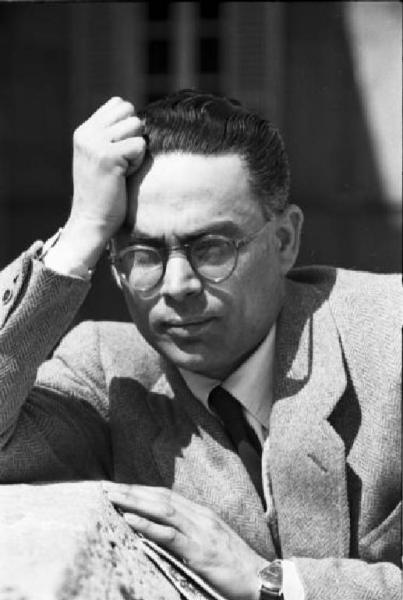
Leonardo Sinisgalli, born on March 9, 1908, in Montemurro, a small town in the province of Potenza, Italy, was a multifaceted figure in Italian culture, known for his work as a poet, engineer, and designer. Often referred to as the “engineer poet,” Sinisgalli’s career spanned across various fields, blending the worlds of science and art in a way that was both innovative and deeply influential. His life story is one of intellectual curiosity, artistic passion, and a unique ability to merge seemingly disparate disciplines.
Early Life and Education
Leonardo Sinisgalli was born into a humble family in Montemurro. His father, Vito Sinisgalli, like many Italians of the time, emigrated to America in search of better opportunities. Initially settling in Brooklyn and later moving to Barranquilla, Colombia, where he found success as a tailor, Vito Sinisgalli eventually returned to Italy in 1922. During these formative years, Leonardo was deeply influenced by the rural and rustic environment of Montemurro, which would later permeate much of his poetic work.
From an early age, Sinisgalli displayed exceptional intellectual abilities. His early education was under the guidance of Don Vito Santoro, a local teacher who recognized Leonardo’s potential and urged his mother to ensure that he continued his studies. Convinced by the teacher’s assessment, as well as by the encouragement from the local notary and archpriest, his family supported his further education.
In 1918, Sinisgalli left Montemurro to attend the Salesian College in Caserta. He later transferred to another college in Benevento, where he completed his secondary education with the highest marks in the region. This academic success paved the way for his enrollment at the University of Rome, where he initially studied mathematics before shifting to engineering—a decision that would significantly shape his future career.
University Years and Literary Awakening
While studying at the University of Rome, Sinisgalli became deeply immersed in the world of mathematics, particularly in courses on analysis, geometry, and higher mathematics. However, despite his technical studies, his passion for literature and poetry began to flourish during this period. He was particularly influenced by the works of Sergio Corazzini, a poet associated with the crepuscular movement, whose melancholic and introspective style resonated with the young Sinisgalli.
In 1927, Sinisgalli published his first collection of poems titled Cuore (Heart), which marked the beginning of his literary career. His poetic voice, characterized by a blend of scientific precision and emotional depth, quickly gained the attention of the literary community. Despite his promising start in the literary world, Sinisgalli faced a personal crisis that led him to change his academic focus from mathematics to engineering, a field that would offer him a stable career while allowing him to continue his literary pursuits.
In 1929, Sinisgalli received an invitation from Enrico Fermi, the renowned physicist, to join his group of students at the Institute of Physics on Via Panisperna in Rome. However, Sinisgalli declined the offer, choosing instead to pursue his passion for poetry over a potential career in atomic physics. This decision exemplified his lifelong commitment to blending the intellectual rigor of science with the expressive power of art.
The “Engineer Poet”
After graduating with a degree in industrial and electrical engineering, Sinisgalli passed the state exam in 1932, enabling him to practice professionally. He moved to Milan, where he embarked on a successful career as an engineer and industrial designer, collaborating with some of Italy’s most prominent companies, including Pirelli, Finmeccanica, Olivetti, ENI, and Alitalia. His work in these industries allowed him to merge his technical expertise with his artistic sensibilities, creating a unique niche for himself as an “engineer poet.”
In Milan, Sinisgalli became involved in the world of advertising and design, where his innovative approach to visual communication set him apart from his peers. His ability to infuse scientific concepts with artistic creativity made him a sought-after collaborator for various industrial projects. During this time, he also maintained his literary pursuits, contributing to the intellectual and cultural life of Italy through his writings and public engagements.
Sinisgalli’s poetry from this period reflects the duality of his identity as both a scientist and an artist. His work often grapples with themes of displacement, nostalgia, and the tension between modernity and tradition. The landscape of Montemurro, with its rugged terrain and deep-rooted cultural heritage, frequently appears in his poems, serving as a symbol of the inner conflict between his rural origins and his cosmopolitan experiences.
“Civiltà delle Macchine” and Cultural Contributions
One of Sinisgalli’s most significant contributions to Italian culture was the founding of the magazine Civiltà delle Macchine in 1953. This publication, which was backed by Finmeccanica, a major Italian industrial conglomerate, became a platform for exploring the intersection of technology, art, and culture. Under Sinisgalli’s direction, Civiltà delle Macchine offered a unique perspective on the role of machines and industrialization in shaping modern society, blending technical articles with essays on literature, philosophy, and the visual arts.
The magazine was groundbreaking in its approach, reflecting Sinisgalli’s belief in the need for a dialogue between the scientific and humanistic disciplines. He sought to bridge the gap between these worlds, advocating for a holistic understanding of human progress that recognized the importance of both technological innovation and cultural development.
Sinisgalli directed Civiltà delle Macchine until 1958, during which time the magazine gained widespread acclaim for its intellectual rigor and interdisciplinary focus. The publication attracted contributions from some of the leading thinkers and artists of the time, solidifying Sinisgalli’s reputation as a key figure in the Italian cultural landscape.
Literary Legacy and Themes
Leonardo Sinisgalli is often grouped with a generation of Italian writers and poets who came of age during the turbulent years of fascism and World War II. This group, which includes figures like Eugenio Montale, Cesare Pavese, and Elio Vittorini, was marked by a deep sense of intellectual and emotional turmoil. Sinisgalli’s poetry is characterized by a pervasive sense of melancholy and dissatisfaction, reflecting both his personal struggles and the broader existential crises of the era.
Much of Sinisgalli’s work deals with the theme of exile, both physical and emotional. His early departure from Montemurro, driven by the lack of professional opportunities in his native region, left him with a lingering sense of displacement. This theme is echoed in his poetry, where the landscapes and memories of his childhood often serve as a backdrop for exploring feelings of alienation and loss.
Another key aspect of Sinisgalli’s work is the integration of scientific concepts into his poetry. His training as an engineer and mathematician gave him a unique perspective on the world, allowing him to explore the connections between science and art in ways that few others could. His poems often incorporate technical language and mathematical imagery, creating a distinctive style that blurs the boundaries between the two fields.
This synthesis of science and poetry is perhaps best exemplified in his collection Furor Mathematicus (Mathematical Fury), where he delves into the philosophical implications of scientific discovery while maintaining the lyrical quality of his verse. Sinisgalli’s ability to balance the logical precision of mathematics with the emotional resonance of poetry is what earned him the nickname “poet engineer” among critics and scholars.
Personal Life and Final Years
Leonardo Sinisgalli’s personal life was marked by the same duality that characterized his professional work. He remained deeply connected to his roots in Montemurro, even as he built a successful career in the bustling metropolises of Rome and Milan. His return to Montemurro later in life, where he designed and built a family chapel, reflects his enduring attachment to his place of origin.
Despite his success, Sinisgalli never lost the sense of being an outsider, a feeling that permeates much of his poetry. His work often grapples with the challenges of reconciling his rural upbringing with the demands of modern life, a struggle that resonated with many of his contemporaries.
Leonardo Sinisgalli passed away on January 31, 1981, in Rome. His remains were interred in the family chapel in Montemurro, a fitting resting place for a man whose work was so deeply rooted in the landscape and culture of his homeland.
Conclusion
Leonardo Sinisgalli’s legacy as a poet, engineer, and cultural thinker is one of profound significance. His ability to bridge the worlds of science and art, and his commitment to exploring the complexities of modern life through his work, have left an indelible mark on Italian culture. Sinisgalli’s life and career serve as a testament to the power of interdisciplinary thinking and the importance of maintaining a dialogue between different fields of knowledge.
As the “poet engineer,” Sinisgalli challenged conventional boundaries and expanded the possibilities of both poetry and science. His work continues to inspire those who seek to understand the world in all its complexity, reminding us that the pursuit of knowledge and the pursuit of beauty are not mutually exclusive, but rather complementary endeavors that enrich our understanding of the human experience.


