
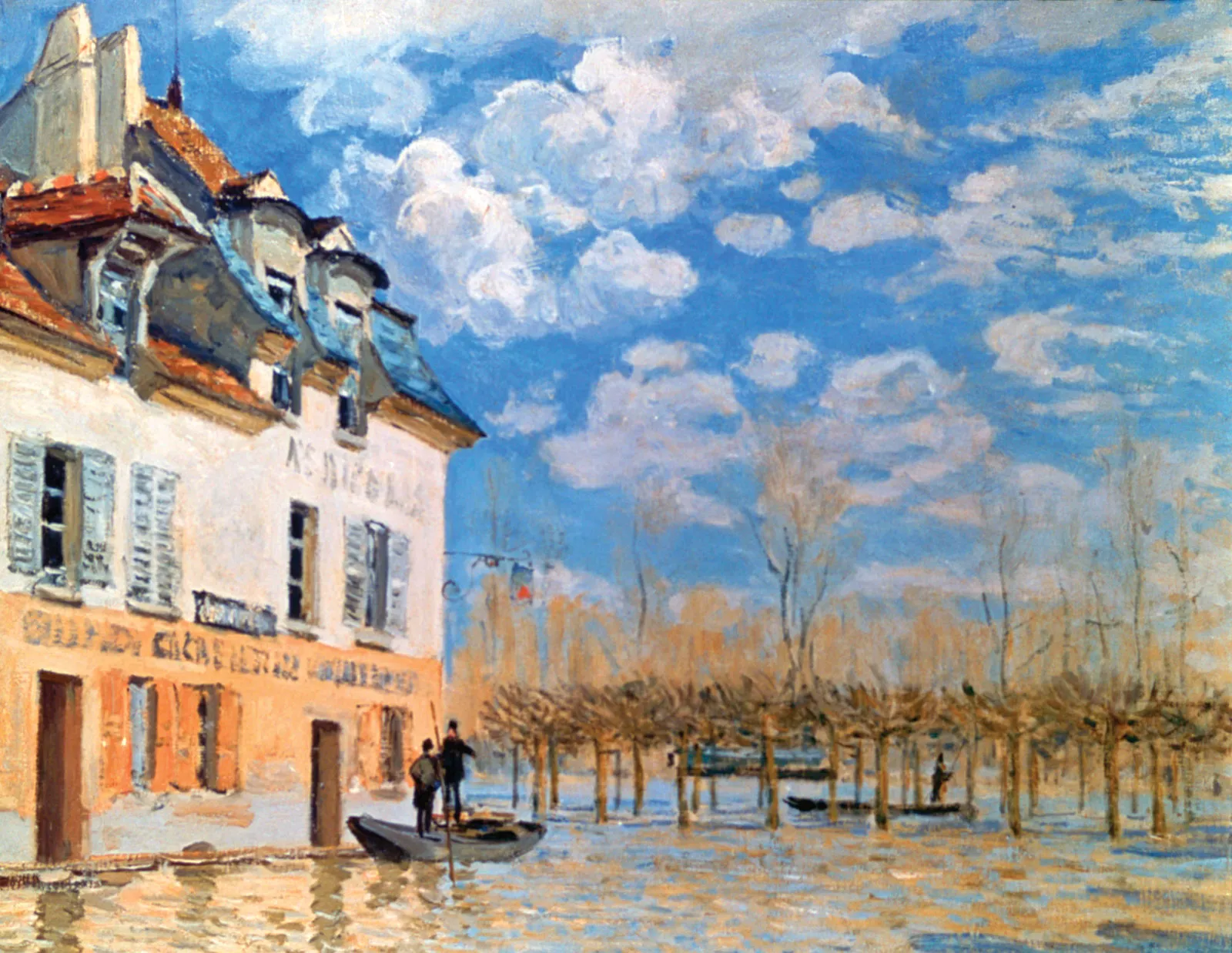
Alfred Sisley, born on October 30, 1839, in Paris, was a pivotal figure in the Impressionist movement, known for his distinct focus on landscape painting. Despite being British by nationality, Sisley’s life and career were deeply rooted in France, where he produced some of the most beautiful and influential works of the Impressionist era. Sisley’s journey was marked by artistic dedication, financial struggle, and an enduring legacy that continues to inspire the art world.
Early Life and Background
Alfred Sisley was born into a well-off English family that had moved to Paris. His father was a successful cotton and coffee merchant, ensuring that young Alfred grew up in a comfortable, affluent environment. This background played a crucial role in his early years, providing him with opportunities that would later influence his career in art.
Sisley’s initial foray into formal education was far from the art world. His father intended for him to join the family business, and thus, in 1857, Sisley was sent to London to study economics. However, the young Sisley found little passion in commerce and soon discovered his true calling: art. During his time in London, Sisley frequently visited museums and was particularly inspired by the works of English landscape painters such as William Turner, John Constable, and Richard Bonington.
This exposure to the English school of landscape painting was instrumental in shaping Sisley’s artistic vision. The vibrant skies, nuanced use of light, and delicate treatment of natural scenes he observed in these works would later become hallmarks of his own style. By 1861, Sisley had returned to Paris, determined to pursue a career in art, with the full support of his family, who recognized his burgeoning talent.
Artistic Development and the Birth of Impressionism
Upon returning to Paris, Sisley enrolled in the prestigious atelier of Charles Gleyre, a renowned Swiss artist. It was here that Sisley met fellow students Pierre-Auguste Renoir, Frédéric Bazille, and Claude Monet, all of whom would become central figures in the Impressionist movement. The camaraderie and mutual influence among these young artists were significant in the development of their individual styles and the birth of Impressionism as a revolutionary art movement.
The group often ventured outside the studio to paint en plein air, or “in the open air,” a practice that was unconventional at the time. They would explore the streets of Paris, the banks of the Seine, and the dense woods of the Forest of Fontainebleau, capturing the natural world in its immediate and fleeting beauty. This approach allowed them to experiment with light, color, and brushwork, breaking away from the rigid formalism of academic art.
Sisley’s early works from this period, though not immediately recognized as groundbreaking, laid the foundation for his mature style. His landscapes were characterized by their subtlety, focusing on the interplay of light and atmosphere rather than dramatic or grandiose subject matter. This quiet, almost contemplative quality set Sisley apart from some of his more flamboyant contemporaries and has led art historians to regard him as the most “English” of the French Impressionists.
Challenges and Persistence in Art
Despite his early promise, Sisley’s path was fraught with challenges, particularly financial difficulties. Unlike many of his peers, Sisley never enjoyed the same level of commercial success during his lifetime. His father’s business, which had initially provided financial support, encountered difficulties, and after Sisley married Eugénie Lescouezec, a florist and model, his father cut off his financial assistance. This turn of events forced Sisley to rely solely on his art for income.
The Franco-Prussian War of 1870 further exacerbated Sisley’s troubles. France’s defeat led to economic hardship, and the art market suffered as a result. Sisley’s friend Frédéric Bazille was killed in the war, a loss that deeply affected him and other members of the Impressionist circle. In the aftermath, Sisley moved to the small town of Argenteuil, where he lived in near-poverty.
It was during this period that Sisley met Paul Durand-Ruel, a pioneering art dealer who would play a crucial role in promoting the works of the Impressionists. Durand-Ruel recognized Sisley’s talent and began purchasing his paintings, giving the artist some financial relief. However, even with this support, Sisley’s work did not sell well, and he continued to struggle financially for much of his life.
The Height of Impressionism and Sisley’s Contribution
Despite these challenges, Sisley remained committed to his craft, contributing significantly to the development of Impressionism. In 1874, he participated in the first Impressionist exhibition, held at the studio of photographer Nadar. This exhibition marked a turning point in the art world, as the works displayed by Sisley, Monet, Renoir, and others were radically different from the academic standards of the time.
Sisley’s landscapes, such as “The Bridge at Villeneuve-la-Garenne” and “Flood at Port-Marly,” exemplified the key elements of Impressionism: loose brushwork, vibrant colors, and an emphasis on capturing the transient effects of light. His work was less concerned with the dramatic or the picturesque, instead offering a meditative view of nature, often depicting scenes of rivers, roads, and rural towns under changing skies.
While Sisley’s work was well received by some critics, it did not achieve the same level of fame as that of Monet or Renoir during his lifetime. Nevertheless, his contributions to the movement were invaluable. He remained a purist of Impressionism, never straying into other styles as some of his contemporaries did. This dedication to his artistic vision, even in the face of financial adversity, underscores Sisley’s importance as a central figure in the Impressionist movement.
Later Years and Legacy
In the later years of his life, Sisley’s financial situation improved somewhat thanks to continued support from Durand-Ruel, who organized exhibitions of his work in Paris and New York. However, his quest for French citizenship, which he applied for twice, was never successful, and he remained a British subject until his death.
Sisley spent his final years in the small town of Moret-sur-Loing, near Fontainebleau, where he painted some of his most serene and reflective works. These late paintings, such as “The Church at Moret,” are considered among his finest, capturing the tranquility of the French countryside with a delicate touch.
Alfred Sisley died on January 29, 1899, at the age of 59, largely unrecognized by the wider public. However, his reputation grew significantly in the years following his death, as the art world began to fully appreciate the subtleties and innovations of his work. Today, Sisley is celebrated as one of the great landscape painters of the 19th century, whose dedication to capturing the beauty of the natural world has left an enduring legacy.
Historical Context and Artistic Influence
Alfred Sisley’s work must be understood within the broader context of the 19th-century art world, which was undergoing significant changes. The rise of industrialization, urbanization, and changes in society influenced the Impressionists’ choice of subject matter and technique. Unlike many of his contemporaries who occasionally focused on urban scenes or human figures, Sisley remained almost exclusively a painter of landscapes. This focus reflects a deep-seated connection to nature, perhaps influenced by his early exposure to the English landscape tradition.
Furthermore, Sisley’s commitment to painting en plein air was not merely a technical choice but a philosophical one. He believed in capturing the immediacy of the natural world, something that studio work could never replicate. His paintings often evoke a sense of place and moment, as seen in works like “The Seine at Bougival” and “View of the Canal Saint-Martin.”
Sisley’s influence extends beyond his lifetime, as his works continue to inspire modern landscape painters. His subtle use of color and light, along with his ability to convey the mood and atmosphere of a scene, are aspects that many artists continue to study and emulate.
Conclusion
Alfred Sisley may not have achieved the same level of fame as some of his contemporaries during his lifetime, but his contributions to the Impressionist movement and landscape painting are undeniable. His dedication to his art, despite personal and financial challenges, is a testament to his passion and vision. Sisley’s works, with their gentle beauty and profound connection to nature, remain a vital part of the Impressionist legacy, offering viewers a glimpse into the serene and timeless world he so masterfully depicted.


