
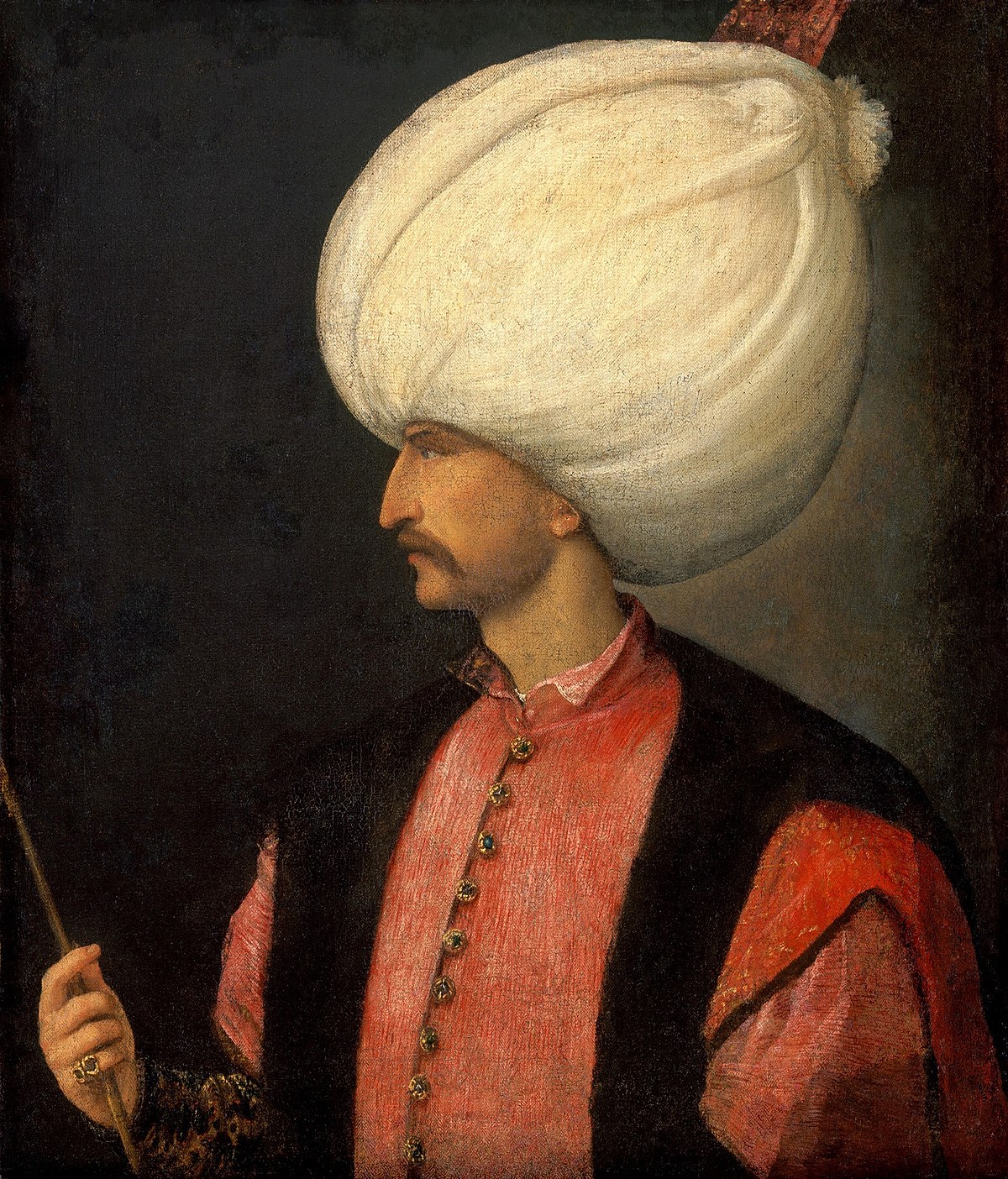
Solimano il Magnifico, known in Turkish as Süleyman I, was born on November 6, 1494, in Trabzon, a city on the Black Sea coast of modern-day Turkey. He was the longest-reigning Sultan of the Ottoman Empire, holding power from 1520 until his death in 1566. His rule marked the apex of the Ottoman Empire’s cultural, military, and political achievements. As a leader, Solimano was known for his military prowess, extensive legal reforms, and patronage of the arts, which led to an era of cultural and architectural flourishing in the Ottoman Empire. This period is often referred to as the Golden Age of the Ottoman Empire.
Early Life: From Prince to Sultan
Solimano was the son of Selim I, the “Grim” or “Resolute,” who was known for his military conquests and ruthless methods to secure power, including the forceful removal of his own father, Bayezid II. From a young age, Solimano was prepared for leadership, receiving a comprehensive education in the imperial palace in Istanbul. He studied science, history, literature, theology, and military tactics, and became fluent in several languages, including Arabic and Persian.
At age 7, Solimano was sent to Istanbul to further his education and began forming key relationships that would influence his future rule. One of his closest companions was Pargalı Ibrahim Pasha, who started as a slave and rose to become Grand Vizier, one of the most powerful positions in the empire. This relationship underscores the unique social mobility within the Ottoman system, where talent and loyalty could elevate an individual from slavery to the highest ranks of government.
Solimano’s early administrative roles were in various provinces of the empire, such as Bolu in Anatolia and Caffa in Crimea, where he gained valuable experience in governance and military leadership. By the time he ascended the throne in 1520, following his father’s death, Solimano was well-prepared to lead the empire into its most prosperous era.
Military Expansion: Conquests and Strategy
Solimano’s reign is characterized by significant military expansion, driven by his ambition to extend Ottoman influence across Europe, Asia, and Africa. His military campaigns were marked by strategic brilliance and logistical efficiency, supported by the formidable Janissaries, an elite infantry unit that was the backbone of the Ottoman military.
One of Solimano’s first major military achievements was the capture of Belgrade in 1521, a strategic fortress that opened the way for further advances into Central Europe. This victory was followed by the conquest of Rhodes in 1522, a stronghold of the Knights Hospitaller and a key strategic point in the Mediterranean.
Solimano’s military campaigns continued with the decisive Battle of Mohács in 1526, where his forces defeated the Kingdom of Hungary, leading to the partition of Hungarian territories between the Habsburgs and the Ottomans. This battle marked a significant expansion of Ottoman influence in Central Europe and demonstrated the military prowess of the empire under Solimano’s leadership.
Despite these successes, Solimano’s attempts to capture Vienna in 1529 and again in 1532 were unsuccessful, marking the limits of Ottoman expansion into Western Europe. Nevertheless, these campaigns established the Ottomans as a formidable power in Europe, compelling many European rulers to seek alliances with Solimano, including Francis I of France, who formed an alliance with the Ottoman Empire against the Habsburgs.
Legal Reforms and Governance: The Lawgiver
Beyond his military achievements, Solimano is also renowned for his contributions to the legal and administrative framework of the Ottoman Empire. Known as Kanuni, or “the Lawgiver,” Solimano undertook significant legal reforms that aimed to harmonize the empire’s diverse legal systems and improve governance.
Under Solimano, the Kanun, or secular legal code, was codified and expanded, complementing the existing Sharia law. These reforms helped streamline the administration of justice and governance across the empire’s vast territories, covering areas such as criminal law, land tenure, and taxation. Solimano’s legal reforms were instrumental in maintaining stability and order in a diverse and multicultural empire, where Christians, Jews, and Muslims coexisted under Ottoman rule.
His commitment to justice and good governance extended to the economic sphere as well. Solimano implemented policies to encourage trade and commerce, reduce corruption, and ensure that the state’s revenue systems were fair and efficient. These efforts helped strengthen the empire’s economic foundations and supported its military and cultural ambitions.
Cultural Patronage: A Renaissance of Arts and Architecture
Solimano’s reign is often considered the zenith of the Ottoman Empire’s cultural and architectural achievements. He was a great patron of the arts, supporting poets, scholars, and artists, and commissioning some of the most iconic structures in Istanbul and beyond.
One of the most famous architectural achievements of his reign is the Süleymaniye Mosque in Istanbul, designed by the renowned Ottoman architect Mimar Sinan. This mosque complex is a masterpiece of Ottoman architecture, combining elements of Islamic and Byzantine design to create a space that reflects the empire’s diverse cultural influences.
Under Solimano’s patronage, Istanbul became a vibrant cultural hub, attracting artists, musicians, and scholars from across the Islamic world and beyond. The cultural policies of Solimano’s reign facilitated a flourishing of the arts, which saw the production of significant works in literature, calligraphy, and miniature painting. This period also saw the compilation and preservation of important historical and religious texts, reflecting the empire’s intellectual and cultural dynamism.
Personal Life and Legacy: The Magnificent and the Human
Solimano’s personal life was marked by both political intrigue and deep personal connections. His marriage to Roxelana (Hürrem Sultan), a former concubine who became his legal wife, was unprecedented and marked a departure from Ottoman tradition. Roxelana wielded significant influence in court and was involved in state affairs, a role that later led to the term Sultanate of Women, describing the period when women of the imperial harem held significant political power.
Solimano’s close relationship with Ibrahim Pasha, his childhood friend and Grand Vizier, ended in tragedy. Ibrahim’s growing power and influence eventually led to his execution in 1536, ordered by Solimano, illustrating the precarious nature of power in the Ottoman court and Solimano’s ruthless dedication to maintaining authority.
Despite his achievements, Solimano’s later years were marked by personal loss and tragedy. He lost several of his children under suspicious circumstances, often attributed to the intense power struggles within the palace. His beloved son Şehzade Mustafa was executed on suspicion of conspiracy, a decision that deeply affected Solimano and is often cited as one of the most tragic events of his reign.
Solimano died on September 5-6, 1566, during a military campaign against the Habsburg Empire in Hungary. His death marked the end of an era, and he was buried beside Roxelana in the Süleymaniye Mosque complex in Istanbul. His death also marked the beginning of a slow decline for the Ottoman Empire, which, despite continuing to be a major power, never again reached the heights it achieved under his rule.
The Legacy of Solimano: A Lasting Influence
Solimano the Magnificent’s legacy is vast and complex. He is remembered not only for his military conquests and legal reforms but also for his role in fostering a cultural renaissance within the Ottoman Empire. His reign represents a period of unprecedented expansion and cultural flourishing, which left an indelible mark on the history of the Middle East, Europe, and beyond.
Under his rule, the Ottoman Empire became a major political, military, and cultural force in the world, and his policies laid the groundwork for the empire’s administration and governance for centuries to come. The architectural and cultural achievements of his reign continue to influence the arts and architecture of the Islamic world and serve as a testament to the empire’s former glory.
Solimano’s vision of a multicultural and multi-religious empire, where diverse communities could coexist under a single, just ruler, remains a powerful example of governance in a complex world. His efforts to integrate various cultures and religions into the fabric of the empire helped create a society that, at its best, was marked by tolerance, diversity, and a shared sense of purpose.
In conclusion, Solimano the Magnificent was a ruler who embodied the complexities and contradictions of his time. His life and reign are a testament to the possibilities and challenges of leadership in a diverse and dynamic world. As both a conqueror and a patron of the arts, a lawgiver and a strategist, Solimano’s legacy continues to inspire and challenge our understanding of what it means to be a ruler in a world of change.


