
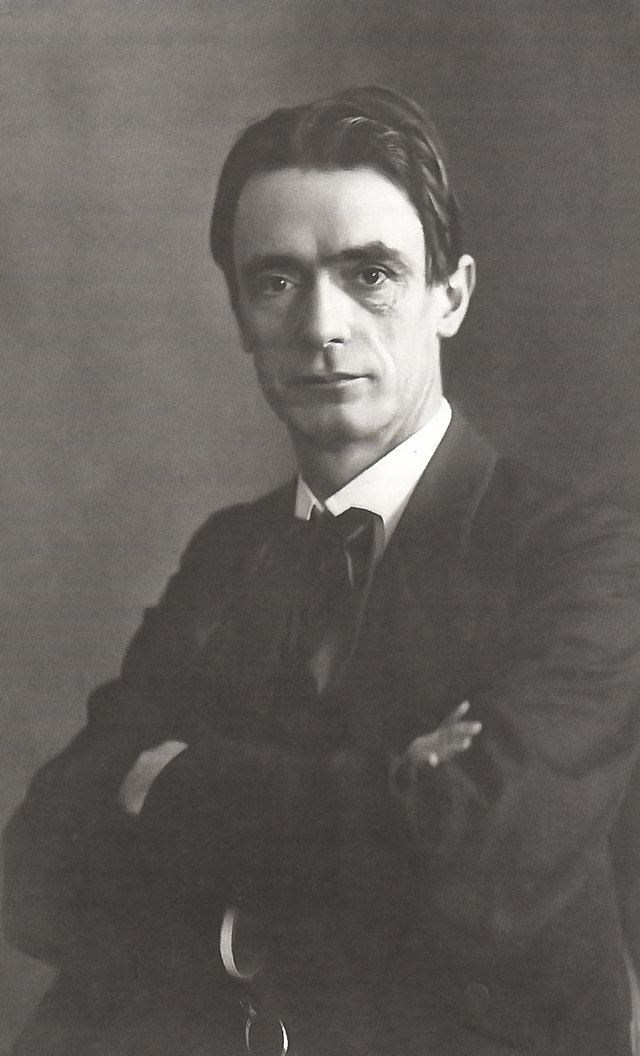
Rudolf Steiner, a name that resonates deeply within the realms of philosophy, education, and esoteric spirituality, was born on February 27, 1861, in Kraljevec, then part of the Austrian-Hungarian Empire (now in modern-day Croatia). His life, marked by profound insights and controversial ideas, has left an indelible mark on various fields, including education, agriculture, medicine, and architecture.
Early Life and Education
Steiner’s early years were deeply influenced by his unique ability to perceive both the material and spiritual worlds. This dual perception shaped his understanding of reality, leading him to explore the boundaries of human consciousness. At the age of seven, Steiner began to distinguish between the physical world and what he described as “beings and things that are seen” and “beings and things that are not seen.”
In 1879, Steiner began his formal education in mathematics and science at the University of Vienna. However, his intellectual curiosity extended far beyond these disciplines. He also pursued studies in literature, philosophy, and history, which laid the foundation for his later work. His fascination with the works of Johann Wolfgang von Goethe led him to Weimar in 1890, where he became a collaborator at the Goethe and Schiller Archives. This period was crucial in shaping Steiner’s philosophical outlook, particularly his interest in the interrelationship between science and spirituality.
Academic and Philosophical Contributions
Steiner earned his doctorate in philosophy in 1891 with a dissertation on epistemology, which was later published as his first book, Truth and Knowledge in 1892. In 1894, he published The Philosophy of Freedom, a work that remains central to understanding his thought. This book explores the concept of free will and the relationship between human consciousness and the external world. It presents a vision of human beings as free agents capable of spiritual and intellectual self-determination.
Steiner’s engagement with contemporary philosophical thought also led him to write extensively on the works of Friedrich Nietzsche and Arthur Schopenhauer. His 1895 publication, Friedrich Nietzsche, Fighter for Freedom, reflects his deep engagement with Nietzschean thought, positioning Nietzsche as a figure struggling against the limitations of his time. Steiner’s philosophical endeavors were not confined to academia; he was also a prolific public speaker, delivering over 6,000 lectures worldwide. These lectures, covering topics ranging from science and medicine to agriculture and the arts, have been compiled into a vast corpus of 354 volumes, reflecting the breadth and depth of his intellectual pursuits.
Theosophy and Anthroposophy
In the early 20th century, Steiner’s interests took a decidedly spiritual turn. He became involved with the Theosophical Society, a group dedicated to exploring mystical and esoteric knowledge. In 1904, he published Theosophy: An Introduction to the Supersensible Knowledge of the World and the Destination of Man, a text that delves into the spiritual dimensions of human existence. His work in this period influenced many contemporary artists, including Wassily Kandinsky, whose book Concerning the Spiritual in Art was significantly shaped by Steiner’s ideas.
Steiner’s relationship with the Theosophical Society eventually led to the founding of his own spiritual movement, Anthroposophy. This movement sought to bridge the gap between the spiritual and material worlds, offering a holistic approach to understanding the human condition. Anthroposophy became the foundation for many of Steiner’s later initiatives, including his work in education, agriculture, and medicine.
The Goetheanum and Architectural Innovation
One of Steiner’s most enduring legacies is the Goetheanum, a building he designed and constructed in Dornach, Switzerland. The Goetheanum, originally built in wood with a distinctive double-domed structure, served as the headquarters for the Anthroposophical Society. Unfortunately, the building was destroyed by fire on New Year’s Eve in 1922. Undeterred, Steiner began work on a new Goetheanum, this time constructed from reinforced concrete. The new Goetheanum, completed after Steiner’s death, remains a testament to his vision of architecture as a living, dynamic art form.
Steiner’s architectural ideas extended beyond the Goetheanum. He believed that architecture should reflect the spiritual realities of human existence. His concept of “living architecture” sought to create spaces that were not only functional but also spiritually nourishing. This approach influenced the design of numerous buildings associated with the Anthroposophical movement, many of which are characterized by their organic, flowing forms and innovative use of materials.
Educational and Social Reforms
Perhaps Steiner’s most widely recognized contribution is his work in education. In 1919, he founded the first Waldorf School in Stuttgart, Germany, at the request of Emil Molt, the owner of the Waldorf-Astoria cigarette factory. Steiner’s educational philosophy, known as Waldorf education, emphasizes the development of the whole child—intellectual, emotional, and spiritual. Waldorf schools focus on creativity, imagination, and the arts, seeking to cultivate a love of learning that lasts a lifetime.
Waldorf education has since become a global movement, with schools in countries around the world. The pedagogy is particularly noted for its emphasis on experiential learning, the integration of the arts into all aspects of the curriculum, and the importance of nurturing a child’s inner life. Steiner’s educational philosophy also includes a strong social component, emphasizing the importance of community, collaboration, and social responsibility.
Biodynamic Agriculture and Holistic Medicine
Steiner’s innovative ideas were not confined to the classroom. In the 1920s, he developed the principles of biodynamic agriculture, a holistic approach to farming that treats the farm as a living organism. Biodynamic agriculture emphasizes the use of organic materials, crop rotation, and the timing of planting and harvesting according to lunar and cosmic rhythms. This approach, which predates the modern organic movement, has gained a dedicated following among farmers and gardeners seeking to cultivate healthy, sustainable ecosystems.
In addition to his work in agriculture, Steiner also made significant contributions to the field of medicine. He collaborated with Dr. Ita Wegman to develop anthroposophical medicine, a holistic approach that integrates conventional medical practices with spiritual and alternative therapies. Anthroposophical medicine seeks to treat the whole person—body, mind, and spirit—rather than just the symptoms of disease. This approach is still practiced today, particularly in Europe, where it is integrated into the healthcare systems of several countries.
Artistic Contributions and Cultural Influence
Steiner’s influence extended into the arts, particularly in the development of eurythmy, an expressive movement art that seeks to make visible the sounds of speech and music. Eurythmy is often performed as part of Waldorf school curricula and has also been developed into a performance art in its own right. Steiner saw eurythmy as a way to bring harmony between the physical body and the spiritual world, expressing the deeper realities of existence through movement.
His artistic vision also extended to visual arts, where he encouraged the creation of works that reflected spiritual truths. Steiner’s approach to art was deeply informed by his understanding of color, form, and composition as vehicles for spiritual expression. This perspective influenced a generation of artists and architects who sought to create works that were not merely decorative but also spiritually meaningful.
Legacy and Enduring Influence
Rudolf Steiner passed away on March 30, 1925, in Dornach, Switzerland, but his legacy continues to inspire and challenge people around the world. The vast body of work he left behind—encompassing philosophy, education, agriculture, medicine, and the arts—remains a source of inspiration for those seeking to understand the deeper dimensions of human existence.
Steiner’s influence can be seen in the global Waldorf school movement, the spread of biodynamic farming, and the continued practice of anthroposophical medicine. His ideas have also found resonance in the fields of architecture, social reform, and spirituality, where his holistic vision of the human being as a spiritual and physical entity continues to inspire new generations.
As we reflect on the life and work of Rudolf Steiner, it is clear that his contributions extend far beyond the confines of any one discipline. He was a true polymath, whose vision of a spiritually informed approach to all aspects of life continues to shape the way we think about education, agriculture, medicine, and the arts. Steiner’s life was a testament to the power of ideas and the enduring impact of a vision that seeks to integrate the spiritual and material dimensions of existence.


