
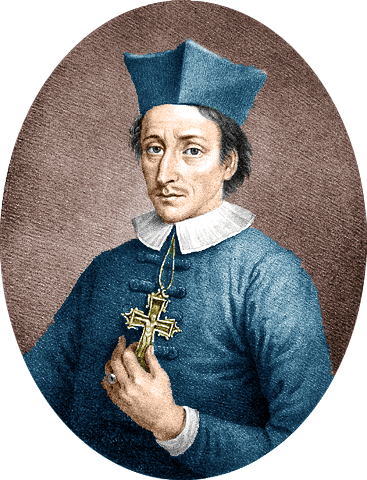
Nicolas Steno, born Niels Stensen on January 11, 1638, in Copenhagen, Denmark, was a pioneering figure in the fields of anatomy, geology, and mineralogy. His work laid the foundations for modern geology, and his life was marked by a remarkable journey from scientific discovery to deep religious devotion. Steno’s contributions to science and his eventual embrace of a devout Catholic faith make his story one of the most fascinating in the history of science. This article delves into the life of Nicolas Steno, exploring his early years, his scientific achievements, his religious conversion, and his lasting legacy.
Early Life and Education
Nicolas Steno was born into a well-respected Lutheran family in Copenhagen. His father was a goldsmith, and from an early age, Steno showed an exceptional aptitude for learning. He pursued his education in medicine under the tutelage of Thomas Bartholin, a prominent Danish physician and anatomist. This early exposure to the medical sciences set the stage for Steno’s future contributions to anatomy.
After completing his initial studies in Copenhagen, Steno moved to the Netherlands, where he continued his education in the bustling intellectual hubs of Amsterdam and Leiden. There, he studied under some of the most renowned anatomists of the time, including Franciscus Sylvius, a key figure in the development of modern medical science. It was during this period that Steno made his first significant scientific discovery.
The Discovery of Steno’s Duct
While in the Netherlands, Steno discovered the duct of the parotid gland, now known as “Steno’s duct.” This discovery was a significant milestone in the field of anatomy, as it provided a deeper understanding of the human body’s salivary glands. Steno’s meticulous approach to dissection and his ability to observe and describe the body’s internal structures set him apart from his contemporaries.
Steno’s work in anatomy was characterized by his insistence on empirical observation and his willingness to challenge established ideas. This approach would later serve him well as he ventured into the emerging field of geology, where his observations would lead to groundbreaking insights.
Move to Paris and Influence of the Medici Court
In 1664, Steno earned his medical degree and soon after moved to Paris, where he became a guest of Melchisédech Thévenot, a well-known patron of the sciences. In Paris, Steno was exposed to a vibrant intellectual environment that included some of the leading scientific minds of the time. However, it was his move to Florence in 1666 that would prove to be the most significant period of his life.
In Florence, Steno joined the court of the Grand Duke of Tuscany, Ferdinando II de’ Medici. The Medici court was a center of scientific inquiry, attracting scholars and scientists from across Europe. Among Steno’s close associates were Vincenzo Viviani, a disciple of Galileo Galilei, and Francesco Redi, a pioneering biologist. These relationships provided Steno with the intellectual stimulation and support necessary to pursue his research in both anatomy and geology.
Contributions to Geology: The Birth of Stratigraphy
While Steno’s early work focused on anatomy, his interests soon expanded to include geology and mineralogy. In Tuscany, he began to study the region’s rich geological formations, which led him to question the prevailing theories of the time regarding the Earth’s history and the formation of rocks.
In 1669, Steno published his most famous work, De solido intra solidum naturaliter contento dissertationis prodromus (Preliminary Discourse to a Dissertation on a Solid Body Naturally Contained within a Solid). This work laid the foundation for the science of stratigraphy, the study of rock layers (strata) and layering (stratification). Steno proposed that layers of rock are laid down over time, with the oldest layers at the bottom and the youngest at the top, a principle known as the “law of superposition.”
Steno’s observations also led him to propose that fossils found in rocks were the remains of once-living organisms, challenging the then-dominant belief that fossils were mere “freaks of nature.” His work provided a framework for understanding the Earth’s history and set the stage for later developments in geology and paleontology.
Religious Conversion and Ordination
Steno’s time in Florence was not only a period of scientific discovery but also of profound personal transformation. Raised as a Lutheran, Steno experienced a religious conversion while in Italy, deeply influenced by the Catholic culture and the religious practices he observed. A pivotal moment came in June 1667, during a Corpus Domini procession in Livorno, which moved Steno deeply and led him to convert to Catholicism.
Following his conversion, Steno’s life took a new direction. In 1675, he was ordained as a Catholic priest, and two years later, in 1677, he was consecrated as a bishop. Pope Innocent XI appointed Steno as the apostolic vicar for the Nordic missions, a position that required him to return to his native Denmark and other parts of Scandinavia to minister to the Catholic faithful in predominantly Protestant regions.
Later Years and Religious Devotion
Steno’s later years were marked by his commitment to his religious duties. In 1680, he moved to Hamburg and later to Schwerin, where he continued his pastoral work. Despite his scientific achievements, Steno chose to live a life of humility and simplicity, renouncing his episcopal dignity in 1685 to live as a simple priest. He dedicated himself to serving the poor and the sick, embodying the Christian virtues of charity and selflessness.
Nicolas Steno passed away on December 6, 1686, at the age of 48. His death marked the end of a life that had been devoted to both scientific inquiry and religious faith. In recognition of his piety and his contributions to the Church, Steno was beatified by Pope John Paul II on October 23, 1988, becoming the only scientist to be honored in this way by the Catholic Church.
Legacy and Impact on Science and Faith
Nicolas Steno’s legacy is multifaceted, encompassing his contributions to science, his religious devotion, and his influence on later generations of scientists and theologians. As one of the founders of modern geology, Steno’s work in stratigraphy and his recognition of the true nature of fossils laid the groundwork for the development of the Earth sciences. His principles of stratigraphy are still taught in geology courses today, and his insights into the formation of rocks and fossils remain foundational to the field.
Steno’s life also serves as an example of the harmonious relationship between science and faith. At a time when the relationship between science and religion was often contentious, Steno managed to navigate both worlds with grace and integrity. His deep religious faith did not hinder his scientific work; rather, it provided him with a sense of purpose and a desire to explore the natural world as a reflection of divine creation.
Steno’s beatification is a testament to his lasting impact on both the Church and the scientific community. His life demonstrates that the pursuit of scientific knowledge and religious faith are not mutually exclusive but can complement and enrich one another.
The Relevance of Steno’s Work Today
In today’s world, where the relationship between science and religion is still a topic of debate, Nicolas Steno’s life offers a powerful example of how these two realms can coexist. His work in geology continues to influence modern science, particularly in the study of Earth’s history and the processes that shape our planet.
Steno’s recognition of the importance of empirical observation and his commitment to understanding the natural world through scientific inquiry are values that remain essential in contemporary science. His ability to integrate these scientific principles with his religious beliefs provides a model for those who seek to reconcile faith with reason.
Furthermore, Steno’s humility and dedication to serving others, especially in his later years, highlight the importance of using one’s talents and knowledge for the greater good. His life encourages scientists, theologians, and laypeople alike to approach their work with a sense of responsibility and a desire to contribute positively to society.
Conclusion
Nicolas Steno’s life is a remarkable testament to the power of curiosity, observation, and faith. From his early discoveries in anatomy to his groundbreaking work in geology, Steno made significant contributions to the scientific world that continue to resonate today. His religious conversion and subsequent devotion to the Catholic Church add a unique dimension to his legacy, illustrating the profound impact that faith can have on one’s life and work.
As we reflect on Steno’s life, it is clear that he was not only a brilliant scientist but also a deeply spiritual individual who sought to understand the world through both the lens of science and the teachings of his faith. His story is a reminder that the pursuit of knowledge and the search for meaning are interconnected journeys that can lead to profound discoveries and a deeper understanding of the world around us.
Nicolas Steno’s legacy lives on in the fields of geology, anatomy, and the philosophy of science, as well as in the hearts of those who continue to be inspired by his life of service, humility, and intellectual curiosity. He remains a shining example of how one can leave a lasting impact on the world through a commitment to both scientific inquiry and spiritual devotion.


