
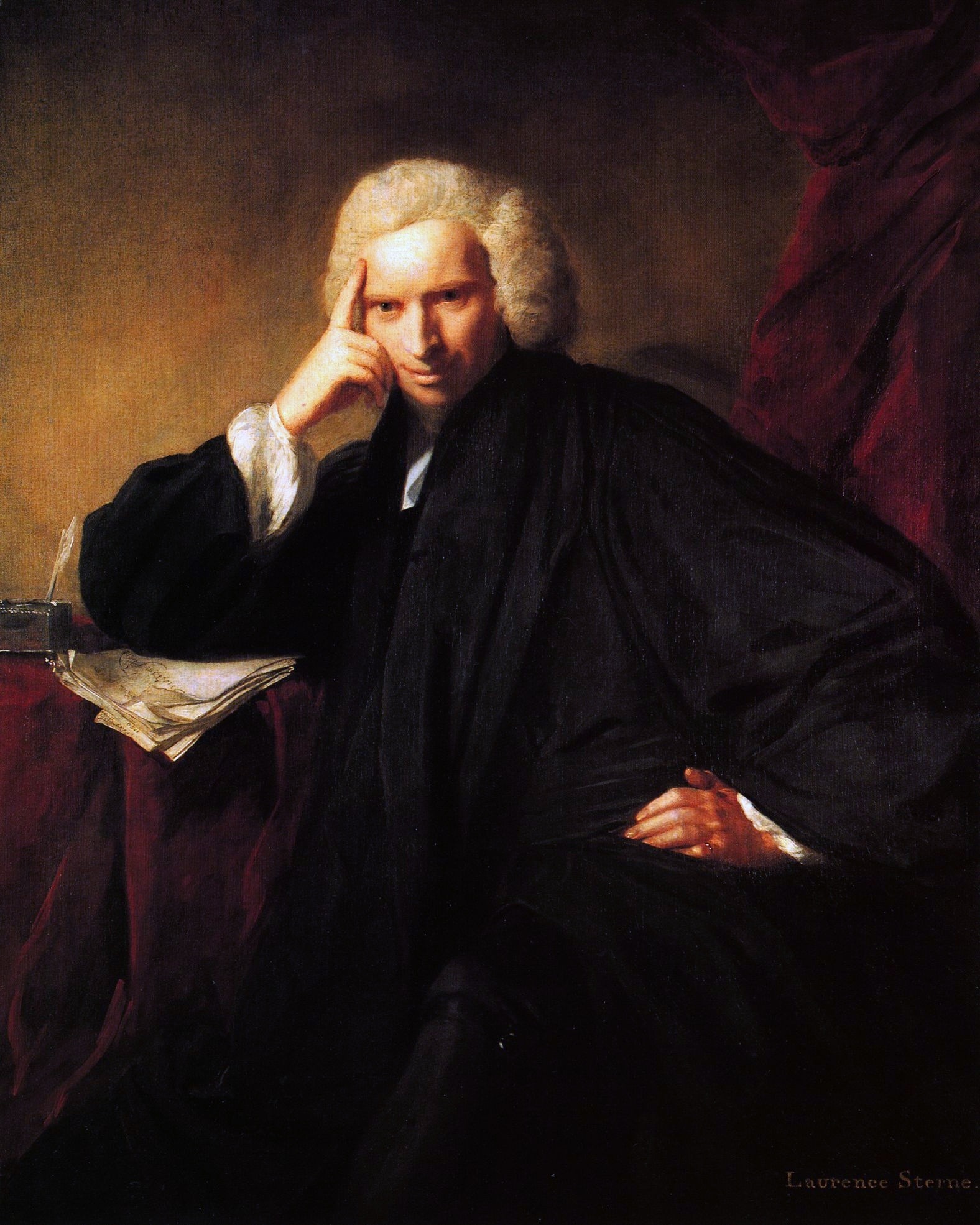
Laurence Sterne, an iconic figure in 18th-century English literature, was born on November 24, 1713, in Clonmel, Ireland. His journey from an Anglican clergyman to one of the most innovative and influential novelists of his time is a story of creativity, struggle, and the relentless pursuit of literary excellence. Best known for his novel “The Life and Opinions of Tristram Shandy, Gentleman,” Sterne’s work remains a cornerstone of literary history, blending humor, sentiment, and narrative experimentation in ways that continue to influence writers today.
Early Life and Education
Laurence Sterne’s early years were marked by the itinerant life of his family, as his father was an army officer whose career took the family across England and Ireland. Despite the instability, Sterne managed to receive a solid education. He attended school in Halifax, Yorkshire, where he developed a passion for literature. His formative years were crucial in shaping his literary sensibilities, with influences ranging from classical authors to the contemporary humorists of his time.
In 1733, Sterne enrolled at Jesus College, Cambridge, where he immersed himself in the study of theology and philosophy. It was during his time at Cambridge that Sterne became acquainted with the works of François Rabelais, John Locke, and other great thinkers, whose ideas would later permeate his writings. Despite his love for literature, Sterne’s career path was initially guided by his family’s expectations, leading him to join the Anglican clergy after graduating from Cambridge in 1737.
Clerical Career and Early Writings
Sterne’s clerical career began in 1738 when he was appointed vicar of Sutton-in-the-Forest, a small parish in Yorkshire. His role as a clergyman, however, did not bring him much satisfaction. Sterne found the ecclesiastical life dull and unfulfilling, often diverting his energies into other pursuits, such as writing satirical articles and letters. These early writings, many of which were published anonymously, showcased his sharp wit and growing disillusionment with the church.
Despite his ambivalence towards his clerical duties, Sterne remained in the church, eventually becoming a prebendary of York Minster. His position within the church provided him with financial stability, allowing him the freedom to explore his literary interests. During this period, Sterne married Elizabeth Lumley, a union that would prove to be unhappy and fraught with difficulties, further fueling his desire to find solace in his writing.
The Birth of Tristram Shandy
Sterne’s literary breakthrough came relatively late in life. In 1759, at the age of 46, he published his first significant work, “A Political Romance,” a satirical pamphlet that lampooned the politics of the church. The pamphlet demonstrated Sterne’s mastery of satire and his ability to blend humor with biting social commentary. However, it was his next work that would secure his place in literary history.
“The Life and Opinions of Tristram Shandy, Gentleman,” Sterne’s magnum opus, was published in nine volumes between 1759 and 1767. The novel is a masterpiece of digressive storytelling, where the narrator, Tristram Shandy, frequently interrupts his own story to explore tangents and asides. This innovative narrative style was groundbreaking, defying the conventions of the novel and challenging readers to rethink the nature of storytelling.
Sterne’s use of humor, combined with his deep understanding of human nature, allowed him to create a novel that was both entertaining and intellectually stimulating. The characters in Tristram Shandy—from the naive Uncle Toby to the pedantic Walter Shandy—are richly drawn and memorable, reflecting Sterne’s keen observations of the people around him. The novel’s success was immediate, catapulting Sterne to fame and establishing him as one of the most original voices in English literature.
Reception and Impact
The reception of Tristram Shandy was mixed; while it was celebrated by many for its originality and wit, it also faced criticism for its perceived lack of coherence and moral ambiguity. In England, the novel was met with both acclaim and scorn. Some critics admired Sterne’s inventive style, while others were bewildered by the novel’s unconventional structure. Despite the controversy, Tristram Shandy was a commercial success, and Sterne quickly became a literary celebrity.
The novel’s impact extended far beyond England’s borders. It was particularly well-received in France, where it influenced the development of the French Enlightenment novel. The novel’s exploration of themes such as the subjective nature of reality, the absurdity of human existence, and the limitations of language resonated with contemporary philosophical debates. Sterne’s work was also admired by later writers, including Goethe and Schopenhauer, who recognized its significance in the evolution of modern literature.
Later Life and Literary Legacy
Following the success of Tristram Shandy, Sterne continued to write, but his health, which had always been fragile, began to deteriorate. Suffering from tuberculosis, he traveled to France in 1762 in search of a milder climate that might improve his condition. During his time in France, Sterne observed the cultural and social life around him, experiences that would later inform his final work, “A Sentimental Journey Through France and Italy,” published in 1768.
“A Sentimental Journey” marked a departure from the satirical tone of Tristram Shandy, focusing instead on the themes of sentiment and empathy. The novel is a semi-autobiographical account of Sterne’s travels, narrated by the character Yorick—a thinly veiled representation of Sterne himself. In contrast to the chaotic structure of Tristram Shandy, A Sentimental Journey is more straightforward in its narrative, yet it retains Sterne’s characteristic wit and keen insight into human nature.
The novel explores the isolation and alienation that Sterne felt during his travels, as well as the difficulties of communication between individuals. Sterne used the metaphor of the “hobby horse”—a recurring motif in his work—to illustrate the personal obsessions that drive human behavior. The novel’s emphasis on the emotional and subjective aspects of experience foreshadowed the Romantic movement and cemented Sterne’s reputation as a pioneer of literary modernism.
Despite his literary success, Sterne’s personal life remained tumultuous. His marriage to Elizabeth Lumley continued to be unhappy, and he became romantically involved with Eliza Draper, a married woman he met during his travels. This affair inspired “The Journal to Eliza,” a collection of letters and reflections written shortly before his death. The work, published posthumously in 1775, reveals a more introspective and melancholic side of Sterne, offering insight into his thoughts and emotions during his final years.
Sterne’s Enduring Influence
Laurence Sterne’s influence on literature is profound and far-reaching. His innovative narrative techniques, particularly his use of digression and his exploration of the interior lives of his characters, have inspired countless writers. Sterne’s work can be seen as a precursor to the modernist movement, with its emphasis on subjectivity, fragmented narrative structures, and the questioning of traditional literary conventions.
In addition to his impact on narrative form, Sterne’s blending of humor and sentiment has influenced the development of the novel as a genre. His ability to shift between tones—moving from comedy to pathos, from satire to sincere reflection—set a precedent for later novelists who sought to capture the complexity of human experience. Sterne’s work also paved the way for the development of the stream-of-consciousness technique, which would be famously employed by writers such as James Joyce and Virginia Woolf.
Moreover, Sterne’s exploration of the theme of communication—or the lack thereof—remains relevant in contemporary discussions of literature and human interaction. His portrayal of the difficulties individuals face in expressing their thoughts and feelings to others speaks to a universal human experience, one that continues to resonate with readers today.
Final Thoughts
Laurence Sterne’s contributions to literature cannot be overstated. His work not only entertained but also challenged readers to think differently about storytelling, character development, and the purpose of literature itself. His novels, particularly Tristram Shandy and A Sentimental Journey, remain essential reading for anyone interested in the evolution of the novel and the history of English literature.
Sterne’s legacy is one of innovation, wit, and a deep understanding of the human condition. His works have stood the test of time, continuing to inspire and provoke thought more than two centuries after his death. Laurence Sterne may have lived a life marked by personal struggles and health challenges, but his literary achievements have ensured that he remains one of the most important figures in the history of the novel.
As we reflect on Sterne’s life and work, it is clear that his contributions to literature extend beyond the boundaries of his time. His exploration of the complexities of human nature, his innovative narrative techniques, and his ability to blend humor with deep philosophical insights make him a writer whose influence will continue to be felt for generations to come.


