
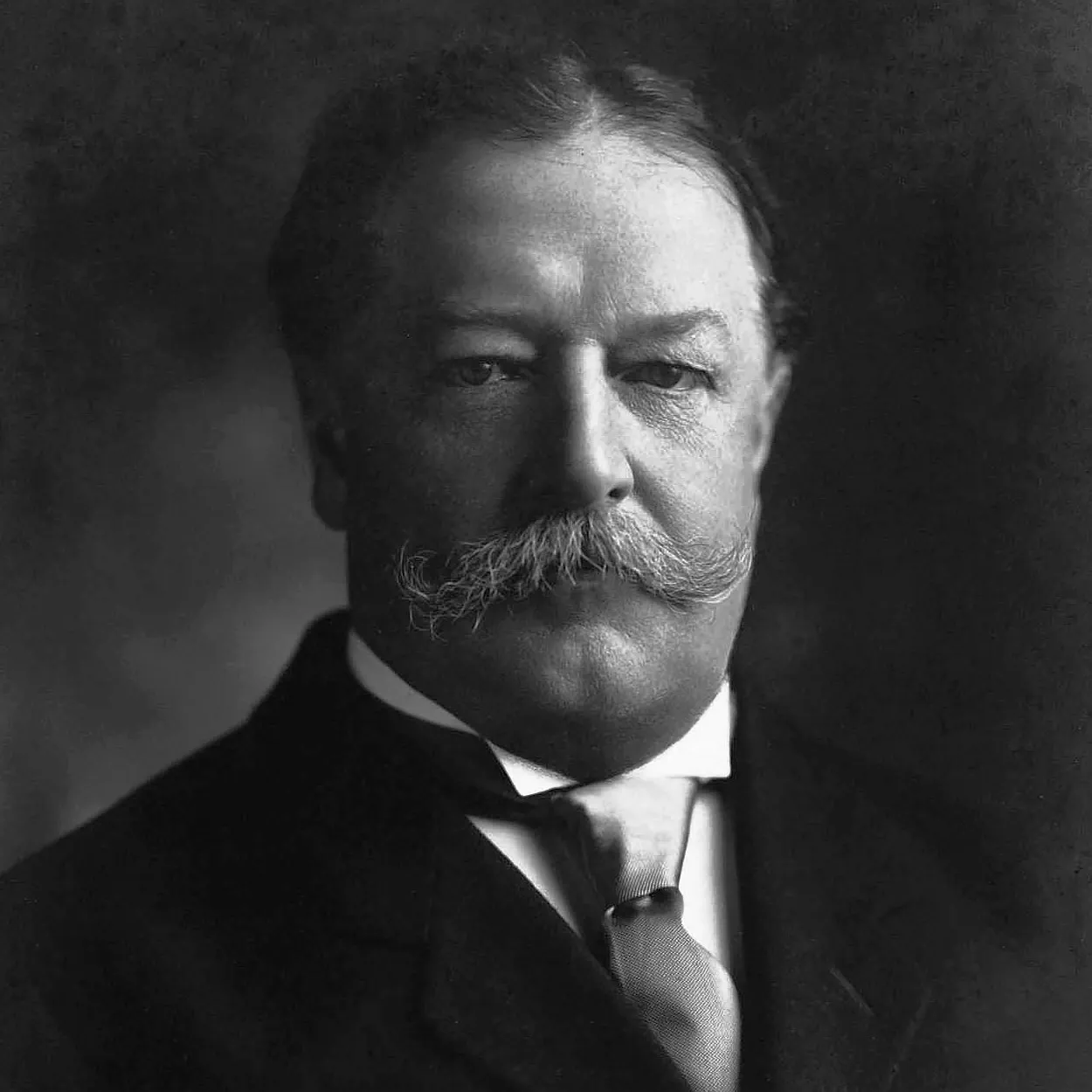
William Howard Taft, born on September 15, 1857, in Cincinnati, Ohio, stands as a pivotal figure in American history, known not only for his role as the 27th President of the United States but also for his unique distinction as the only person to serve as both President and Chief Justice of the United States. Taft’s career is marked by his dedication to the law, his influence on U.S. foreign and domestic policies, and his complex relationship with his predecessor, Theodore Roosevelt.
Early Life and Education
William Howard Taft was born into a politically and socially prominent family. His father, Alphonso Taft, was a distinguished lawyer who served as U.S. Attorney General and Secretary of War under President Ulysses S. Grant. The elder Taft also held diplomatic posts in Russia and Austria-Hungary, which exposed young William to the world of politics and governance from an early age.
Taft’s education was rigorous. He attended the Woodward High School in Cincinnati, where he excelled academically, and later enrolled at Yale University. At Yale, Taft was a member of the prestigious Skull and Bones society, a secret society known for its influential members. He graduated second in his class in 1878, demonstrating an early aptitude for law and governance.
After Yale, Taft returned to Cincinnati to study law at the Cincinnati Law School (now the University of Cincinnati College of Law). He was admitted to the bar in 1880 and quickly began a legal career that would set the stage for his future in public service.
Early Legal and Judicial Career
Taft’s early career was characterized by a series of rapid advancements within the legal and judicial systems. After a brief stint in private practice, he was appointed Assistant Prosecutor of Hamilton County, Ohio, in 1881. His skill and reputation grew, leading to his appointment as a judge of the Superior Court of Cincinnati in 1887, making him one of the youngest judges in the country at the time.
Taft’s judicial career continued to ascend when President Benjamin Harrison appointed him as Solicitor General of the United States in 1890. As Solicitor General, Taft argued cases before the Supreme Court, gaining valuable experience and earning respect for his legal acumen. Just two years later, in 1892, he was appointed a judge on the United States Court of Appeals for the Sixth Circuit, a position that further solidified his reputation as a fair and thoughtful jurist.
Governor of the Philippines and Cuba
Taft’s career took a significant turn towards international governance when President William McKinley appointed him as the first civilian Governor-General of the Philippines in 1901, following the Spanish-American War. The Philippines, recently acquired by the United States, was in a state of unrest, and Taft’s mission was to establish a stable and effective government.
During his tenure as Governor-General, Taft implemented a range of reforms aimed at modernizing the Philippines. He focused on improving infrastructure, education, and public health, and worked to foster better relations between the United States and the Filipino people. One of his notable achievements was negotiating with the Catholic Church to purchase large tracts of land owned by religious orders, which were then redistributed to Filipino farmers, helping to alleviate tensions over land ownership.
In 1904, Taft briefly served as the provisional Governor of Cuba, where he managed to stabilize the island during a period of political turmoil. His successful administration in the Philippines and Cuba showcased his diplomatic skills and ability to govern in complex international contexts, furthering his reputation as a capable and fair-minded leader.
Secretary of War and the Panama Canal
Taft’s success in the Philippines caught the attention of President Theodore Roosevelt, who appointed him as Secretary of War in 1904. In this role, Taft was not only responsible for overseeing the U.S. military but also played a crucial part in several key diplomatic and infrastructure initiatives.
One of Taft’s most significant achievements as Secretary of War was his involvement in the construction of the Panama Canal. The canal, a monumental engineering project, was vital to U.S. strategic interests as it provided a shortcut between the Atlantic and Pacific Oceans. Taft’s administrative oversight and his negotiations with various stakeholders ensured that the project progressed smoothly, solidifying his status as a leader capable of handling large-scale national projects.
Presidency (1909-1913)
William Howard Taft’s presidency began in 1909, after he won the 1908 election against Democratic candidate William Jennings Bryan. Taft had been handpicked by Theodore Roosevelt as his successor, largely because Roosevelt believed Taft would continue his progressive policies. However, Taft’s presidency would eventually strain his relationship with Roosevelt and highlight the complexities of his political philosophy.
Domestic Policies
Taft’s approach to domestic policy was more conservative than Roosevelt’s, emphasizing the importance of legal processes and the Constitution. One of his key achievements was the establishment of the U.S. Postal Savings System, which provided a safe place for people to deposit their money, particularly those who distrusted private banks. He also signed into law the Mann-Elkins Act of 1910, which expanded the powers of the Interstate Commerce Commission to regulate telecommunications and railroads, continuing efforts to curb the power of monopolies.
Taft’s administration was marked by his commitment to antitrust actions, continuing Roosevelt’s legacy but taking it further by filing more antitrust lawsuits than his predecessor. His administration’s efforts led to the breakup of major monopolies, including Standard Oil and American Tobacco, which were both deemed to be in violation of the Sherman Antitrust Act.
However, Taft’s approach to tariffs led to significant controversy. The Payne-Aldrich Tariff Act of 1909, which he signed into law, was intended to reduce tariffs but instead resulted in only modest reductions and some increases. This decision alienated many progressives who felt that Taft had betrayed the reformist agenda, leading to a rift within the Republican Party.
Foreign Policies
In foreign affairs, Taft is best known for his “Dollar Diplomacy,” a policy aimed at expanding American influence abroad through economic investment rather than military intervention. This policy was particularly evident in Latin America, where Taft encouraged U.S. businesses to invest in infrastructure projects, believing that economic stability would lead to political stability.
While “Dollar Diplomacy” was intended to promote U.S. interests and prevent European powers from intervening in the Western Hemisphere, it was often criticized for supporting unpopular regimes and for placing U.S. economic interests above democratic ideals. The policy’s mixed results contributed to the growing dissatisfaction with Taft’s presidency, both domestically and abroad.
The 1912 Election and Aftermath
The 1912 presidential election was one of the most contentious in American history, primarily because of the split between Taft and Roosevelt. Roosevelt, dissatisfied with Taft’s performance, particularly on progressive issues, decided to run for president again under the newly formed Progressive Party, also known as the “Bull Moose Party.”
The split in the Republican vote allowed the Democratic candidate, Woodrow Wilson, to win the election with a significant majority in the Electoral College. Taft’s third-place finish was a significant blow, and the election marked the end of his political career at the national level.
Chief Justice of the United States
After his presidency, Taft returned to his first love: the law. In 1921, President Warren G. Harding appointed him as Chief Justice of the United States, fulfilling a lifelong ambition for Taft. He remains the only person to have served as both President and Chief Justice, a testament to his profound impact on both the executive and judicial branches of government.
As Chief Justice, Taft was known for his efforts to improve the efficiency of the Supreme Court. He advocated for and achieved the passage of the Judiciary Act of 1925, which gave the Supreme Court greater control over its docket by allowing it to select the cases it wished to hear. This reform significantly reduced the Court’s workload and allowed it to focus on cases of national importance.
Taft’s tenure as Chief Justice was marked by his commitment to the principle of judicial restraint. He believed that the courts should not engage in policymaking but should instead interpret the law as written. His decisions often reflected a conservative approach to the Constitution, emphasizing the separation of powers and the limits of federal authority.
Personal Life and Legacy
William Howard Taft’s personal life was as distinguished as his public career. He married Helen Herron, known as Nellie, in 1886. Nellie was a woman of considerable intellect and ambition, and she played a significant role in Taft’s career, encouraging his pursuit of the presidency even when he was initially reluctant. The couple had three children: Robert, Helen, and Charles. Robert Taft would go on to become a prominent U.S. Senator, continuing the family’s legacy of public service.
One of the most enduring aspects of Taft’s legacy is his contribution to the American legal system. His role as Chief Justice, particularly his efforts to reform the judiciary, had a lasting impact on the Supreme Court and its operations. Taft’s belief in the importance of the rule of law and his commitment to judicial integrity are still recognized as defining aspects of his career.
Taft is also remembered for his unique personal challenges. At over 300 pounds, he was the heaviest president in U.S. history. His weight caused health issues, including sleep apnea, which sometimes led him to fall asleep in public, even during important meetings. Despite these challenges, Taft remained active and enjoyed sports, particularly golf, which he helped popularize in the United States.
Conclusion
William Howard Taft’s life and career offer a unique perspective on the intersections of law, politics, and governance. His journey from a young lawyer in Ohio to the highest offices in the United States exemplifies a commitment to public service and a belief in the importance of legal and constitutional principles.
Taft’s presidency, though often overshadowed by his predecessor Roosevelt, was marked by significant achievements in antitrust law and government regulation, as well as controversial decisions in foreign policy. His tenure as Chief Justice further cemented his legacy as a pivotal figure in American jurisprudence.
Today, Taft is remembered not only as a president but as a jurist who left an indelible mark on the Supreme Court and the American legal system. His life’s work reflects a deep dedication to the principles of justice and governance, making him a figure of enduring importance in U.S. history.


