
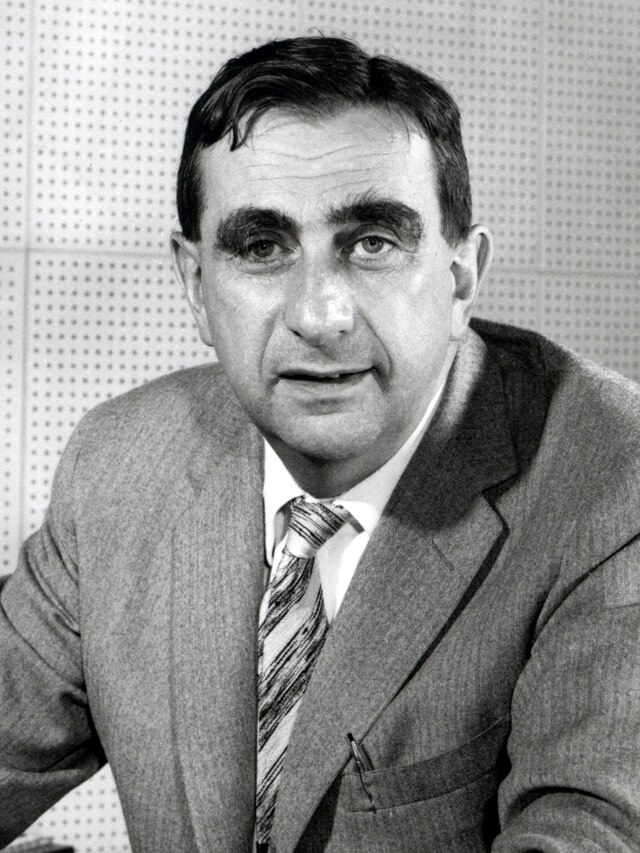
Edward Teller, born on January 15, 1908, in Budapest, Hungary, is a name indelibly linked with the development of nuclear weapons, particularly the hydrogen bomb. Often referred to as the “father of the hydrogen bomb,” Teller’s life and career are characterized by significant scientific achievements, controversies, and profound impacts on global military policies. This article delves into the life of Edward Teller, exploring his age, rise to fame, and the critical highlights that shaped his legacy in both science and international relations.
Early Life and Education: Foundations of a Scientific Mind
Edward Teller was born into a well-educated Jewish family in Budapest, Hungary. His father, Max Teller, was an attorney, and his mother, Ilona, was a pianist. This intellectually stimulating environment fostered Teller’s early interest in mathematics and science. However, his early life was marked by the turmoil of World War I and the political instability that followed in Hungary, experiences that likely influenced his later views on security and defense.
Teller’s academic journey began in Budapest, but he soon moved to Germany to pursue higher education. He studied at the University of Karlsruhe before transferring to the University of Leipzig, where he completed his Ph.D. in physics under the supervision of Werner Heisenberg in 1930. During his time in Germany, Teller was deeply influenced by the burgeoning field of quantum mechanics, a discipline that would lay the groundwork for his future contributions to nuclear physics.
Emigration to the United States: Escaping the Shadows of War
The rise of Adolf Hitler and the Nazi regime in Germany prompted Teller, like many Jewish intellectuals, to emigrate to the United States in the 1930s. In 1935, he joined the faculty at George Washington University, where he began working closely with other prominent physicists, including George Gamow. During this period, Teller’s work focused on molecular physics and spectroscopy, but the looming threat of World War II soon shifted his attention to nuclear research.
As the war intensified, Teller became increasingly involved in the effort to develop nuclear weapons. His expertise in nuclear physics and his growing reputation as a brilliant scientist led to his recruitment to the Manhattan Project, the U.S. government’s secret program to develop the atomic bomb.
The Manhattan Project: The Birth of the Atomic Age
Edward Teller played a crucial role in the Manhattan Project, which culminated in the development of the first atomic bombs during World War II. Stationed at the Los Alamos Laboratory in New Mexico, Teller was part of a team of elite scientists working under the direction of J. Robert Oppenheimer. While much of the focus at Los Alamos was on creating a fission bomb, Teller was already envisioning a more powerful weapon based on nuclear fusion—the hydrogen bomb.
Teller’s insistence on pursuing the hydrogen bomb project created friction within the Manhattan Project team. Oppenheimer and others were more concerned with the immediate task of developing the atomic bomb and were reluctant to divert resources to the hydrogen bomb, which at that time was considered a theoretical and impractical concept. Nonetheless, Teller’s ideas planted the seeds for future developments in nuclear weapons technology.
Post-War Years and the Hydrogen Bomb: A Controversial Legacy
After World War II, Teller continued to advocate for the development of the hydrogen bomb. His persistence paid off in the early 1950s when the U.S. government, driven by fears of Soviet advancements in nuclear technology, greenlit the project. The first successful test of a hydrogen bomb, known as “Ivy Mike,” took place on November 1, 1952, at Enewetak Atoll in the Pacific Ocean. The explosion obliterated the island of Elugelab, demonstrating the terrifying power of the new weapon.
Teller’s role in the hydrogen bomb’s development cemented his reputation as a leading figure in nuclear physics, but it also sparked intense controversy. Many of his contemporaries, including Oppenheimer, questioned the morality of developing such a massively destructive weapon. The ethical debate surrounding nuclear weapons was further complicated by Teller’s involvement in the 1954 hearings that led to the revocation of Oppenheimer’s security clearance, a move that many viewed as a betrayal of his former colleague.
Teller’s Later Career: Advocacy and Awards
Despite the controversies, Edward Teller remained a prominent figure in the scientific community and a staunch advocate for nuclear weapons development. In 1952, he was appointed the founding director of the Lawrence Livermore National Laboratory, a facility dedicated to nuclear research and weapons development. Under Teller’s leadership, the lab became a central player in advancing U.S. nuclear capabilities during the Cold War.
Teller’s advocacy for a strong national defense extended beyond his work on nuclear weapons. In the 1980s, he became a vocal proponent of the Strategic Defense Initiative (SDI), popularly known as “Star Wars,” a proposed missile defense system championed by President Ronald Reagan. Teller’s support for SDI reflected his belief in the necessity of advanced technology to protect the United States from potential nuclear threats, particularly from the Soviet Union.
Throughout his career, Teller received numerous accolades for his contributions to science and national defense. These honors included the Albert Einstein Award, the Enrico Fermi Award, the Harvey Prize from the Technion-Israel Institute, and the National Medal of Science. These awards underscored Teller’s status as one of the most influential and controversial scientists of the 20th century.
The Man Behind the Science: Teller’s Complex Personality
Edward Teller’s scientific achievements are undeniable, but his legacy is also marked by his complex and often polarizing personality. Described by colleagues as brilliant but abrasive, Teller was known for his uncompromising views and his willingness to challenge even the most established figures in the scientific community. His role in the Oppenheimer hearings, in particular, cast a long shadow over his career, leading some to view him as a villain in the history of science.
However, Teller’s supporters argue that his actions were motivated by a deep concern for national security and a desire to prevent the horrors of nuclear war. His advocacy for the hydrogen bomb and missile defense systems can be seen as part of a broader effort to maintain a strategic advantage in an increasingly dangerous world. Teller’s willingness to tackle controversial issues head-on made him a key player in shaping U.S. nuclear policy during the Cold War.
Teller’s Contributions Beyond Nuclear Weapons: Theoretical Physics and Climate Engineering
While Teller is most famous for his work on nuclear weapons, his contributions to theoretical physics and other scientific fields should not be overlooked. Throughout his career, Teller published numerous papers on a wide range of topics, including quantum mechanics, statistical mechanics, and astrophysics. His early work on the Jahn-Teller effect, which describes the geometric distortion of molecules in certain states, remains a fundamental concept in chemistry and physics.
In addition to his work in physics, Teller also made significant contributions to discussions on climate engineering. In the latter part of his career, he proposed the idea of using geoengineering techniques to mitigate the effects of global warming. Specifically, Teller suggested that injecting particles into the stratosphere could reflect sunlight away from Earth and cool the planet, a concept that has gained renewed interest in recent years as scientists explore potential solutions to climate change.
The Final Years: A Lasting Influence
Even in his later years, Edward Teller remained active in the scientific community, teaching, lecturing, and continuing to influence the debate on nuclear weapons and defense policy. Despite suffering a severe heart attack in his 90s, Teller’s passion for science and public policy never waned. He continued to travel, speak, and write, leaving a lasting impression on both the scientific and political landscapes.
Edward Teller passed away on September 9, 2003, at the age of 95. His death marked the end of an era in nuclear science, but his legacy lives on in the form of the technologies he helped create and the debates he sparked. Teller’s life story is a reminder of the complex interplay between science, ethics, and politics, and the profound impact that one individual can have on the course of history.
Legacy and Historical Context
Edward Teller’s legacy is one of innovation, controversy, and enduring influence. His contributions to the development of nuclear weapons reshaped global military strategies and played a pivotal role in the Cold War’s balance of power. Yet, his work also raised fundamental ethical questions about the use of science and technology in warfare, questions that continue to resonate today.
Teller’s story is also a reflection of the broader historical context in which he lived and worked. The 20th century was a time of rapid technological advancement, global conflict, and shifting political alliances. As a key figure in these developments, Teller’s life offers valuable insights into the challenges and opportunities that arise when science intersects with national security.
Conclusion
Edward Teller was a towering figure in the world of science, whose contributions to nuclear physics and national defense have left an indelible mark on history. His work on the hydrogen bomb and his advocacy for missile defense systems helped shape U.S. policy during the Cold War and beyond. However, Teller’s legacy is also a complex one, marked by controversy and ethical debates that continue to this day.
As we reflect on Teller’s life and achievements, it is clear that his influence extends far beyond the laboratory. His ideas, both celebrated and contested, have shaped the modern world in profound ways, making Edward Teller a pivotal figure in the history of science and global politics.


