
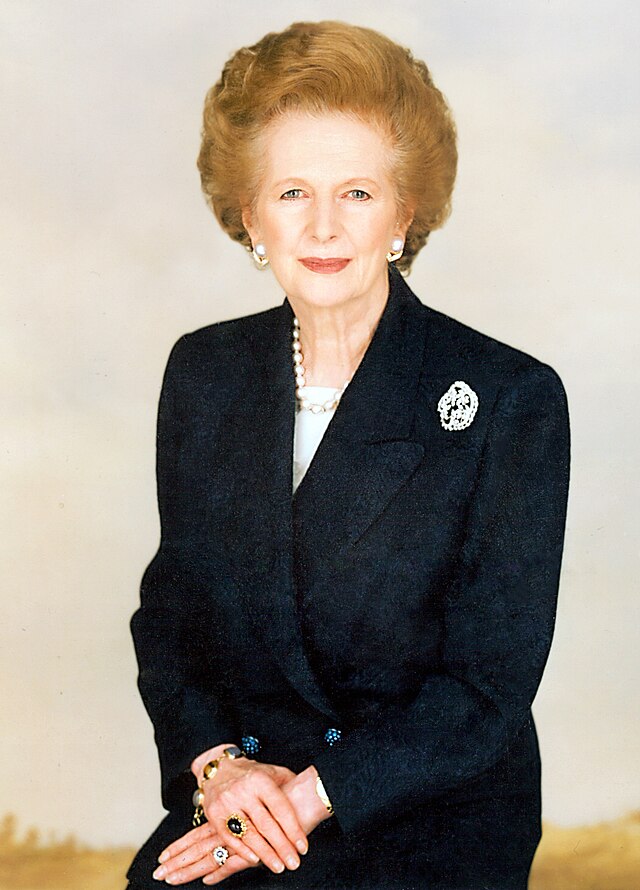
Margaret Thatcher, often referred to as the “Iron Lady,” was a British politician who served as the Prime Minister of the United Kingdom from 1979 to 1990. She was the first woman to hold this office and remains one of the most influential and controversial figures in British political history. Known for her strong will, conservative policies, and unwavering commitment to free-market capitalism, Thatcher left an indelible mark on the world stage, shaping the course of British history in the late 20th century.
Early Life and Education
Margaret Hilda Roberts was born on October 13, 1925, in Grantham, Lincolnshire, England. She was the daughter of Alfred Roberts, a grocer and local alderman, and Beatrice Ethel. Her father was a significant influence on her life, instilling in her a strong work ethic, a sense of responsibility, and a conservative political philosophy. Growing up, Margaret was a diligent student, though she did not initially exhibit any extraordinary academic talents. However, her intelligence and determination were apparent even in her youth.
Margaret attended Kesteven and Grantham Girls’ School, where she excelled in her studies and won a scholarship to study chemistry at Somerville College, Oxford. At Oxford, she studied under the renowned chemist Dorothy Hodgkin, who would later win the Nobel Prize in Chemistry. Thatcher graduated in 1947 with a degree in chemistry and briefly worked as a research chemist before deciding to pursue a career in law and politics.
Early Political Career
Thatcher’s interest in politics was evident early on, and she quickly became involved in the Conservative Party. After moving to London, she studied law and qualified as a barrister in 1953, specializing in tax law. In the same year, she married Denis Thatcher, a successful businessman. The couple had two children, twins Mark and Carol, born in 1953.
Thatcher’s first foray into electoral politics came in 1950 when she ran as the Conservative candidate for the safe Labour seat of Dartford. Although she lost the election, she impressed many within the Conservative Party with her determination and oratory skills. Her persistence paid off in 1959 when she was elected as the Member of Parliament for Finchley, a position she would hold until her retirement in 1992.
Rise to Power
Thatcher’s rise within the Conservative Party was swift. In 1961, she was appointed Parliamentary Undersecretary at the Ministry of Pensions and National Insurance, marking the beginning of her ministerial career. Her talent for grasping complex issues and her ability to articulate conservative principles made her a rising star in the party.
In 1970, when Edward Heath became Prime Minister, Thatcher was appointed Secretary of State for Education and Science. During her tenure, she became infamous for her decision to end free milk for schoolchildren, earning her the nickname “Thatcher, the Milk Snatcher.” This early controversy did little to deter her ambitions, and in 1975, following Heath’s defeat in the general election, Thatcher challenged and defeated him for the leadership of the Conservative Party, becoming the first woman to lead a major political party in the United Kingdom.
Prime Ministership (1979-1990)
Thatcher became Prime Minister on May 4, 1979, after leading the Conservative Party to a decisive victory in the general election. Her election marked the beginning of a new era in British politics, characterized by a shift away from the post-war consensus of welfare state policies and towards a free-market economy. Thatcher’s government implemented sweeping economic reforms, which included deregulation of industries, reduction of the power of trade unions, and widespread privatization of state-owned enterprises.
One of Thatcher’s core beliefs was that “there is no such thing as society,” only individuals and families. She argued that the role of the state should be minimized to allow individuals to thrive through personal responsibility and hard work. Her policies, often referred to as “Thatcherism,” were rooted in free-market economics, monetarism, and a belief in the importance of individual entrepreneurship.
Thatcher’s economic policies were controversial but also credited with revitalizing the British economy. By the early 1980s, Britain was emerging from a period of economic stagnation, high inflation, and industrial unrest. However, her policies also led to significant social upheaval, particularly in the industrial regions of the North and Midlands, where many traditional industries such as coal mining and steel production were in decline. Unemployment rose sharply during her early years in office, leading to widespread protests and criticism.
The Falklands War and International Relations
One of the defining moments of Thatcher’s premiership was the Falklands War in 1982. When Argentina invaded the British-controlled Falkland Islands, Thatcher responded decisively, dispatching a naval task force to reclaim the territory. The successful recapture of the Falklands boosted her popularity at home and reinforced her image as a strong and determined leader. The victory in the Falklands War played a significant role in her re-election in 1983.
On the international stage, Thatcher was a staunch ally of the United States, particularly under President Ronald Reagan. The two leaders shared a common ideological bond over their commitment to free-market capitalism and opposition to Soviet communism. Thatcher was also a vocal critic of the European Economic Community (EEC), the precursor to the European Union, arguing that it infringed on British sovereignty.
Domestic Policies and Controversies
Thatcher’s domestic policies were characterized by a commitment to reducing the role of the state in the economy. Her government pursued a program of privatization, selling off state-owned enterprises such as British Telecom, British Gas, and British Airways. These policies were aimed at reducing the national debt, increasing efficiency, and encouraging a culture of ownership and entrepreneurship. While privatization was popular among investors and created a new class of shareholders, it also led to criticism that essential services were being placed in the hands of profit-driven companies.
Thatcher’s approach to social issues was equally controversial. She implemented policies to reduce the power of trade unions, which she viewed as an obstacle to economic progress. The miners’ strike of 1984-1985 was one of the most bitter industrial disputes in British history, pitting Thatcher’s government against the National Union of Mineworkers (NUM) led by Arthur Scargill. The strike ended in defeat for the miners, further weakening the influence of trade unions in Britain.
Another controversial policy was the introduction of the Community Charge, commonly known as the “poll tax,” in 1989. The tax was deeply unpopular and led to widespread protests, including the infamous poll tax riots in London. The unpopularity of the poll tax, combined with growing opposition within her own party, ultimately led to Thatcher’s resignation in November 1990.
Resignation and Legacy
Margaret Thatcher resigned as Prime Minister on November 28, 1990, after more than 11 years in office. Her resignation was a result of mounting pressure from within the Conservative Party, particularly over her handling of the poll tax and her increasingly Eurosceptic stance. Despite her resignation, Thatcher remained a powerful figure in British politics and continued to influence Conservative Party policy and direction.
Thatcher’s legacy is a subject of intense debate. Supporters argue that her policies revitalized the British economy, reduced the power of trade unions, and restored Britain’s standing on the world stage. They credit her with transforming Britain from the “sick man of Europe” into a dynamic and competitive economy. Critics, however, contend that her policies widened the gap between rich and poor, decimated traditional industries, and created social divisions that persist to this day.
One of Thatcher’s lasting legacies is the ideological shift she brought about in British politics. Even after her departure from office, her ideas continued to shape the policies of successive governments. The Labour Party, under Tony Blair, adopted many of the principles of Thatcherism, including an emphasis on market-oriented reforms and a reduction in the role of the state in the economy.
Later Years and Death
After leaving office, Thatcher was elevated to the House of Lords as Baroness Thatcher of Kesteven. She remained active in public life, giving speeches and writing memoirs, including The Downing Street Years (1993) and The Path to Power (1995). However, her later years were marked by declining health. She suffered a series of small strokes and was diagnosed with dementia in the early 2000s.
Margaret Thatcher passed away on April 8, 2013, at the age of 87. Her death prompted a wide range of reactions, from tributes recognizing her as one of the most important figures in modern British history to protests highlighting the divisive nature of her policies. A ceremonial funeral with military honors was held at St. Paul’s Cathedral, reflecting her status as a significant national figure.
Conclusion
Margaret Thatcher’s life and career were characterized by a commitment to conservative principles, a belief in individual responsibility, and an unwavering determination to reshape Britain according to her vision. As the first female Prime Minister of the United Kingdom, she broke barriers and set a new standard for leadership. Her policies, collectively known as Thatcherism, continue to influence British politics and economics today.
Thatcher’s impact on the UK and the world is undeniable. Whether revered or reviled, her legacy as the “Iron Lady” endures, embodying a period of profound change and marking her as one of the most formidable leaders of the 20th century.


