
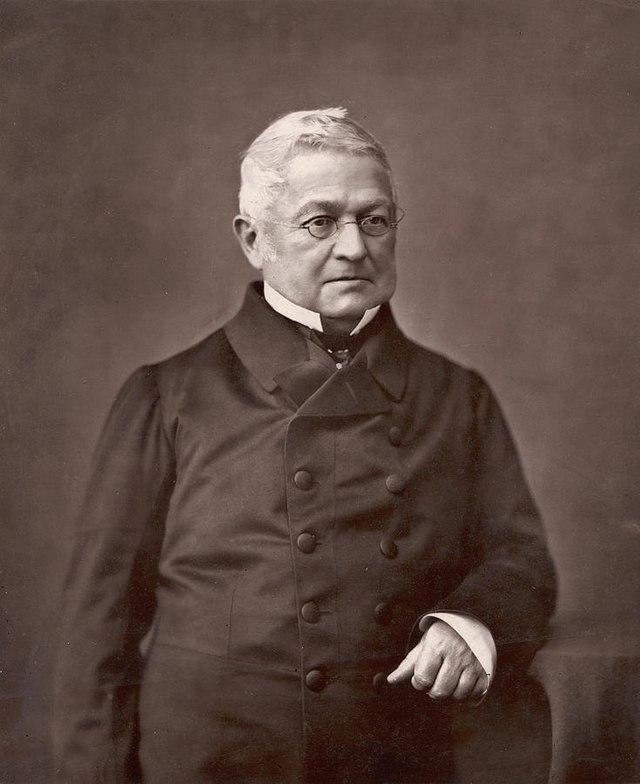
Adolphe Thiers, born on April 15, 1797, in Marseille, France, was a towering figure in 19th-century French politics and history. Thiers’s life was marked by his significant contributions as a historian, journalist, and politician. He played a critical role in shaping modern France, particularly during the tumultuous periods of the July Monarchy, the Second Republic, and the early years of the Third Republic. Thiers’s legacy is multifaceted, reflecting his deep intellectual engagement with the revolutionary ideals of his time and his pragmatic approach to governance.
Early Life and Intellectual Foundations
Adolphe Marie Joseph Louis Thiers was born into a modest family in Marseille, a city with a rich history of political and cultural dynamism. His early education was grounded in the classics, and he later pursued legal studies, which provided him with a solid foundation in the principles of law and governance. However, Thiers’s passion for history and politics soon eclipsed his legal career.
In 1821, Thiers moved to Paris, the epicenter of French intellectual and political life. Paris in the early 19th century was a city of vibrant debates and ideological clashes, particularly in the wake of the French Revolution and the Napoleonic Wars. Thiers quickly immersed himself in this environment, becoming a prominent liberal journalist. His writings were characterized by a deep appreciation for the revolutionary ideals of liberty, equality, and fraternity, which were central to his political philosophy.
The Historian of the French Revolution
Thiers’s reputation as a historian was cemented with the publication of his monumental work, the History of the French Revolution, written between 1823 and 1827. This multi-volume history was more than just a scholarly account; it was a passionate defense of the revolution’s principles and a critique of the Bourbon Restoration, which sought to undo many of the revolution’s achievements.
The History of the French Revolution was widely acclaimed across Europe, earning Thiers a place among the leading intellectuals of his time. The work not only highlighted the profound social and political changes brought about by the revolution but also served as a clarion call against the reactionary forces of the Bourbon monarchy. Thiers’s historical writings reflected his belief in the necessity of progress and reform, ideas that would later influence his political career.
Political Ascendancy and the July Monarchy
Thiers’s transition from historian to politician was a natural progression, given his deep engagement with the political issues of his time. The July Revolution of 1830, which resulted in the overthrow of Charles X and the ascension of Louis-Philippe I to the French throne, provided Thiers with the opportunity to put his political ideas into practice.
Thiers was one of the key architects of the July Monarchy, a regime that sought to reconcile the revolutionary ideals of 1789 with the need for stability and order. He was elected as a deputy in 1830 and quickly rose through the ranks of government, holding various ministerial positions, including Minister of the Interior, Minister of Public Works, and Minister of Commerce.
As Minister of the Interior, Thiers played a crucial role in suppressing the popular uprisings that threatened the stability of the July Monarchy. His actions during this period reflected his increasingly conservative stance, as he moved away from his earlier liberal positions. Thiers believed that maintaining order was essential to preserving the gains of the revolution, even if it meant curbing certain freedoms.
Prime Minister and the Struggle for Power
Adolphe Thiers’s political career reached its zenith when he was appointed Prime Minister of France on February 22, 1836. His tenure as Prime Minister, however, was short-lived, lasting only until September 6 of the same year. Thiers’s time in office was marked by intense political battles, particularly with François Guizot, a rival politician who represented the more conservative faction of the government.
Thiers’s resignation in 1836 did not mark the end of his political influence. He returned to the French Parliament two years later, where he continued to advocate for constitutional monarchy and parliamentary democracy. Thiers was a staunch defender of the French Parliament, viewing it as a bulwark against the absolutist tendencies of the monarchy.
In 1840, Thiers was once again appointed Prime Minister, a position he held for eight months. His second term was marked by a strong stance on foreign policy, particularly in his opposition to British influence in the Mediterranean. However, disagreements with King Louis-Philippe over foreign policy led to his resignation in October 1840. These political experiences gradually led Thiers to embrace republicanism, setting the stage for his later role in the establishment of the Third Republic.
The Revolution of 1848 and the Second Republic
The revolutionary fervor that swept through Europe in 1848 had a profound impact on Adolphe Thiers’s political trajectory. The February Revolution of 1848 led to the abdication of Louis-Philippe and the establishment of the Second Republic in France. Thiers, who had by this time developed republican sympathies, played an active role in the provisional government.
Thiers was elected to the Constituent Assembly, where he contributed to the drafting of the new republican constitution. However, his relationship with the Second Republic was complicated. While he supported the republic in principle, he was deeply concerned about the radicalism of some of its leaders and the potential for social upheaval.
Thiers’s caution was evident in his opposition to the socialist-inspired June Days Uprising of 1848, which he believed threatened the stability of the republic. His conservative leanings led him to support Louis-Napoleon Bonaparte’s candidacy for the presidency of the republic, a decision that would have far-reaching consequences for both Thiers and France.
Exile and Return: The Historian Re-emerges
The election of Louis-Napoleon Bonaparte as President of the Second Republic in December 1848 initially seemed to confirm Thiers’s belief in the need for a strong executive to maintain order. However, when Bonaparte staged a coup d’état in 1851 and declared himself Emperor Napoleon III, Thiers became one of the regime’s most vocal critics.
Thiers’s opposition to Napoleon III’s authoritarian rule led to his arrest and subsequent exile. During this period, he turned his attention back to his scholarly pursuits, completing his History of the Consulate and the Empire, a detailed account of Napoleon Bonaparte’s rise to power and the subsequent establishment of the French Empire. This work, published between 1845 and 1862, further solidified Thiers’s reputation as one of France’s foremost historians.
Thiers’s exile lasted until 1863, when he was allowed to return to France. By this time, his political views had shifted significantly. He emerged as a leader of the opposition to Napoleon III, advocating for a return to parliamentary democracy and criticizing the emperor’s foreign policy, particularly the ill-fated Franco-Prussian War, which ultimately led to the collapse of the Second Empire.
The Third Republic and the Presidency
The defeat of France in the Franco-Prussian War in 1870 marked the end of the Second Empire and the beginning of the Third Republic. Adolphe Thiers, now in his seventies, was called upon to lead the fledgling republic during one of the most challenging periods in French history.
Thiers was elected as the first President of the Third Republic in 1871, a position he held until 1873. His presidency was dominated by the need to negotiate peace with Prussia and to restore order in a country devastated by war and internal conflict. The Treaty of Frankfurt, signed in May 1871, ended the war but imposed harsh terms on France, including the cession of Alsace-Lorraine to Germany and the payment of a large indemnity.
Despite these challenges, Thiers worked tirelessly to stabilize the republic and to lay the foundations for a democratic government. His leadership during the early years of the Third Republic was characterized by pragmatism and a commitment to national unity. However, his increasingly authoritarian measures, including the suppression of the Paris Commune in 1871, alienated many republicans, leading to his resignation in 1873.
Legacy and Historical Impact
Adolphe Thiers died on September 3, 1877, in Saint-Germain-en-Laye at the age of 80. His death marked the end of an era in French politics, but his legacy continued to influence the course of French history.
Thiers’s contributions to French political thought and practice were significant. He was a complex figure, embodying the tensions and contradictions of 19th-century France. As a historian, he provided one of the most comprehensive accounts of the French Revolution and the Napoleonic era, works that remain essential reading for anyone interested in these pivotal periods of history.
As a politician, Thiers was a pragmatist who believed in the necessity of compromise and moderation. His political career was marked by a willingness to adapt to changing circumstances, whether it meant shifting from liberalism to conservatism or from monarchism to republicanism. Thiers’s ability to navigate the turbulent waters of French politics made him one of the most influential figures of his time.
Thiers’s presidency of the Third Republic laid the groundwork for the longest-lasting republican government in French history. His efforts to stabilize the country in the aftermath of the Franco-Prussian War and the Paris Commune were crucial in ensuring the survival of the republic. Although his methods were sometimes controversial, his commitment to the principles of democracy and national unity left an enduring legacy.
Conclusion
Adolphe Thiers was a man of many talents and contradictions. A historian, journalist, and politician, he played a key role in shaping the course of French history during one of its most tumultuous centuries. Thiers’s life and career reflect the complexities of the times in which he lived, as well as his ability to adapt and respond to the changing political landscape.
Thiers’s legacy is one of intellectual rigor, political pragmatism, and a deep commitment to the ideals of the French Revolution. His contributions to French history and politics continue to be studied and debated, and his influence can still be seen in the institutions and values of modern France.
For anyone interested in the history of France, the life of Adolphe Thiers offers valuable insights into the development of French democracy and the challenges of leadership in a time of profound social and political change.


