
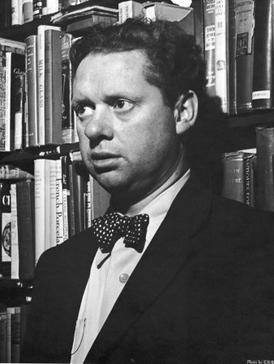
Early Life and Formative Years
Dylan Marlais Thomas was born on October 27, 1914, in Swansea, Wales, a small coastal town that would significantly influence his literary voice. His parents, Florence and David John Thomas, instilled in him a love for language and literature from a young age. His father, a schoolmaster, was particularly influential, introducing Dylan to the works of Shakespeare and other classic literature, which would leave a lasting imprint on his writing style.
Despite being born into a modest household, Thomas exhibited an early passion for poetry. By the age of 11, he was already publishing poems in his school magazine, demonstrating a precocious talent that would only grow with time. His early years were marked by frequent bouts of illness, particularly asthma and bronchitis, conditions that plagued him throughout his life and contributed to his introspective and often somber view of the world.
The Road to Literary Fame
Thomas’s first major breakthrough came in 1934 with the publication of his debut poetry collection, Eighteen Poems, at the tender age of 20. This collection was met with critical acclaim, and its bold, evocative language established him as one of the most promising young poets of his generation. Among the poems in this collection, “And death shall have no dominion” stands out as a powerful meditation on mortality, one of the recurring themes in Thomas’s work.
The success of Eighteen Poems brought Thomas into the literary circles of London, where he quickly became known for his charisma, wit, and, unfortunately, his growing penchant for excess, particularly alcohol. Despite his struggles with substance abuse, Thomas continued to produce remarkable work. His next collection, Twenty-Five Poems, published in 1936, further cemented his reputation as a leading figure in modern poetry.
Personal Life and Marriage
In 1937, Thomas married Caitlin MacNamara, a spirited and independent woman who shared his love for the arts. Their marriage, while passionate, was also tumultuous, marked by infidelities, financial difficulties, and mutual bouts of heavy drinking. Together, they had three children: Llewelyn, Aeronwy, and Colm. Caitlin played a significant role in Thomas’s life, both as a muse and as a stabilizing force, albeit a volatile one.
The couple eventually settled in the Welsh coastal town of Laugharne, where they lived in a modest house known as the Boathouse. It was here that Thomas wrote some of his most celebrated works, drawing inspiration from the natural beauty and the close-knit community of the town. The Boathouse, with its views of the Taf estuary, became both a retreat and a creative sanctuary for Thomas.
World War II and the Later Years
The outbreak of World War II had a profound impact on Thomas, both personally and professionally. Although he was deemed unfit for military service due to his health issues, the war loomed large in his consciousness and influenced his work. During this period, he wrote several radio plays and scripts for the Ministry of Information, which provided him with a steady income but also exposed him to the harsh realities of the time.
One of the most significant works from this period is Death and Entrances (1946), a collection that is often considered his magnum opus. This collection features some of his most mature and introspective poetry, exploring themes of war, death, and the passage of time with a poignant intensity. Despite his growing reputation, Thomas’s financial situation remained precarious, exacerbated by his extravagant lifestyle and his worsening alcoholism.
The American Tours and International Recognition
In 1950, Thomas embarked on the first of several lecture tours in the United States, organized by the poet and critic John Brinnin. These tours were intended to introduce Thomas’s work to a broader audience and provide him with much-needed financial support. The American audiences were captivated by Thomas’s dynamic readings and his larger-than-life personality, and he quickly became a literary celebrity.
However, the demands of the tours, combined with Thomas’s heavy drinking, took a severe toll on his health. Despite this, he continued to produce new work, including his most famous play, Under Milk Wood, a “play for voices” that is both a celebration and a critique of Welsh village life. Under Milk Wood was first performed in New York in 1953 and is considered one of his greatest achievements, showcasing his unique blend of lyricism, humor, and pathos.
Final Days and Legacy
Thomas’s health continued to decline throughout the early 1950s. His relentless touring schedule, combined with his excessive drinking, led to several health crises. In November 1953, during his fourth and final American tour, Thomas collapsed after a night of heavy drinking and was admitted to St. Vincent’s Hospital in New York. He died on November 9, 1953, at the age of 39, officially from pneumonia, though his alcoholism and other health issues undoubtedly contributed to his untimely death.
Despite his relatively short life, Dylan Thomas left behind a body of work that has had a lasting impact on both poetry and popular culture. His poetry is characterized by its rich imagery, musicality, and emotional depth, and it continues to be celebrated for its exploration of universal themes such as love, death, and the human condition.
Historical Context and Literary Influence
Dylan Thomas’s work must be understood within the broader context of the early 20th century, a period marked by significant social, political, and cultural upheaval. His writing emerged at a time when modernist experimentation was at its peak, and while Thomas is often associated with modernism, his work also contains elements of romanticism, particularly in his emphasis on nature, emotion, and individual experience.
Thomas was influenced by a wide range of literary traditions, from the Bible and Welsh folklore to the works of Shakespeare and the metaphysical poets. His writing, however, is also deeply personal and idiosyncratic, marked by a distinctive voice that is immediately recognizable. His ability to blend the sacred and the profane, the lyrical and the colloquial, sets his work apart from his contemporaries and has made it a lasting part of the literary canon.
The Role of Wales in Thomas’s Work
Wales, with its rugged landscapes, rich history, and vibrant culture, plays a central role in Dylan Thomas’s work. His deep connection to the land and people of Wales is evident in much of his poetry, which often evokes the beauty and harshness of the Welsh countryside. This connection is perhaps most famously expressed in the poem “Fern Hill,” a nostalgic reflection on the innocence and joy of childhood, set against the backdrop of the Welsh countryside.
Laugharne, the small coastal town where Thomas spent much of his later life, also features prominently in his work. The town served as the inspiration for the fictional village of Llareggub in Under Milk Wood, a place where the ordinary and the extraordinary coexist in a vibrant tapestry of life. Through his depiction of Welsh life, Thomas not only celebrated his heritage but also explored broader themes of identity, memory, and belonging.
Impact on Modern Poetry and Culture
Dylan Thomas’s influence extends far beyond the world of poetry. His work has inspired countless writers, musicians, and artists, and his life story has become the subject of numerous biographies, films, and plays. Thomas’s reading style, characterized by its sonorous and rhythmic delivery, has also had a lasting impact on how poetry is performed and appreciated.
In the decades since his death, Thomas’s reputation has continued to grow. He is now recognized as one of the most important poets of the 20th century, and his work is studied and celebrated around the world. His ability to capture the complexities of the human experience in language that is both beautiful and accessible has ensured that his poetry remains relevant and resonant to this day.
Conclusion
Dylan Thomas was a poet of extraordinary talent, whose work continues to captivate readers with its emotional intensity, linguistic inventiveness, and profound insights into the human condition. His life, marked by both triumph and tragedy, is a testament to the challenges and rewards of the creative process.
Thomas’s legacy is one of a fearless and passionate commitment to art, even in the face of personal and professional difficulties. His poetry, with its timeless exploration of love, death, and the beauty of the natural world, will undoubtedly continue to inspire and move generations of readers for years to come.


