
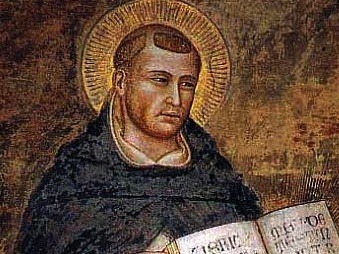
Tommaso d’Aquino, widely known in English as Thomas Aquinas, is one of the most significant figures in Western philosophy and theology. Born around the end of 1225 in the castle of Roccasecca, near Aquino, in present-day Italy, Thomas was the son of a noble family. His life and works have had an enduring influence on Christian thought and the broader intellectual tradition.
Early Life and Family Background
Thomas was born into a family of noble standing. His father, the Count of Aquino, had high hopes for his son, aiming for him to follow in the footsteps of many noble families of the time by pursuing a career within the Church, potentially aiming for high ecclesiastical office. However, Thomas’s life took a different turn that would eventually lead him to become one of the most revered saints and scholars in the Catholic Church.
At the age of 18, Thomas made a life-changing decision to join the Dominican Order, known as the Order of Preachers, which was dedicated to poverty, teaching, and preaching. This decision was met with strong opposition from his family. His brothers even went so far as to attempt to kidnap him to prevent him from pursuing what they saw as a less prestigious and financially unrewarding path. Nevertheless, Thomas remained resolute in his decision, demonstrating an early sign of the steadfastness that would characterize his life and work.
Education and Intellectual Pursuits
Thomas’s commitment to the Dominican Order was not merely a spiritual one; it was also intellectual. He went on to study under Albertus Magnus, one of the most renowned scholars of the time, at the University of Cologne. Albertus Magnus recognized Thomas’s extraordinary intellect and potential, which laid the foundation for his future accomplishments.
After completing his studies, Thomas began teaching in Paris, where he quickly earned a reputation as a brilliant philosopher and theologian. His quiet demeanor and contemplative nature earned him the nickname “the Dumb Ox” (a reflection of his physical stature and his silent, deep thought). Despite this nickname, Thomas’s intellectual prowess was anything but dull. He was known for his ability to synthesize complex ideas and present them in a clear, logical, and accessible manner.
Major Works and Theological Contributions
Among Thomas’s numerous contributions to theology and philosophy, the “Summa Theologiae” stands out as his magnum opus. Written as a comprehensive guide for theologians, the “Summa” covers a vast array of topics, including the existence of God, the nature of morality, and the principles of ethics. Its style is straightforward yet profound, marked by a clarity and precision that make it accessible to both scholars and students alike.
In the “Summa,” Thomas sought to reconcile faith and reason, a theme that runs throughout his work. He argued that both faith and reason are paths to truth and that they are not in conflict but rather complement each other. This idea was revolutionary for its time, as it provided a framework for engaging with secular knowledge within the context of Christian theology. His work laid the groundwork for much of the Catholic Church’s teachings and influenced countless theologians and philosophers in the centuries that followed.
The Intellectual Legacy of Thomas Aquinas
The intellectual legacy of Thomas Aquinas is immense. He is often credited with bridging the gap between ancient philosophy, particularly the works of Aristotle, and Christian theology. Thomas was a master at synthesizing the philosophical ideas of the past with the theological doctrines of the Church, creating a cohesive and comprehensive worldview that has endured for centuries.
One of the key aspects of Thomas’s thought was his belief in the compatibility of faith and reason. In a time when the relationship between these two was often seen as contentious, Thomas’s work provided a rational foundation for Christian beliefs. This approach not only strengthened the intellectual rigor of Christian theology but also made it more accessible to those who valued reason and empirical evidence.
Thomas’s influence extended far beyond the realm of theology. His ideas on ethics, natural law, and the nature of the human soul have been foundational in the development of Western legal and moral philosophy. The concept of natural law, in particular, has had a profound impact on the development of Western legal systems and continues to be a central theme in discussions of human rights and justice.
Historical Context and Impact
To fully appreciate the significance of Thomas Aquinas, it is essential to understand the historical context in which he lived and worked. The 13th century was a time of great intellectual ferment in Europe. The rediscovery of Aristotle’s works, which had been preserved and expanded upon by Islamic scholars, sparked a renewed interest in philosophy and science. This period also saw the rise of the universities as centers of learning, where scholars from various disciplines could engage in debate and exchange ideas.
Thomas was at the forefront of this intellectual revival. His work represented a synthesis of the best of classical philosophy with the theological insights of Christianity. He was not afraid to engage with the ideas of non-Christian philosophers, such as Aristotle, and to incorporate their insights into his own work. This willingness to engage with different intellectual traditions is one of the hallmarks of Thomas’s approach and is a key reason for the enduring relevance of his work.
The Canonization and Legacy of a Saint
Thomas Aquinas’s life was relatively short; he died in 1274 at the age of 48 while on his way to the Second Council of Lyon. However, his impact on the Church and the world of ideas was profound. In 1323, less than 50 years after his death, Pope John XXII canonized Thomas as a saint. His canonization was significant not only because of the recognition of his sanctity but also because of the acknowledgment of his intellectual contributions to the Church.
When Pope John XXII declared Thomas a saint, he reportedly responded to critics who questioned the lack of miracles attributed to Thomas by stating, “How many propositions of theology he wrote, so many miracles did he perform.” This statement reflects the Church’s recognition of the intellectual and spiritual miracles wrought through Thomas’s writings.
Thomas was later given the title “Doctor Angelicus” or “Angelic Doctor,” a testament to the belief that his teachings were inspired by divine wisdom. His feast day is celebrated on January 28th, and his works continue to be studied and revered by theologians, philosophers, and students worldwide.
Thomas Aquinas in the Modern World
In the modern world, Thomas Aquinas remains a towering figure in both religious and secular contexts. His ideas have been incorporated into the teachings of the Catholic Church, particularly through the encyclicals of various popes, who have emphasized the importance of his work for understanding the relationship between faith and reason.
In addition to his influence within the Church, Thomas’s ideas have also found a place in broader philosophical discussions. His concepts of natural law, justice, and the common good continue to resonate in contemporary debates on ethics and political philosophy. The Thomistic tradition, which refers to the school of thought that follows Thomas’s teachings, remains vibrant and continues to evolve, addressing new challenges and questions that arise in the modern world.
Conclusion: The Enduring Legacy of a Philosopher and Theologian
Thomas Aquinas’s life and work represent a unique blend of intellectual rigor, spiritual devotion, and practical wisdom. His ability to engage with the philosophical ideas of his time and integrate them into a coherent theological framework has left an indelible mark on the history of Western thought. His teachings continue to inspire and challenge those who seek to understand the complexities of faith, reason, and the human condition.
In the centuries since his death, Thomas has been recognized not only as a saint and a Doctor of the Church but also as one of the greatest minds in the history of philosophy. His legacy is a testament to the power of ideas and the enduring relevance of the questions he sought to answer. As we continue to explore the relationship between faith and reason, the life and work of Thomas Aquinas remain a guiding light for those who seek truth in all its forms.


