
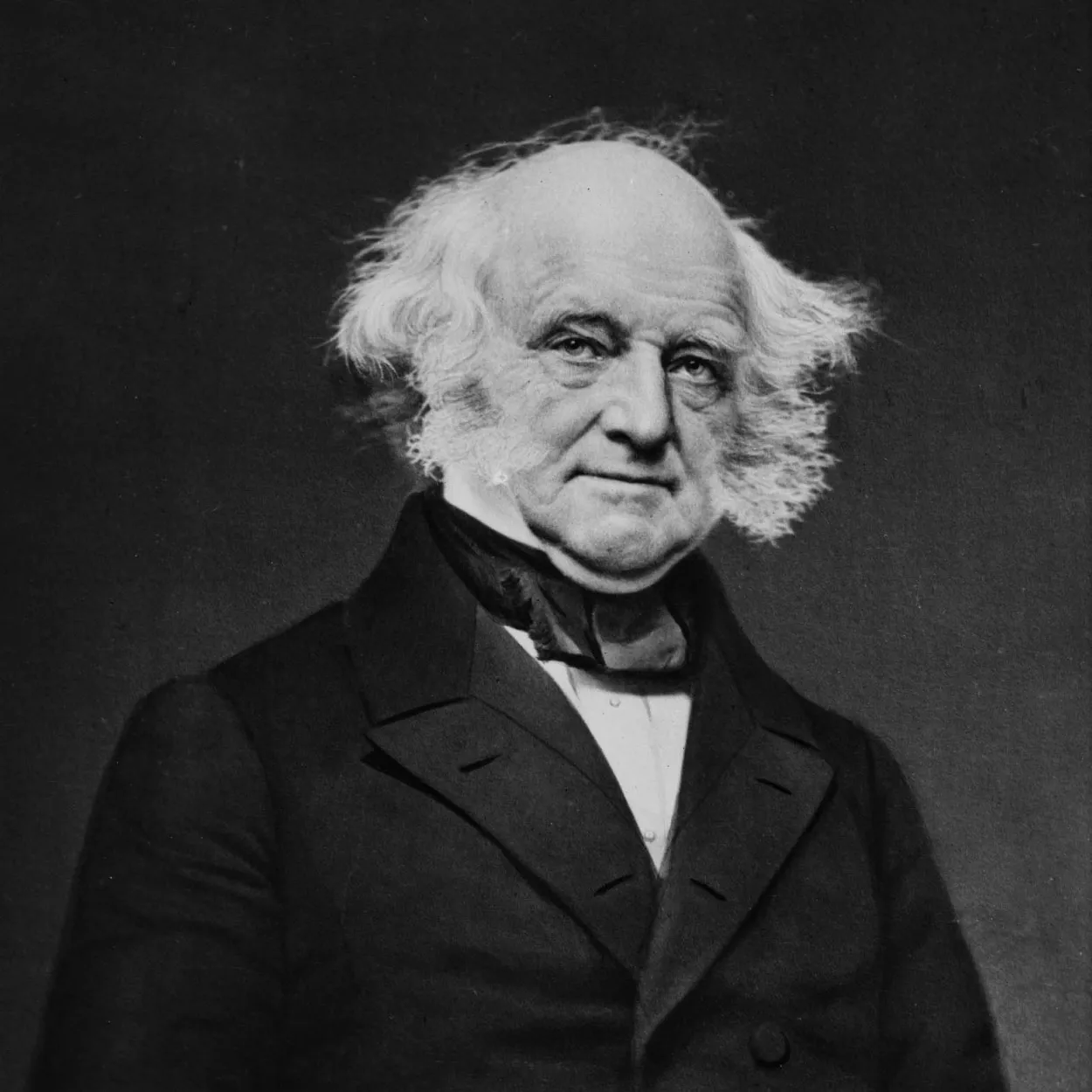
Martin Van Buren, the eighth President of the United States, holds a unique place in American history. Born on December 5, 1782, in Kinderhook, New York, Van Buren’s life and career reflect the complexities of early American politics and the evolving identity of the young nation. As the first president born after the United States declared independence, and the first whose native language was not English, Van Buren’s legacy is marked by both his contributions to the political landscape and the challenges he faced during his presidency.
Early Life and Education
Martin Van Buren was born into a modest family of Dutch descent in Kinderhook, a village in upstate New York. His father, Abraham Van Buren, was a farmer and innkeeper who owned six slaves, a practice that was common in New York at the time. Van Buren’s early life was steeped in the Dutch culture of the region, and he grew up speaking Dutch as his first language. This cultural background would influence his political views and his approach to governance.
Van Buren’s formal education began at the Kinderhook Academy, where he received a basic education that included learning Latin. At the age of 14, he began studying law under the mentorship of Francis Sylvester, a prominent local lawyer and federal official. This apprenticeship was the first step in Van Buren’s journey into the world of law and politics.
By the age of 20, Van Buren moved to New York City to further his legal studies under the guidance of William P. Van Ness, a close associate of Aaron Burr. This period in the bustling city exposed Van Buren to the intricacies of New York’s legal and political environment, setting the stage for his future career.
Legal Career and Early Political Involvement
Martin Van Buren was admitted to the New York State Bar in 1803, launching a legal career that would soon intertwine with politics. His early involvement in the political scene was shaped by his alignment with the Jeffersonian Republicans, who advocated for limited federal government and greater states’ rights. Van Buren quickly established himself as a skilled lawyer and a shrewd political operator.
In 1807, Van Buren married his cousin, Hannah Hoes, who also came from a Dutch family. The couple had five children, but their marriage was tragically cut short when Hannah died of tuberculosis in 1819 at the age of 35. Van Buren would never remarry, and his personal life became increasingly private as he devoted himself to his political career.
Van Buren’s rise in politics began in earnest when he was elected to the New York State Senate in 1812. He quickly became known for his political acumen and his ability to build alliances. He played a key role in organizing the Democratic-Republican Party in New York and was a strong supporter of the War of 1812, which endeared him to many of his contemporaries.
The Road to the Presidency
By the 1820s, Martin Van Buren had become one of the most influential politicians in New York, earning the nickname “The Little Magician” for his political skill. In 1821, he was elected to the U.S. Senate, where he continued to champion states’ rights and oppose federal intervention in state affairs. Van Buren’s political philosophy was deeply rooted in the belief that the best government was one that governed least, a principle that would guide his actions throughout his career.
Van Buren’s influence extended beyond New York as he became a key figure in the national Democratic-Republican Party. His support for Andrew Jackson, who shared his views on states’ rights and limited government, earned him a place in Jackson’s inner circle. When Jackson was elected president in 1828, he appointed Van Buren as Secretary of State, a position that further solidified Van Buren’s status as a national leader.
As Secretary of State, Van Buren played a crucial role in shaping U.S. foreign policy, particularly in relation to Europe and Latin America. His diplomatic skills were instrumental in resolving several international disputes, and he became one of Jackson’s most trusted advisors. In 1832, Van Buren was elected Vice President of the United States, serving under Jackson during his second term.
Van Buren’s close association with Jackson and his support for the president’s policies, including the controversial Indian Removal Act, positioned him as the natural successor to Jackson. In 1836, Van Buren was elected the eighth President of the United States, defeating his Whig opponent, William Henry Harrison, by a comfortable margin.
The Presidency: Triumphs and Challenges
Martin Van Buren’s presidency began on a high note, but it was soon overshadowed by the Panic of 1837, a financial crisis that led to a severe economic depression. The panic was triggered by a combination of factors, including speculative lending practices, the collapse of land prices, and the tightening of credit by the Bank of England. As banks failed and businesses closed, unemployment soared, and the country plunged into its first major depression.
Van Buren’s response to the crisis was shaped by his belief in limited government intervention. He opposed federal assistance to the struggling economy, arguing that the government should not interfere in the natural course of economic events. Instead, he proposed the creation of an independent treasury system to manage the nation’s finances without reliance on private banks. This proposal, known as the “Sub-Treasury Plan,” was eventually adopted in 1840, but it did little to alleviate the suffering caused by the depression.
The economic downturn and Van Buren’s perceived inaction eroded his popularity, and he faced growing opposition from the Whig Party, which accused him of failing to address the nation’s economic woes. Despite these challenges, Van Buren remained committed to his principles, refusing to abandon his belief in limited government.
Van Buren’s presidency also saw the continuation of the Indian Removal policy, which resulted in the forced relocation of thousands of Native Americans from their ancestral lands in the southeastern United States to territories west of the Mississippi River. This policy, initiated by Jackson and supported by Van Buren, led to the infamous Trail of Tears, a series of forced marches that resulted in the deaths of thousands of Native Americans.
Post-Presidency and Later Political Life
After serving one term as president, Martin Van Buren was defeated in the 1840 election by William Henry Harrison, who ran a populist campaign that capitalized on Van Buren’s unpopularity during the economic depression. Despite his defeat, Van Buren remained active in politics, continuing to advocate for his vision of limited government and states’ rights.
In 1844, Van Buren sought the Democratic nomination for president once again, but his opposition to the immediate annexation of Texas, which he believed would provoke a war with Mexico, cost him the support of many Southern Democrats. Instead, the nomination went to James K. Polk, who supported the annexation and went on to win the presidency.
Undeterred, Van Buren continued to influence American politics. In 1848, he became the presidential candidate for the newly formed Free Soil Party, which opposed the expansion of slavery into the western territories. Although he did not win any electoral votes, his candidacy helped to draw attention to the growing national debate over slavery and contributed to the eventual rise of the Republican Party.
In the 1850s, as the issue of slavery increasingly divided the nation, Van Buren remained a vocal critic of the institution, even as he struggled with the contradictions in his own views. While he opposed the expansion of slavery, he was reluctant to support its immediate abolition, believing that the Constitution protected the rights of slaveholders. This ambivalence reflected the broader tensions within the Democratic Party and the country as a whole.
Legacy and Historical Significance
Martin Van Buren’s legacy is a complex one. As a politician, he was a master strategist who played a key role in shaping the Democratic Party and advancing the principles of states’ rights and limited government. His presidency, however, was marred by economic hardship and the controversial policies he inherited from Andrew Jackson.
Van Buren’s commitment to limited government and his opposition to federal intervention in the economy have made him a subject of debate among historians. Some view him as a principled leader who adhered to his beliefs even in the face of political and economic adversity. Others criticize him for his failure to address the needs of the nation during the Panic of 1837 and for his role in the Indian Removal policy.
In his later years, Van Buren’s opposition to the expansion of slavery and his support for the Free Soil movement positioned him as a forerunner of the Republican Party, which would later emerge as the primary political force opposing slavery. His efforts to navigate the complex and often contradictory political landscape of his time reflect the challenges faced by a nation struggling to define its identity and principles.
Van Buren retired from public life in the early 1860s, spending his final years at his estate, Lindenwald, in Kinderhook. In the autumn of 1861, he fell ill with pneumonia, and on July 24, 1862, Martin Van Buren passed away at the age of 79. He was buried in the Kinderhook Cemetery, alongside his wife, Hannah.
Conclusion: The Enduring Impact of Martin Van Buren
Martin Van Buren’s life and career offer a window into the early years of the American republic, a time of political experimentation and ideological conflict. His rise from humble beginnings to the highest office in the land exemplifies the opportunities and challenges of the American political system.
While his presidency was marked by economic difficulties and controversial decisions, Van Buren’s contributions to the development of the Democratic Party and his efforts to navigate the contentious issues of his time have left a lasting impact on American history. As a statesman, Van Buren was guided by a commitment to his principles, even when they led him into difficult and unpopular decisions. His legacy, though complex, is one that continues to be studied and debated by historians and political scholars.
As the first president born after American independence and the first with a non-English mother tongue, Martin Van Buren stands as a symbol of the evolving identity of the United States in the 19th century. His life reflects the broader currents of American history, from the nation’s early struggles with its economic system to the deep divisions over slavery that would eventually lead to civil war. In this way, Van Buren’s story is not just the story of a single man, but a reflection of the broader American experience.


