
Johannes van der Meer, more commonly known as Jan Vermeer or Johannes Vermeer, is one of the most celebrated painters in art history. His name is synonymous with masterpieces that capture the subtleties of light and color, but his life story is shrouded in mystery, with only sparse details surviving the passage of time. This article explores the life, age, fame, and significant moments of Jan Vermeer, offering a detailed look into the world of this enigmatic artist.
Early Life and Background
Jan Vermeer was baptized on October 31, 1632, in Delft, a city in the Netherlands. He was born into a Protestant family; his father was a silk weaver and art dealer. These professions undoubtedly influenced Vermeer’s exposure to art and his eventual path as a painter. The social and economic environment of Delft during the 17th century played a crucial role in shaping Vermeer’s early life. Delft, a vibrant and wealthy city, was part of the Dutch Golden Age, a period characterized by great wealth, artistic innovation, and scientific advancements.
Vermeer’s entry into the world of art can be traced back to the mid-1640s when he began his artistic training. His early education was not extensively documented, but it is widely believed that he trained under Carel Fabritius, a painter from Delft and a student of the renowned Rembrandt. Fabritius’ influence is evident in Vermeer’s technique, particularly in his use of light and shadow, which would later become his trademark.
The Artist’s Personal Life and Challenges
In 1653, at the age of 21, Vermeer married Catherina Bolnes, a woman from a Catholic and affluent family. This marriage marked a significant turning point in Vermeer’s life, as he converted to Catholicism, a decision that might have influenced his artistic themes and choice of patrons. Together, Jan and Catherina had eleven children, a factor that undoubtedly added to the financial pressures Vermeer faced throughout his life.
Vermeer inherited his father’s art dealership and the family inn, but despite these assets, he struggled with financial difficulties. His membership in the Guild of Saint Luke, a prestigious association of painters in Delft, did little to alleviate these struggles. Documents from the Guild indicate that Vermeer had trouble paying his membership fees, reflecting his ongoing financial instability.
Artistic Style and Techniques
Jan Vermeer’s art is distinguished by its meticulous attention to detail, masterful use of light, and a serene atmosphere that permeates his works. He is best known for his depictions of domestic interiors, where he often portrayed women engaged in everyday activities, such as reading a letter, playing an instrument, or pouring milk. These scenes, while seemingly mundane, are imbued with a quiet dignity and a sense of timelessness.
One of the hallmarks of Vermeer’s technique is his use of light. He was a master of chiaroscuro, the contrast between light and dark, which he used to create depth and volume in his paintings. Vermeer often employed a technique known as pointillé, a method of applying tiny dots of paint to create a luminous effect, especially in his portrayal of fabrics and textures. His use of the camera obscura, an optical device that projects an image onto a surface, is also notable. This tool helped Vermeer achieve the precise outlines and perspectives that characterize his work, as well as the subtle gradations of light and shadow.
Notable Works and Fame
Despite producing only about 36 known works, Vermeer’s paintings have become some of the most revered in the art world. His masterpieces include “The Girl with a Pearl Earring,” “The Milkmaid,” and “View of Delft.” These works are celebrated for their exquisite detail, use of color, and the almost tangible quality of the light that bathes his subjects.
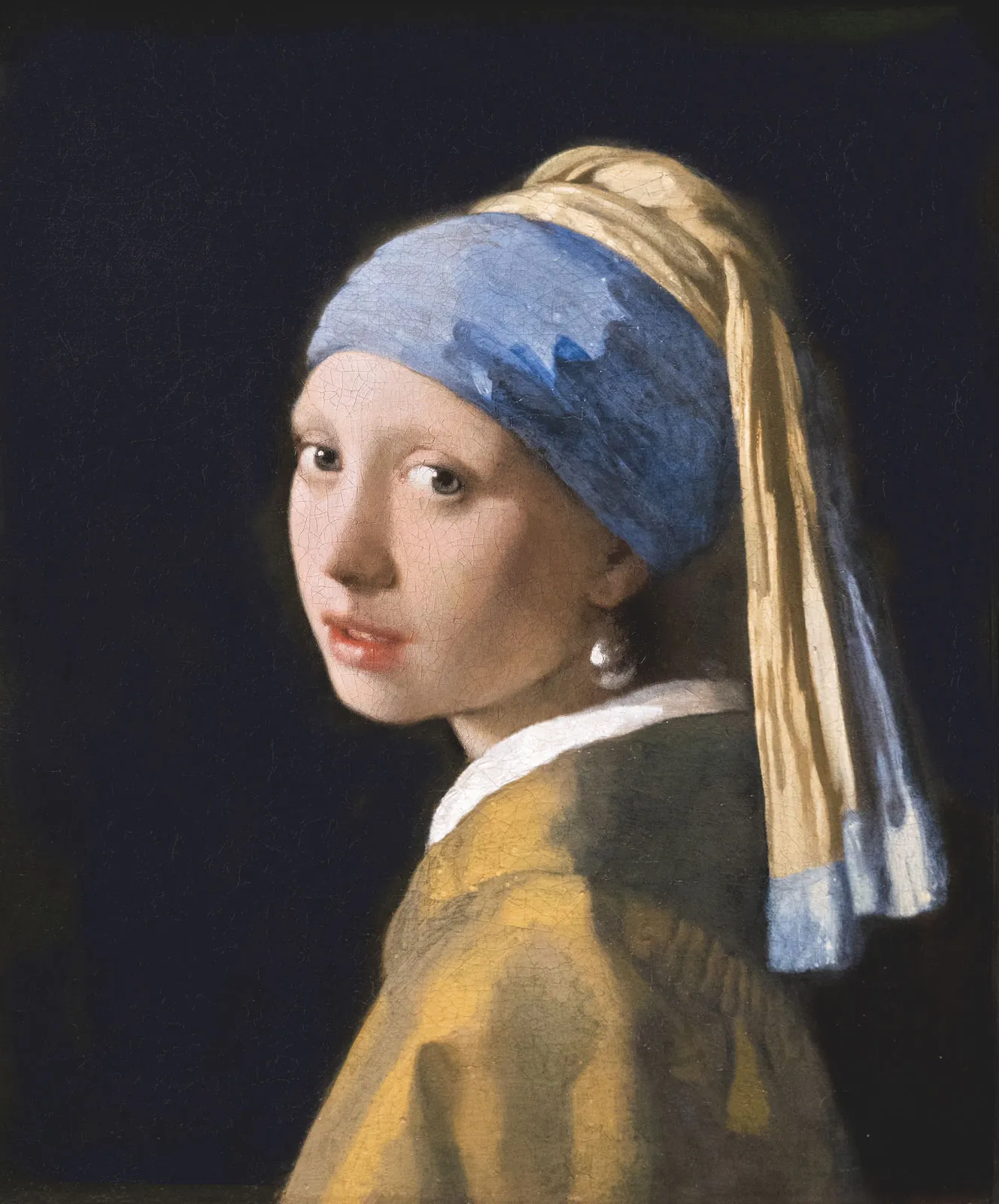
“The Girl with a Pearl Earring” is perhaps Vermeer’s most famous painting. Often referred to as the “Mona Lisa of the North,” this portrait captures a young girl, her head turned over her shoulder, with a soft, mysterious gaze and a large pearl earring catching the light. The painting has inspired countless interpretations and remains one of the most enigmatic portraits in Western art.
“The Milkmaid” is another iconic work that exemplifies Vermeer’s ability to elevate a simple, everyday scene into something extraordinary. In this painting, a woman is depicted pouring milk from a jug with intense concentration. The textures of her clothing, the play of light on her skin, and the quiet dignity of her task are rendered with astonishing realism.
“View of Delft” is a rare cityscape in Vermeer’s oeuvre and one of the few outdoor scenes he painted. This work is celebrated for its panoramic view of the city of Delft, bathed in the soft light of a cloudy day. The precise rendering of the buildings and the serene atmosphere make this painting one of the most admired landscapes of the Dutch Golden Age.
Historical Context and Legacy
Vermeer’s life coincided with the Dutch Golden Age, a period of great wealth, cultural achievements, and global exploration. The Netherlands, during the 17th century, was a hub of commerce, science, and art. This was the era of the Dutch East India Company, the world’s first multinational corporation, and the time when the Netherlands became a dominant sea power.
The prosperity of the Dutch Republic led to a flourishing of the arts, with a burgeoning middle class eager to commission and collect paintings. However, Vermeer’s limited output and his slow, meticulous painting process meant that he struggled to support his large family. Unlike many of his contemporaries, who produced hundreds of works, Vermeer’s oeuvre is small, but each piece is a masterpiece.
Vermeer’s death in 1675 marked the end of a career that had seen little recognition in his lifetime. He died at the age of 43, overwhelmed by debt and financial troubles. According to his wife, Catherina, Vermeer’s financial difficulties were so severe that they affected his health, leading to his sudden death. After his death, Vermeer fell into obscurity, and it was not until the 19th century that his work was rediscovered and his genius recognized.
Today, Vermeer is celebrated as one of the greatest painters of the Dutch Golden Age. His works are housed in some of the most prestigious museums in the world, including the Rijksmuseum in Amsterdam, the Mauritshuis in The Hague, and the Louvre in Paris. His paintings are admired for their beauty, technical perfection, and the sense of tranquility that they convey.
The Modern Revival of Vermeer’s Art
The 19th and 20th centuries saw a revival of interest in Vermeer’s work, largely due to the efforts of art historians and collectors who recognized the unique quality of his paintings. Exhibitions, books, and films have since brought Vermeer’s life and art to a broader audience.
One of the most significant moments in the modern appreciation of Vermeer’s work was the release of the 2003 film “Girl with a Pearl Earring,” starring Scarlett Johansson. The film, based on the novel by Tracy Chevalier, imagines the life of the girl in the painting and explores the possible relationship between Vermeer and his model. While the story is fictional, it has helped to cement Vermeer’s place in popular culture and has introduced his art to a new generation.
Vermeer’s influence can also be seen in contemporary art and photography, where his use of light, color, and composition continues to inspire artists. The meticulous craftsmanship and the subtle emotional depth of his work resonate with modern audiences, making Vermeer as relevant today as he was in the 17th century.
Conclusion: Vermeer’s Enduring Legacy
Jan Vermeer’s life and work offer a fascinating glimpse into the world of 17th-century Dutch art. His ability to capture the beauty of everyday life, his mastery of light and color, and the serene, almost meditative quality of his paintings have earned him a place among the greatest artists in history. Despite the challenges he faced during his lifetime, including financial difficulties and limited recognition, Vermeer’s legacy endures, with his works continuing to captivate and inspire audiences around the world.
Vermeer’s art reminds us that beauty can be found in the simplest of moments and that the quiet dignity of everyday life is worthy of celebration. His paintings are not just depictions of the past but are timeless works that speak to the universal human experience. As we continue to study and appreciate Vermeer’s art, we keep alive the legacy of an artist who, though once forgotten, has now taken his rightful place among the giants of art history.


