
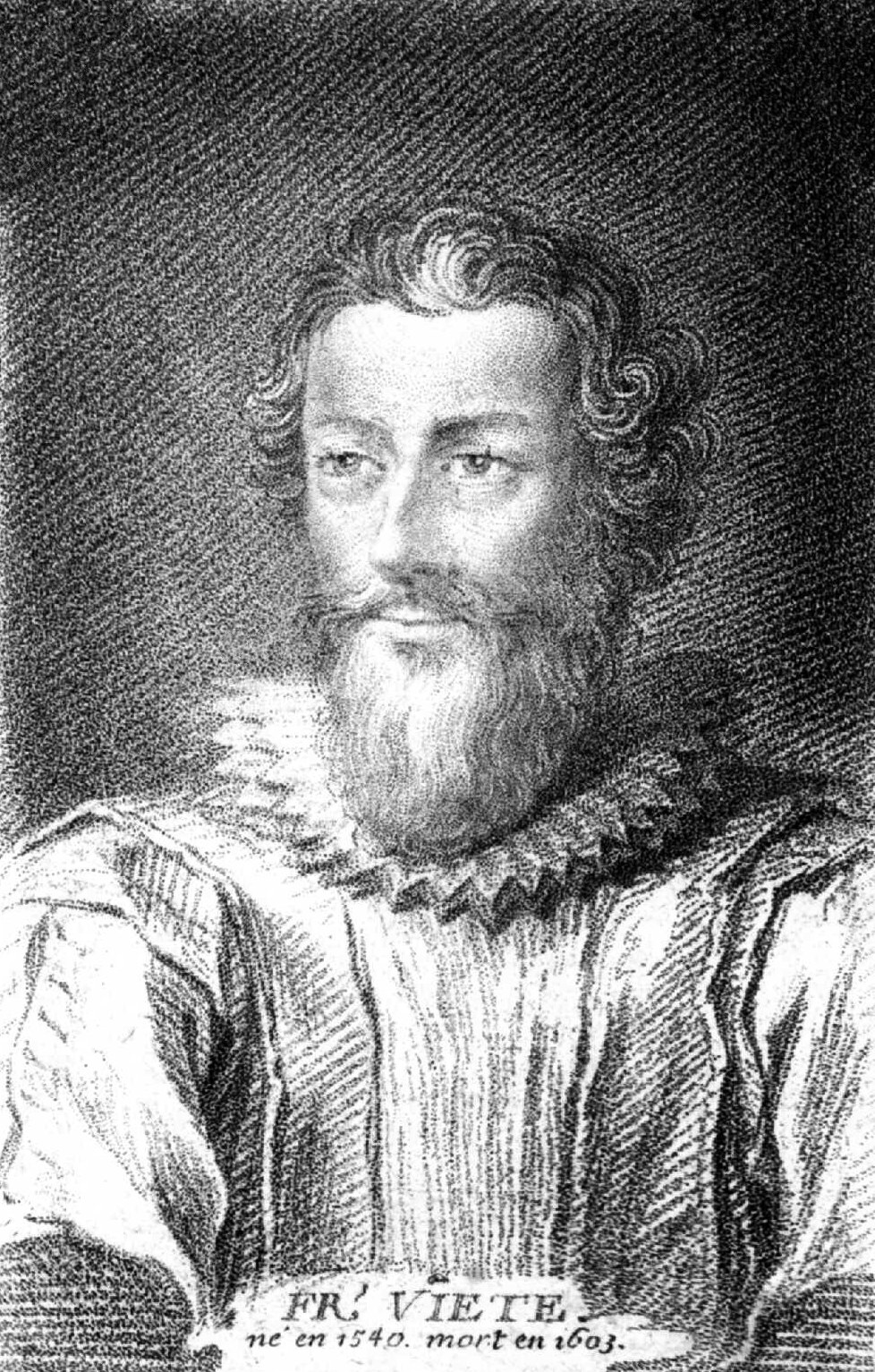
François Viète, born on December 13, 1540, in Fontenay-le-Comte, a small town in western France, approximately 50 kilometers from the coastal city of La Rochelle, is a pivotal figure in the history of mathematics. His life, marked by significant contributions to both mathematics and cryptography, intertwines with the turbulent political and religious landscape of 16th-century France. This article delves into the life, achievements, and lasting legacy of François Viète, highlighting his influence on modern mathematics and his role in the political affairs of his time.
Early Life and Education
François Viète was born into a family with a strong legal background. His father, Etienne Viète, was a lawyer, which greatly influenced François’s initial educational path. Viète received his early education in Fontenay-le-Comte before moving to Poitiers, about 80 kilometers east, where he attended the University of Poitiers. Given his father’s profession, it is not surprising that Viète pursued studies in law. In 1560, he graduated from the University of Poitiers with a law degree and embarked on a legal career.
Transition to a New Career
Viète’s legal career, however, was short-lived. After practicing law for just four years, he decided to change his professional direction. In 1564, he entered the service of Antoinette d’Aubeterre, a noblewoman, where he was tasked with overseeing the education of her daughter, Catherine de Parthenay. This role took him to La Rochelle, a city that would become a significant part of his life.
Political and Religious Turmoil
The period during which Viète lived was marked by intense political and religious unrest in France. The country was embroiled in a series of conflicts known as the French Wars of Religion, which began in 1562 and involved violent clashes between Catholics and Protestants. This turbulent environment would later play a crucial role in shaping Viète’s career and personal life.
A Return to Paris and Service to the Crown
In 1570, Viète left La Rochelle and moved to Paris. The following year, he began practicing law at the Paris Parliament, a significant institution in French governance. His legal expertise and growing reputation led to his appointment as a counselor to the Parliament of Brittany in Rennes in 1573. By 1576, Viète had entered the service of King Henry III of France. His role as “maître des requêtes” in the Parliament of Paris and his position as a special advisor to Henry of Navarre, the future King Henry IV of France, marked the height of his political influence.
Cryptography and Mathematical Contributions
One of Viète’s most notable contributions to history is his work in cryptography. During his service to Henry IV, Viète was tasked with deciphering encrypted messages from the Spanish, a task he performed with such skill that his success led to accusations of sorcery from his adversaries. Viète’s method involved a key over 500 characters long, a feat that underscored his mathematical prowess and his ability to apply mathematical concepts to real-world problems.
In addition to his cryptographic work, Viète made significant advancements in mathematics. His period of greatest mathematical productivity coincided with times when he was not directly involved in political affairs, notably between 1564 and 1568 and during his temporary removal from power between 1584 and 1589 due to the pressures of the Catholic League. Viète’s work during these periods laid the foundation for modern algebra, and he is often credited with introducing the use of letters to represent variables in equations.
Religious Conversion and Later Life
Despite being a Protestant (Huguenot), Viète eventually converted to Catholicism in 1594, likely due to the political pressures of serving a Catholic monarch. This conversion allowed him to continue his service under King Henry IV until 1602, after which he retired from public life. François Viète passed away in Paris in 1603, at the age of 63.
Legacy and Impact on Mathematics
François Viète’s legacy in the field of mathematics is profound. He is often referred to as the “father of modern algebra” for his introduction of symbolic notation in equations, a practice that is fundamental to modern mathematics. Viète’s work bridged the gap between classical Greek mathematics and the more advanced algebraic techniques that would later be developed during the Renaissance and beyond.
His contributions to trigonometry and astronomy, alongside his work in algebra, positioned Viète as a key figure in the scientific revolution. He was one of the first to systematically use algebra to solve geometrical problems, a method that was revolutionary at the time and paved the way for future mathematicians like Descartes and Fermat.
Conclusion
François Viète’s life is a testament to the power of intellectual curiosity and adaptability. From his beginnings in the legal profession to his pivotal role in the development of modern algebra and cryptography, Viète’s contributions have had a lasting impact on both mathematics and history. His ability to navigate the complex political and religious landscape of 16th-century France, while simultaneously advancing mathematical knowledge, underscores his importance as a historical figure.
Viète’s work laid the groundwork for future developments in mathematics and continues to be studied and revered by mathematicians and historians alike. His life, marked by both intellectual achievement and political intrigue, remains a fascinating chapter in the history of science.


