
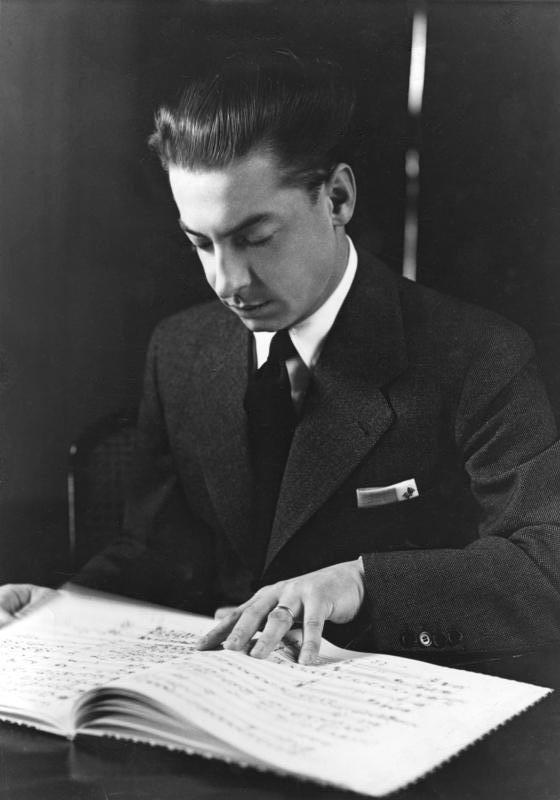
Herbert von Karajan, born on April 5, 1908, in Salzburg, Austria, is widely regarded as one of the most influential and controversial conductors of the 20th century. His career spanned several decades, during which he achieved unparalleled fame and left an indelible mark on the world of classical music. This article delves into the life, achievements, and legacy of Herbert von Karajan, exploring his rise to fame, his musical innovations, and the controversies that surrounded his career.
Early Life and Musical Beginnings
Herbert von Karajan was born into a cultured and affluent family in Salzburg. His father, Ernst von Karajan, was a prominent physician, and his mother, Martha Kosmac, hailed from a family with deep musical roots. Karajan’s musical journey began at a very young age. He started learning the piano at the tender age of four, displaying extraordinary talent. By the age of five, he was already performing in public, showcasing his prodigious abilities.
Karajan’s formal education in music took place at the Mozarteum in Salzburg, where he studied piano, theory, and conducting. His talent was evident, and it wasn’t long before he made his professional debut as a pianist at the age of 18. However, it was his passion for conducting that would define his career.
Rise to Fame
In 1927, at just 19 years old, Karajan was appointed as the assistant conductor at the Ulm Opera in Germany. This early opportunity allowed him to hone his skills and gain valuable experience in the world of opera and orchestral music. Two years later, in 1929, he made his debut as a conductor in Salzburg, marking the beginning of a career that would eventually elevate him to the highest echelons of classical music.
Karajan’s reputation as a conductor quickly grew, and by 1933, he was appointed as the principal conductor of the Aachen Opera. His tenure in Aachen was marked by a series of successful performances, and he soon caught the attention of the wider musical world. His ability to extract powerful and precise performances from his musicians became a hallmark of his conducting style.
World War II and Controversy
Herbert von Karajan’s career was not without controversy, particularly during the tumultuous years of World War II. In 1935, he joined the Nazi Party, a decision that would later haunt him and tarnish his legacy. Although his involvement with the party was seen by some as a pragmatic move to advance his career, it remains a contentious issue in discussions of his life.
During the war, Karajan held several prominent positions, including his appointment as the principal conductor of the Berlin State Opera in 1941. However, as the war came to an end, his association with the Nazi regime led to a temporary ban on his conducting career by the Allied forces. This period of professional exile lasted until 1947, when he was allowed to resume his career, though the shadow of his wartime actions would continue to follow him.
Post-War Success and Global Fame
Despite the controversies of his past, Karajan’s post-war career saw him achieve unprecedented levels of success and international fame. In 1949, he was appointed as the principal conductor for life of the Vienna Philharmonic, one of the most prestigious positions in the classical music world. This role solidified his status as a leading conductor of his time.
Karajan’s tenure with the Berlin Philharmonic, which began in 1955, is perhaps the most celebrated period of his career. Under his leadership, the orchestra achieved a level of precision and artistry that became legendary. Karajan’s meticulous attention to detail and his insistence on perfection helped the Berlin Philharmonic become one of the finest orchestras in the world.
During this period, Karajan also became a pioneer in the use of technology in classical music. He embraced the advent of new recording techniques and was among the first conductors to recognize the potential of the compact disc (CD) format. His recordings with the Berlin Philharmonic set new standards for audio quality and were highly influential in the development of the classical music recording industry.
The Karajan Legacy
Herbert von Karajan’s influence on classical music extends far beyond his performances and recordings. He was a visionary who understood the importance of technology in bringing classical music to a wider audience. His collaborations with major recording labels, such as Deutsche Grammophon, produced an extensive catalog of recordings that continue to be celebrated today.
Karajan’s legacy also includes his work as a mentor and promoter of young talent. He was instrumental in launching the careers of several prominent musicians, including the celebrated violinist Anne-Sophie Mutter, whom he discovered when she was just 13 years old. His commitment to nurturing young talent ensured that his impact on the world of music would be felt for generations to come.
In addition to his work in the concert hall and recording studio, Karajan was also a key figure in the world of music festivals. He founded the Salzburg Easter Festival in 1967, which quickly became one of the most prestigious events in the classical music calendar. The festival provided a platform for some of the world’s finest musicians and further cemented Karajan’s reputation as a leading figure in the arts.
Controversy and Criticism
While Karajan’s achievements are undeniable, his career was not without its detractors. Some critics accused him of being overly focused on perfection and accused him of prioritizing technical precision over emotional depth in his performances. His authoritarian style of conducting, which some musicians found stifling, also drew criticism.
Moreover, his association with the Nazi Party during World War II remained a source of controversy throughout his life. While Karajan always maintained that his membership in the party was purely for professional reasons, the issue continued to cast a shadow over his legacy.
Despite these criticisms, Karajan’s contributions to classical music are immense. He is credited with revolutionizing the art of conducting and setting new standards for orchestral performance. His recordings remain some of the most celebrated in the history of classical music, and his influence can be seen in the work of countless conductors who followed in his footsteps.
A Life in Numbers
- Birth: April 5, 1908, Salzburg, Austria
- Death: July 16, 1989, Salzburg, Austria
- Principal Positions:
- Assistant Conductor, Ulm Opera (1927)
- Principal Conductor, Aachen Opera (1933)
- Principal Conductor, Berlin State Opera (1941)
- Principal Conductor for Life, Vienna Philharmonic (1949)
- Principal Conductor, Berlin Philharmonic (1955-1989)
- Major Achievements:
- Over 1,500 recordings, many of which are considered definitive interpretations of classical works.
- Pioneered the use of technology in classical music, including early adoption of the compact disc.
- Founded the Salzburg Easter Festival in 1967.
Conclusion
Herbert von Karajan’s life was marked by extraordinary achievements, innovation, and controversy. His influence on the world of classical music is unparalleled, and his recordings continue to be a benchmark for quality and artistry. Despite the complexities of his legacy, there is no denying that Karajan was a towering figure in the history of music, whose work has left an indelible mark on the cultural landscape.
As we reflect on his life and career, it is clear that Herbert von Karajan was a conductor who transcended the ordinary, pushing the boundaries of what was possible in classical music and leaving a legacy that will be remembered for generations to come.


