
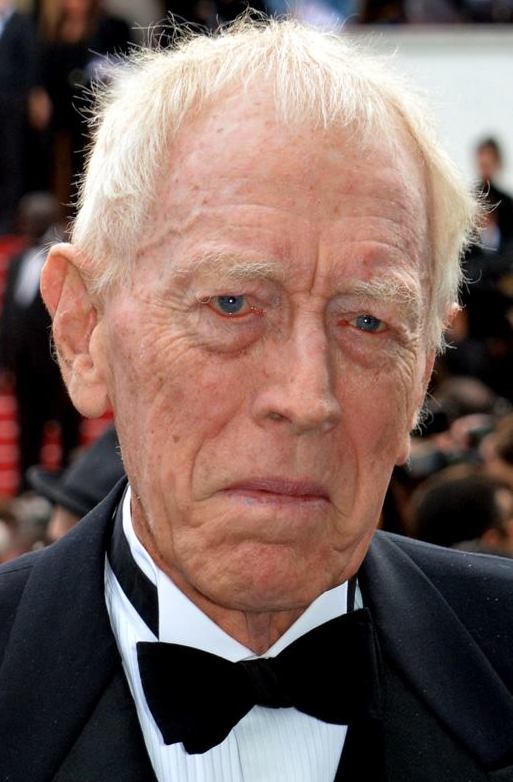
Max von Sydow, born as Carl Adolf von Sydow on April 10, 1929, in Lund, Sweden, was a towering figure in cinema whose career spanned more than seven decades. With his imposing presence, distinctive voice, and profound ability to embody complex characters, von Sydow became one of the most respected and recognized actors in both European and American cinema. His life and career are a testament to his versatility and dedication to the craft of acting, leaving an indelible mark on the world of film and theater.
Early Life and Education
Max von Sydow was born into a well-to-do and cultured family. His father, Carl Wilhelm von Sydow, was a prominent ethnologist and professor at Lund University, and his mother, Baroness Maria Margareta Rappe, was a schoolteacher. Raised in an environment that valued education and culture, von Sydow was exposed to the arts from a young age. His interest in theater began early, and by the time he was a teenager, he had formed an amateur theater group with friends, showcasing his burgeoning talent for acting.
In 1948, von Sydow enrolled at the Royal Dramatic Theatre in Stockholm, one of the most prestigious acting schools in Sweden. It was here that he honed his craft and began to lay the foundation for what would become an extraordinary career in acting. His time at the Royal Dramatic Theatre also marked the beginning of his lifelong passion for the stage, a passion that would remain a constant throughout his life.
The Bergman Years: A Defining Partnership
Max von Sydow’s career took a pivotal turn in the early 1950s when he was discovered by the legendary Swedish director Ingmar Bergman. This collaboration would go on to define much of von Sydow’s career and establish him as one of the most important actors of his generation. Their first film together, The Seventh Seal (1957), became a cinematic landmark, with von Sydow’s portrayal of the knight Antonius Block, who plays chess with Death, becoming one of the most iconic images in film history. The film’s existential themes, combined with von Sydow’s powerful performance, resonated with audiences worldwide, catapulting him to international fame.
Von Sydow’s collaboration with Bergman continued with a series of films that are now considered classics of world cinema. These include Wild Strawberries (1957), The Virgin Spring (1960), and Through a Glass Darkly (1961). Each of these films showcased von Sydow’s ability to convey deep emotional and psychological complexity, often portraying characters grappling with themes of faith, mortality, and human frailty. His work with Bergman not only solidified his status as a leading actor in European cinema but also set the stage for his later success in Hollywood.
Transition to Hollywood and International Fame
After achieving significant success in Sweden, Max von Sydow began to attract the attention of international filmmakers. His first major Hollywood role came in 1965 when he was cast as Jesus Christ in George Stevens’ epic film The Greatest Story Ever Told. The role was a significant departure from his earlier work with Bergman, and it introduced him to a broader international audience. Following this, von Sydow continued to take on diverse roles in Hollywood, showcasing his versatility as an actor.
One of his most memorable performances during this period was in William Friedkin’s horror classic The Exorcist (1973), where he played Father Merrin, a priest battling a powerful demonic force. Von Sydow’s portrayal of the wise and weathered priest became one of the defining roles of his career and solidified his reputation as a consummate actor capable of handling complex and challenging roles. His performance in The Exorcist earned him a Golden Globe nomination for Best Supporting Actor.
Throughout the 1970s and 1980s, von Sydow continued to work in both European and American films, taking on a wide variety of roles. He played a cold and calculating hitman in Three Days of the Condor (1975), a Nazi colonel in Victory (1981), and even appeared in the sci-fi epic Dune (1984) directed by David Lynch. Despite his growing success in Hollywood, von Sydow remained deeply connected to his European roots, often returning to Sweden to work on projects with Bergman and other European directors.
Expanding His Horizons: Directing and Later Career
In 1987, Max von Sydow took on a new challenge by stepping behind the camera to direct his first and only film, Katinka, a romantic drama based on the novel by Herman Bang. The film, which explored themes of love and loss, received critical acclaim and demonstrated von Sydow’s ability to craft a compelling narrative from the director’s chair. However, despite the success of Katinka, von Sydow chose to return to acting rather than pursue a full-time career as a director.
As von Sydow entered the later stages of his career, he continued to take on roles that allowed him to explore new facets of his talent. In 1987, he received his first Academy Award nomination for Best Actor for his performance in Pelle the Conqueror, a Danish film that told the story of a Swedish immigrant’s struggles in late 19th-century Denmark. His portrayal of the downtrodden but resilient Lasse Karlsson was both moving and powerful, further solidifying his reputation as one of the finest actors of his generation.
The 1990s saw von Sydow take on a variety of roles in both film and television. He appeared in the critically acclaimed film Awakenings (1990) alongside Robert De Niro and Robin Williams, and worked with renowned directors such as Wim Wenders and Lars von Trier. His role in von Trier’s Europa (1991) showcased his continued ability to bring depth and nuance to his characters, even in the most challenging and unconventional films.
A Return to the Stage and Final Roles
Despite his success in film, Max von Sydow never lost his love for the stage. In the later years of his career, he returned to theater, participating in readings of poetry and classic plays, reminding audiences of his roots in the dramatic arts. His stage work during this period was a testament to his enduring passion for acting and his commitment to the craft.
In the early 2000s, von Sydow continued to take on notable roles in major films. He worked with Steven Spielberg in Minority Report (2002), where he played a key antagonist in the futuristic thriller. His performance as a paralyzed father in The Diving Bell and the Butterfly (2007) was widely praised for its emotional depth and sensitivity. In 2010, he appeared in Martin Scorsese’s Shutter Island, playing a mysterious and enigmatic psychiatrist in a film that blended psychological suspense with noir elements.
At the age of 82, von Sydow received his second Academy Award nomination, this time for Best Supporting Actor, for his role in Extremely Loud & Incredibly Close (2011). In this film, he played a mute survivor of the Dresden bombings, a role that required him to convey deep emotion and character through expression and body language alone. His nomination was a fitting recognition of his ability to captivate audiences without the use of dialogue, a skill that few actors possess.
In his final years, von Sydow continued to work in both film and television, appearing in Star Wars: The Force Awakens (2015) and the popular HBO series Game of Thrones (2016). His appearance in Game of Thrones as the Three-Eyed Raven introduced him to a new generation of fans, many of whom were unaware of his extensive and storied career.
Legacy and Impact on Cinema
Max von Sydow passed away on March 8, 2020, at the age of 90. His death marked the end of an era for cinema, as he was one of the last surviving actors from the golden age of European arthouse cinema. His legacy, however, continues to live on through his body of work, which remains as compelling and influential today as it was during his lifetime.
Von Sydow’s impact on cinema is profound. He brought a level of gravitas and authenticity to his roles that few actors could match, whether he was playing a medieval knight, a Hollywood priest, or a futuristic villain. His collaborations with Ingmar Bergman are particularly noteworthy, as they produced some of the most important and enduring films in the history of cinema.
In addition to his work with Bergman, von Sydow’s contributions to international cinema cannot be overstated. He was one of the few actors who could seamlessly transition between European and American films, bringing the same level of intensity and dedication to every role he played. His work in horror, drama, science fiction, and historical epics showcased his versatility and his ability to adapt to different genres and styles.
Von Sydow’s legacy is also evident in the way he influenced subsequent generations of actors. His approach to acting, characterized by a deep commitment to understanding and embodying his characters, set a standard for actors worldwide. He was a mentor and inspiration to many, and his influence can be seen in the work of countless actors who followed in his footsteps.
Conclusion: The Enduring Influence of Max von Sydow
Max von Sydow was more than just an actor; he was a cinematic icon whose work transcended borders, languages, and genres. His contributions to film and theater are immeasurable, and his influence will continue to be felt for generations to come. From his early days with Ingmar Bergman to his final roles in major Hollywood productions, von Sydow’s career is a testament to his talent, dedication, and love for the art of acting.
As we reflect on his life and legacy, it is clear that Max von Sydow’s place in the history of cinema is secure. His performances will continue to inspire and captivate audiences, ensuring that his legacy endures long after his passing. Whether through his iconic roles in The Seventh Seal and The Exorcist, or his later work in films like Shutter Island and Game of Thrones, Max von Sydow remains a towering figure in the world of cinema, a true master of his craft.


