
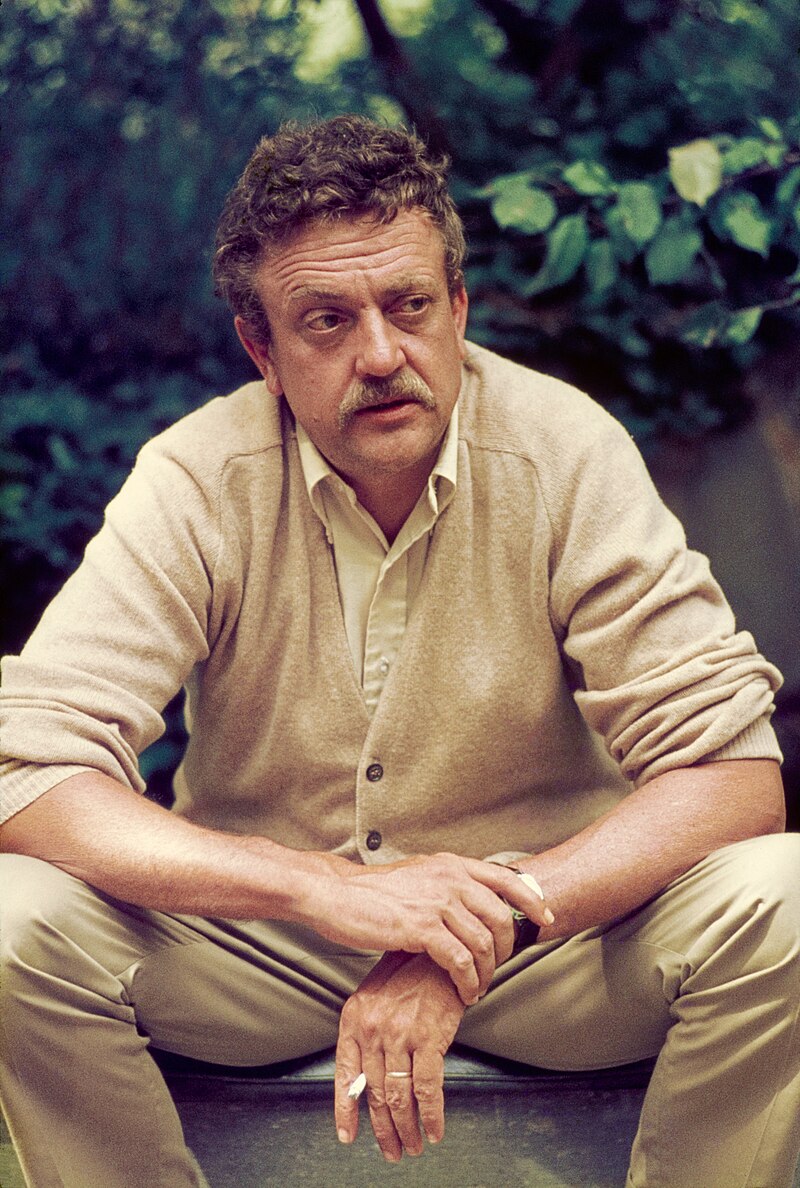
Kurt Vonnegut, born on November 11, 1922, in Indianapolis, Indiana, is a literary giant whose work transcends traditional genre classifications. Best known for his satirical and darkly humorous novels, Vonnegut’s writing often blends science fiction with deep social and political commentary. His impact on American literature is profound, and his works continue to be celebrated for their moral and philosophical insights.
Early Life and Background
Vonnegut was born into a family of German descent. His father, Kurt Vonnegut Sr., was a successful architect, and his mother, Edith Sophia Lieber, was a homemaker. The Vonnegut family, like many others, was deeply affected by the Great Depression, which began in 1929 when Kurt was just seven years old. The economic downturn had a devastating effect on the family, leading to significant financial losses and contributing to his mother’s tragic death. This period of hardship had a lasting impact on Vonnegut’s worldview, influencing the themes of despair, resilience, and absurdity that permeate his work.
Education and Early Career
Kurt Vonnegut’s educational journey was marked by his diverse interests. He initially studied biochemistry at Cornell University but left in 1943 to enlist in the U.S. Army during World War II. This decision would profoundly shape his life and career. As a soldier, Vonnegut was captured by German forces and held as a prisoner of war in Dresden. He survived the infamous Allied bombing of Dresden in 1945, an event that killed approximately 130,000 people. This horrific experience became the basis for his most famous novel, Slaughterhouse-Five (1969).
After the war, Vonnegut returned to the United States and pursued a degree in anthropology at the University of Chicago. During this time, he began working as a publicist for General Electric, but his passion for writing soon took over. His first novel, Player Piano (1952), a dystopian tale about a future society dominated by technology, was published during this period. Although the book received little commercial success, it marked the beginning of a prolific writing career.
Rise to Fame: Key Works and Themes
Vonnegut’s rise to literary fame was gradual, with each of his works contributing to his reputation as a master storyteller with a unique voice. His early novels, such as The Sirens of Titan (1959) and Cat’s Cradle (1963), explore complex themes through the lens of science fiction. The Sirens of Titan, for instance, delves into questions of free will, the nature of God, and the purpose of human existence, all while introducing readers to the “Tralfamadorians,” extraterrestrial beings who would appear in several of Vonnegut’s later works.
Cat’s Cradle is another significant novel, where Vonnegut critiques the arms race and the hubris of scientific endeavors. The novel’s invention of “Ice-Nine,” a substance capable of freezing water instantly and potentially ending life on Earth, serves as a powerful metaphor for the destructive capabilities of unchecked technological advancement.
However, it was Slaughterhouse-Five that truly cemented Vonnegut’s status as a leading figure in American literature. The novel is a semi-autobiographical account of Billy Pilgrim, a character who, like Vonnegut, survives the Dresden bombing. The narrative’s non-linear structure, blending of science fiction elements, and deep anti-war sentiment resonated with readers during the Vietnam War era, making it a seminal work of 20th-century literature.
Later Works and Shifts in Style
Following the success of Slaughterhouse-Five, Vonnegut continued to write novels that challenged societal norms and delved into existential questions. Breakfast of Champions (1973) and Slapstick (1976) showcased his evolving style, characterized by an increasingly fragmented narrative structure and a more pronounced use of dark humor.
Vonnegut’s later novels, such as Galápagos (1985) and Hocus Pocus (1990), reflect his deepening pessimism about the future of humanity. Galápagos, for example, is a novel set a million years in the future, where humans have evolved into seal-like creatures. The book is a satirical take on Darwinian evolution and the folly of human arrogance.
In addition to his novels, Vonnegut wrote numerous essays and short stories, often addressing contemporary issues such as environmental degradation, political corruption, and the absurdities of modern life. His final novel, Timequake (1997), explores the concept of free will and the inevitability of fate, themes that had long preoccupied his work.
Personal Life and Legacy
Vonnegut’s personal life was as complex and eventful as his writing. He married Jane Marie Cox in 1945, and the couple had three children together. They also adopted the three children of Vonnegut’s sister Alice, who died of cancer. However, the marriage eventually ended in divorce, and Vonnegut later married photographer Jill Krementz in 1979.
Vonnegut was an outspoken humanist and served as the honorary president of the American Humanist Association. His views on religion, politics, and society were often reflected in his work, making him a significant cultural critic of his time.
Kurt Vonnegut passed away on April 11, 2007, at the age of 84, following a fall in his Manhattan home. His death marked the end of an era, but his legacy lives on through his enduring literary works. In 2010, the Kurt Vonnegut Memorial Library was established in his hometown of Indianapolis, serving as a testament to his lasting impact on American culture.
Historical Context and Influence
Understanding Vonnegut’s work requires an appreciation of the historical context in which he wrote. The post-World War II era was a time of significant social and political change, with the Cold War, the civil rights movement, and the counterculture of the 1960s all shaping the American consciousness. Vonnegut’s writing reflects these turbulent times, often critiquing the absurdity of war, the dangers of authoritarianism, and the loss of individual autonomy in a rapidly changing world.
Vonnegut’s use of science fiction elements allowed him to explore these themes in ways that were both imaginative and deeply resonant with readers. His works often blur the line between reality and fantasy, challenging readers to question their assumptions about the world around them. This approach has made his work particularly relevant in times of social and political upheaval, ensuring that his books remain popular with new generations of readers.
In terms of literary influence, Vonnegut’s work has inspired countless writers, particularly in the genres of science fiction and satire. His ability to combine humor with profound philosophical insights set a standard for writers who followed, and his distinctive voice continues to be a touchstone for those exploring similar themes in their own work.
Conclusion: The Enduring Legacy of Kurt Vonnegut
Kurt Vonnegut’s contributions to American literature are immeasurable. His unique blend of science fiction, satire, and social commentary has left an indelible mark on the literary landscape. Vonnegut’s ability to tackle complex issues with humor and humanity made him a beloved figure both in his time and in the years since his death.
As we continue to grapple with the challenges of the modern world, Vonnegut’s work remains as relevant as ever, offering a lens through which to view the absurdities and contradictions of human existence. Whether through the tragicomedy of Slaughterhouse-Five or the satirical wit of Cat’s Cradle, Kurt Vonnegut’s voice continues to resonate, reminding us of the power of literature to challenge, to inspire, and to endure.


