
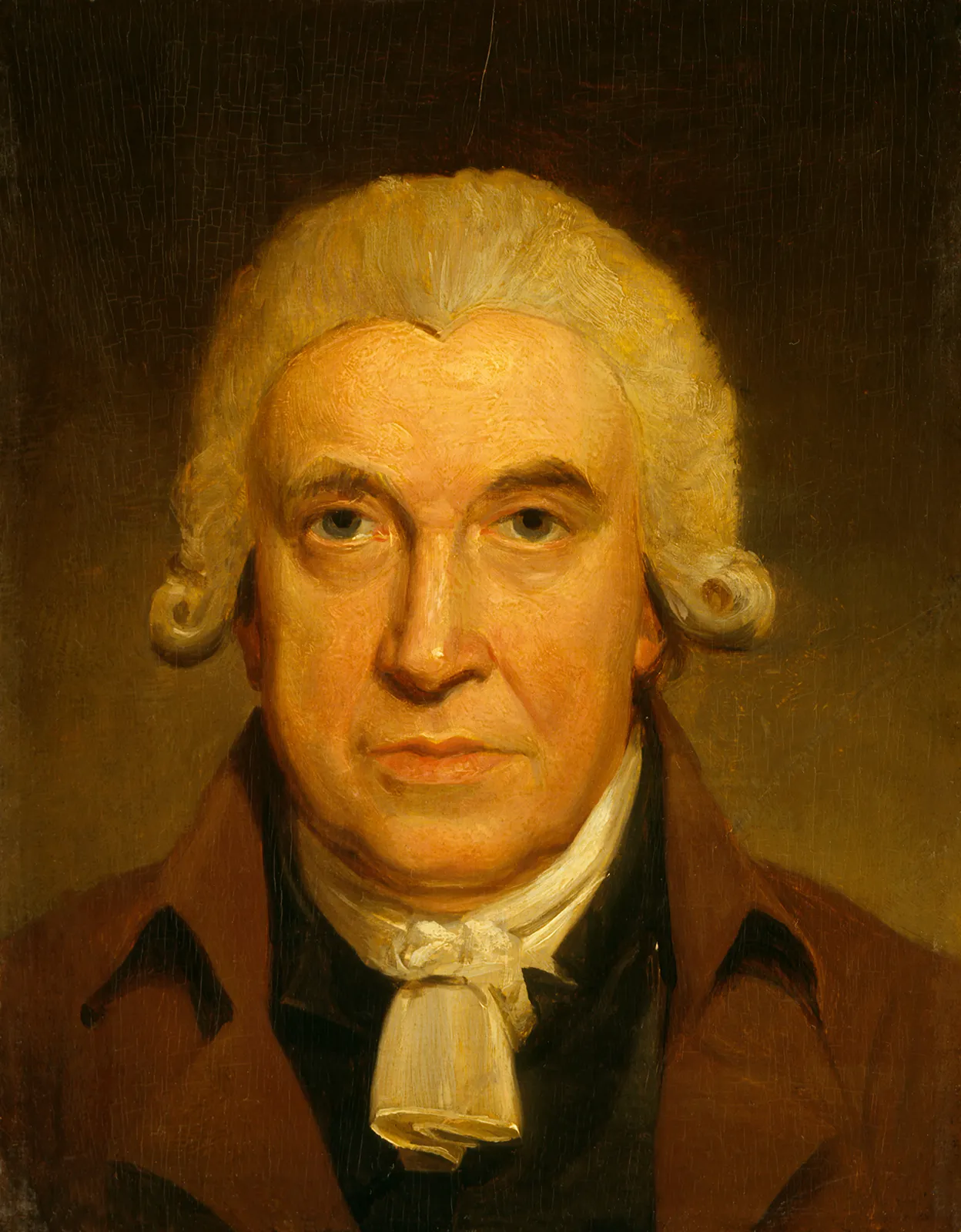
James Watt, born on January 19, 1736, in Greenock, Scotland, was an eminent inventor, mechanical engineer, and chemist whose improvements to the steam engine were fundamental to the advancements of the Industrial Revolution. Watt’s work significantly contributed to the fields of energy, thermodynamics, and mechanical engineering, making him a pivotal figure in the history of science and technology. His name is immortalized in the unit of power, the watt, symbolizing his lasting impact on modern industry and engineering.
Early Life and Education
James Watt was born into a relatively well-off family; his father was a shipwright and shipowner, while his mother hailed from a prosperous family in the Scottish Highlands. Watt’s early education was somewhat unconventional. Though he attended school, his frequent absences were due to health issues, and he was primarily educated at home by his mother. This home education allowed Watt to develop his skills in mathematics and manual crafts from a young age, fostering a lifelong curiosity and aptitude for technical work.
At the age of 18, Watt moved to London to further his education, where he studied instrument making under the mentorship of John Morgan, a master craftsman. However, after a year, Watt returned to Scotland due to health issues and continued his work in Glasgow, where he eventually established a small workshop. This workshop, located at the University of Glasgow, became a hub for Watt’s innovations and a place where he interacted with leading intellectuals of the time, including Joseph Black, a chemist who introduced the concept of latent heat. These interactions were crucial in shaping Watt’s understanding of thermodynamics, which later influenced his work on the steam engine.
Innovations in Steam Power
James Watt’s most significant contribution to the Industrial Revolution was his improvement of the steam engine. The story of Watt’s work with steam power began in 1764 when he was asked to repair a model of a Newcomen steam engine, which was then widely used for pumping water out of mines. While working on this engine, Watt noticed a critical flaw: the engine was highly inefficient, losing a significant amount of steam and therefore wasting energy.
Watt’s breakthrough came with the invention of the separate condenser, which he developed in 1765. This innovation allowed the steam engine to maintain a hot cylinder while condensing steam in a separate chamber, dramatically improving efficiency. By separating the condensation process from the cylinder, Watt’s design reduced energy losses and significantly increased the engine’s power output. This development not only enhanced the performance of steam engines but also made them more economical, thereby accelerating the adoption of steam power across various industries.
In 1769, Watt secured a patent for his steam engine design. However, bringing his invention to market was not straightforward. Watt faced numerous challenges, particularly financial ones, in developing a full-scale engine. It wasn’t until he partnered with John Roebuck, a Scottish entrepreneur, that he was able to continue his work. Roebuck provided the financial backing Watt needed, although this partnership was short-lived due to Roebuck’s financial troubles.
Partnership with Matthew Boulton and Industrial Impact
In 1775, Watt entered into a new partnership with Matthew Boulton, a successful manufacturer and the owner of the Soho Foundry in Birmingham. This partnership proved to be the turning point in Watt’s career. With Boulton’s financial support and business acumen, the Boulton & Watt company was able to manufacture and market Watt’s improved steam engines on a large scale.
The impact of Watt’s innovations was profound. The improved steam engine became a critical component of the Industrial Revolution, powering factories, mills, and mines across Britain and eventually the world. Watt’s engines were used not only for pumping water but also for driving machinery, allowing for greater industrial productivity and the expansion of the manufacturing sector. The efficiency of Watt’s engines also contributed to the growth of the coal industry, as steam engines became a key technology in mining operations.
One of Watt’s other significant contributions was the development of the concept of “horsepower” as a unit of measurement. To demonstrate the power of his engines to potential customers, Watt introduced the term “horsepower” to compare the output of his engines with that of a draft horse. He calculated that one horsepower was equivalent to 746 watts of power, a term that is still used today.
In 1781, Watt further enhanced his steam engine by inventing the rotary engine, which converted the up-and-down motion of the piston into rotational motion. This innovation made the steam engine even more versatile, enabling it to power a wide variety of industrial machines, from spinning machines in textile mills to water pumps and even early locomotives.
Later Years and Recognition
James Watt’s contributions to science and industry were widely recognized during his lifetime. In 1785, he was elected as a fellow of the Royal Society of London, one of the highest honors in the scientific community. His membership in the Lunar Society of Birmingham, a group of prominent industrialists, natural philosophers, and intellectuals, further solidified his standing as a leading figure in the advancement of technology during the Industrial Revolution.
In 1800, after a highly successful career, Watt retired from active business. He spent his later years traveling with his second wife, Ann MacGregor, whom he married in 1776 after the death of his first wife, Margaret Miller. Watt continued to work on various inventions and improvements to his existing designs during his retirement, though none were as groundbreaking as his earlier work on the steam engine.
Watt’s legacy is reflected not only in the continued use of steam power in various forms but also in the unit of power named in his honor: the watt. This unit, equivalent to one joule per second, is used universally to measure power in electrical systems, reflecting Watt’s enduring influence on the field of engineering and beyond.
Death and Legacy
James Watt passed away on August 19, 1819, at the age of 83, in his home in Handsworth, near Birmingham, England. His death marked the end of an era in industrial innovation, but his legacy continued to grow as the technologies he developed became the backbone of the modern industrial world.
Watt’s contributions to the Industrial Revolution cannot be overstated. His improvements to the steam engine made it the dominant source of power during the 19th century, driving the mechanization of industries and enabling unprecedented economic growth. Watt’s work laid the foundation for the development of modern power generation and mechanical engineering, influencing countless engineers and inventors who followed in his footsteps.
Watt’s impact is also commemorated in various ways beyond the unit of power that bears his name. Monuments and statues have been erected in his honor, and his name is enshrined in history as one of the greatest inventors of all time. The Watt steam engine remains a symbol of the ingenuity and innovation that characterized the Industrial Revolution and a testament to the profound impact that one individual can have on the course of history.
Conclusion
James Watt was a visionary whose work revolutionized the world. His improvements to the steam engine transformed it from a rudimentary machine into a powerful tool that fueled the Industrial Revolution, forever changing the landscape of industry and society. Watt’s legacy is not only found in the machines and technologies that arose from his inventions but also in the fundamental principles of engineering and thermodynamics that continue to underpin modern science and industry.
As one of the most important figures in the history of technology, James Watt’s life and achievements remind us of the power of innovation and the enduring impact of those who dare to imagine a better future. His name, immortalized in the unit of power, continues to inspire engineers, scientists, and inventors to push the boundaries of what is possible.


