
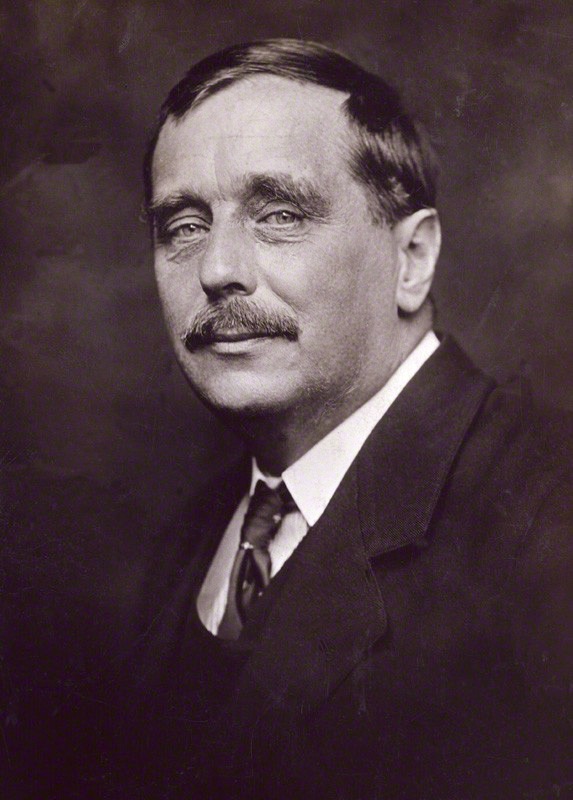
Herbert George Wells, more commonly known as H.G. Wells, is a name that resonates across the realms of literature and social commentary. Born on September 21, 1866, in Bromley, England, Wells is often hailed as one of the founding fathers of science fiction. His imaginative genius, combined with a deep understanding of contemporary science, allowed him to craft narratives that not only entertained but also provoked thought on the future of humanity. Wells’s works, such as The War of the Worlds, The Time Machine, and The Invisible Man, continue to influence science fiction writers and filmmakers to this day. Beyond his literary contributions, Wells was also a passionate advocate for social reform, with his political writings and public advocacy further cementing his legacy as a forward-thinking intellectual.
Early Life and Education
Herbert George Wells was born into a modest family. His father, Joseph Wells, was a professional cricket player and shopkeeper, while his mother, Sarah Neal, worked as a housekeeper. The family’s financial struggles meant that young Herbert was often on the move, working various jobs to help make ends meet. His early experiences with poverty and the working-class conditions of Victorian England would later inform much of his social commentary.
Wells’s early education was sporadic, as he had to leave school at the age of 14 to work as a draper’s apprentice. However, an accident that left him bedridden for several months turned out to be a blessing in disguise. During this time, Wells developed a voracious appetite for reading, devouring books that ranged from classics to contemporary science. His passion for learning eventually led him back to school, where he earned a scholarship to the Royal College of Science in London.
At the Royal College of Science, Wells studied under the tutelage of Thomas Henry Huxley, a prominent biologist and advocate of Charles Darwin’s theory of evolution. Huxley’s teachings had a profound impact on Wells, particularly his belief in the power of science to transform society. Wells graduated in 1888 with a degree in zoology, and he briefly worked as a teacher before turning to writing full-time.
Literary Beginnings and Breakthrough
Wells’s journey as a writer began somewhat accidentally. A bout of illness forced him to take time off from teaching, and during this period, he began writing short stories and articles to earn a living. His first major success came with the publication of The Time Machine in 1895. The novel, which introduced the concept of time travel through a machine, was an instant hit and established Wells as a leading voice in speculative fiction.
The Time Machine is more than just a story about time travel; it is a commentary on the social and economic inequalities of Wells’s time. The novel presents a dystopian future where humanity has evolved into two distinct species: the Eloi, who live a life of leisure but are intellectually and physically degenerate, and the Morlocks, who live underground and maintain the machinery that supports the Eloi’s existence. Wells uses this scenario to explore themes of class struggle, evolution, and the dangers of unchecked technological progress.
Following the success of The Time Machine, Wells continued to write prolifically. His next major works, The Island of Dr. Moreau (1896), The Invisible Man (1897), and The War of the Worlds (1898), cemented his reputation as a master of science fiction. Each of these novels introduced concepts and themes that were groundbreaking at the time and have since become staples of the genre.
Social Commentary and Political Engagement
While H.G. Wells is best known for his science fiction, his work extended far beyond the realm of speculative storytelling. Wells was deeply concerned with the social and political issues of his time, and he used his writing to advocate for change. His involvement with the Fabian Society, a socialist organization that sought to advance social democracy through gradual and reformist means, was particularly influential in shaping his views.
Wells’s political beliefs are evident in many of his later works, which often explore themes of social justice, inequality, and the potential for human progress. His novel The War in the Air (1908), for example, warns of the dangers of technological advancements in warfare, while The Sleeper Awakes (1910) depicts a future society dominated by corporate power and social stratification.
In addition to his fiction, Wells wrote extensively on politics, history, and education. His non-fiction works, such as Anticipations (1901), A Modern Utopia (1905), and The Outline of History (1920), offer detailed visions of a future society shaped by scientific and technological progress. Wells was a firm believer in the idea that science and reason could be harnessed to create a better world, and he was an outspoken advocate for world government, social planning, and education reform.
Later Works and Changing Worldview
As Wells grew older, his optimism about the potential for human progress began to wane. The outbreak of World War I in 1914 was a turning point for him, as the horrors of the war shattered his belief in the inevitability of progress. His later works reflect this shift in perspective, as he became increasingly concerned with the destructive potential of science and technology.
One of Wells’s most significant later works is The Shape of Things to Come (1933), a speculative novel that imagines a future world devastated by war and economic collapse. The novel is notable for its prediction of a second world war, as well as its portrayal of a dystopian society where totalitarian regimes use technology to maintain control over the population.
Despite his growing pessimism, Wells continued to write and speak out on social and political issues until the end of his life. In his final years, he became increasingly disillusioned with the state of the world, particularly in the wake of World War II and the rise of totalitarianism in Europe. His last book, Mind at the End of Its Tether (1945), reflects his bleak outlook on the future of humanity, as he questions whether the human race has the capacity to survive the challenges it faces.
Legacy and Influence
H.G. Wells’s impact on literature and culture cannot be overstated. His innovative use of science fiction to explore social, political, and philosophical ideas set a new standard for the genre and paved the way for future writers. Wells’s influence can be seen in the works of later science fiction authors such as Isaac Asimov, Arthur C. Clarke, and George Orwell, as well as in films, television shows, and other media that have adapted his stories or drawn inspiration from his ideas.
Beyond his contributions to science fiction, Wells’s social and political writings have also left a lasting legacy. His advocacy for education reform, social planning, and world government influenced the development of these ideas in the 20th century, and his work continues to be studied by scholars and students of history, politics, and literature.
Wells’s ability to blend scientific speculation with social commentary made him a unique and influential voice in the literary world. His work not only entertained but also challenged readers to think critically about the world around them and the future that lay ahead. Whether through his visions of alien invasions, time travel, or dystopian futures, Wells encouraged his readers to consider the consequences of technological progress and the importance of striving for a more just and equitable society.
Conclusion
Herbert George Wells was a visionary writer whose work transcended the boundaries of genre and continues to resonate with readers today. His pioneering contributions to science fiction laid the foundation for the genre as we know it, while his social and political writings offered a compelling critique of the world in which he lived. Wells’s life and career were marked by a deep commitment to exploring the potential and pitfalls of human progress, and his legacy remains a testament to the power of literature to inspire change.
As we look back on Wells’s life and work, we are reminded of the importance of imagination, curiosity, and critical thinking in shaping our understanding of the world and our place in it. In a time of rapid technological advancement and social change, Wells’s insights into the challenges and opportunities of the future are more relevant than ever. His work continues to inspire new generations of writers, thinkers, and dreamers, ensuring that his legacy will endure for years to come.


