
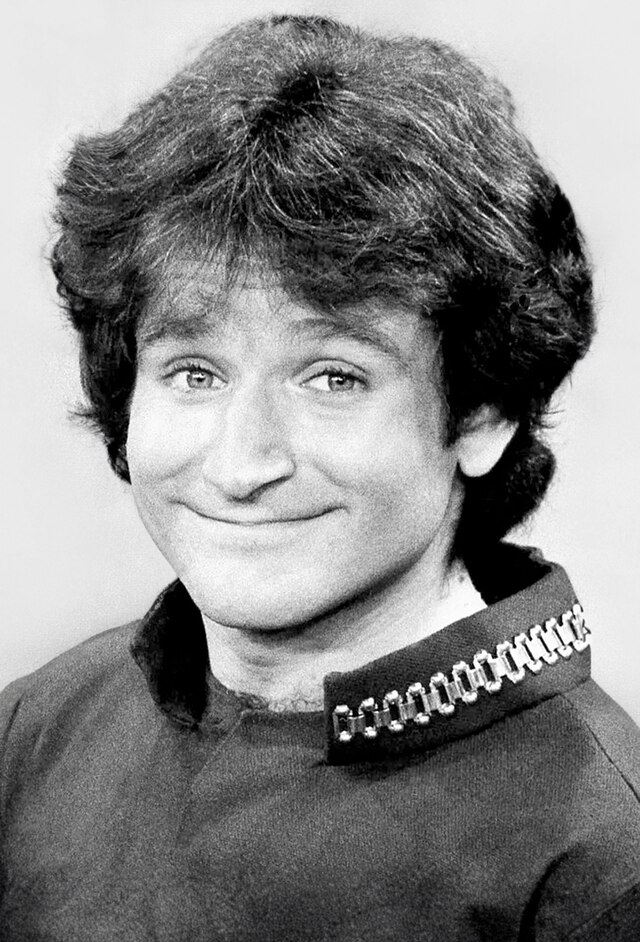
Robin Williams, born on July 21, 1951, in Chicago, Illinois, was an American actor and comedian whose extraordinary talent, unmatched wit, and incredible versatility made him one of the most beloved figures in the entertainment industry. Over the course of his career, Williams became known for his ability to effortlessly transition between comedy and drama, captivating audiences with performances that were as moving as they were hilarious. This article delves into the life, career, and enduring legacy of Robin Williams, offering a comprehensive exploration of his rise to fame and the highlights of his remarkable life.
Early Life and Passion for Performing
Robin Williams was born into a well-to-do family, with his father, Robert Fitzgerald Williams, serving as a senior executive at Ford Motor Company, and his mother, Laurie McLaurin, working as a model. Despite his privileged upbringing, Williams’s childhood was marked by loneliness. As a child, he was often left to entertain himself, which he did by creating imaginary characters and scenarios. This early experience of isolation may have fueled his later passion for performing, as it provided an outlet for his vivid imagination.
Williams’s love for performing became evident during his time at Redwood High School in Larkspur, California, where he was voted “Most Likely to Not Succeed” by his classmates—a prediction that would later prove far off the mark. After high school, he briefly studied political science at Claremont Men’s College but soon realized that his true calling was in the arts. Williams transferred to the College of Marin, where he studied theater, and later earned a scholarship to the prestigious Juilliard School in New York City. At Juilliard, he was mentored by the legendary actor John Houseman, who recognized Williams’s unique talent and encouraged him to pursue comedy.
Breakthrough with “Mork & Mindy”
Williams’s big break came in 1978 when he was cast as the alien Mork in the television series “Mork & Mindy.” The role, originally a guest spot on the show “Happy Days,” became so popular that it was spun off into its own series. “Mork & Mindy” quickly became a hit, and Williams’s portrayal of the eccentric, fast-talking alien with a penchant for saying “Na-no Na-no” and greeting people with the Vulcan-like “Nanu Nanu” salute made him a household name. The show ran for four seasons and established Williams as a comedic force to be reckoned with.
The success of “Mork & Mindy” provided Williams with the platform he needed to transition into film. His first major film role came in 1980, when he starred as the iconic comic strip character Popeye in Robert Altman’s film adaptation. Though the film received mixed reviews, Williams’s performance was praised, and it set the stage for his future in Hollywood.
Rise to Stardom: “Good Morning, Vietnam” and “Dead Poets Society”
The 1980s marked the beginning of Williams’s ascent to stardom. In 1987, he starred in “Good Morning, Vietnam,” a film that showcased his ability to blend comedy with drama. Williams played Adrian Cronauer, a radio DJ who uses humor to entertain troops during the Vietnam War. His performance, which included significant improvisation, was a critical and commercial success, earning him his first Academy Award nomination for Best Actor.
Following the success of “Good Morning, Vietnam,” Williams took on a more dramatic role in Peter Weir’s 1989 film “Dead Poets Society.” In this film, Williams played John Keating, an unorthodox English teacher at a conservative boarding school who inspires his students to “seize the day” and think for themselves. The film was both a critical and commercial success, and Williams’s portrayal of Keating became one of his most iconic roles. The phrase “O Captain! My Captain!” from the film has since become synonymous with Williams’s legacy, symbolizing his ability to inspire and uplift through his performances.
The 1990s: A Decade of Versatility and Success
The 1990s were a period of incredible versatility for Robin Williams, as he took on a wide range of roles that showcased his ability to move seamlessly between comedy and drama. In 1990, he starred alongside Robert De Niro in the film “Awakenings,” a poignant drama based on the true story of Dr. Malcolm Sayer, who discovers a treatment for patients who have been catatonic for decades. Williams’s portrayal of Sayer was both subtle and powerful, further proving his dramatic chops.
In 1991, Williams starred in Terry Gilliam’s “The Fisher King,” playing a homeless man named Parry who believes he is on a quest to find the Holy Grail. The role was both whimsical and tragic, earning Williams another Academy Award nomination. That same year, he played the adult Peter Pan in Steven Spielberg’s “Hook,” a film that allowed him to explore themes of childhood, imagination, and the passage of time.
Williams’s ability to appeal to both children and adults was perhaps best exemplified in his role as Mrs. Doubtfire in the 1993 film of the same name. In this beloved comedy, Williams played a father who disguises himself as a female housekeeper in order to spend more time with his children after a divorce. The film was a massive box office success and remains one of Williams’s most popular films.
The decade continued with a series of successful films, including “Jumanji” (1995), a fantasy adventure film that has since become a cult classic, and “The Birdcage” (1996), a comedy in which Williams played the owner of a drag nightclub. Williams also received critical acclaim for his role as Sean Maguire, a compassionate therapist, in the 1997 film “Good Will Hunting.” His performance earned him the Academy Award for Best Supporting Actor, a testament to his ability to deliver deeply emotional and nuanced performances.
The 2000s: Continuing to Captivate Audiences
As Williams entered the 2000s, he continued to take on diverse roles that demonstrated his range as an actor. He appeared in a number of films that allowed him to explore darker and more complex characters, such as in “One Hour Photo” (2002), where he played a lonely and obsessive photo developer, and “Insomnia” (2002), in which he portrayed a morally ambiguous writer opposite Al Pacino.
Despite these darker roles, Williams also continued to charm audiences with his comedic talents. He provided the voice of the Genie in Disney’s “Aladdin” (1992), a role that allowed him to showcase his improvisational skills and was widely praised for its energy and creativity. Williams also starred in family-friendly films like “RV” (2006) and lent his voice to animated films such as “Happy Feet” (2006).
Throughout the 2000s, Williams remained a beloved figure in Hollywood, known for his generosity, kindness, and ability to bring joy to audiences of all ages. He also returned to the stage, performing stand-up comedy and participating in charity events, further endearing himself to fans and colleagues alike.
Personal Struggles and Legacy
Despite his professional success, Robin Williams faced significant personal struggles throughout his life. He battled addiction to drugs and alcohol, issues that he was open about in interviews and comedy routines. In the early 1980s, Williams quit drugs and alcohol following the death of his close friend John Belushi, but he relapsed in the early 2000s and sought treatment several times over the years.
Williams also struggled with depression, a battle that became more public following his death in 2014. On August 11, 2014, Robin Williams was found dead in his home in Tiburon, California. His death was ruled a suicide by asphyxiation, and it was later revealed that he had been suffering from Lewy body dementia, a debilitating brain disorder that can cause severe depression, anxiety, and hallucinations.
The news of Williams’s death sent shockwaves through the entertainment industry and around the world. Tributes poured in from fans, colleagues, and friends, all of whom remembered Williams not only for his incredible talent but also for his kindness, generosity, and ability to make others laugh. His passing highlighted the importance of mental health awareness and the devastating impact of diseases like Lewy body dementia.
The Enduring Impact of Robin Williams
Robin Williams’s legacy is one of laughter, love, and compassion. He left behind a body of work that continues to entertain and inspire people around the world. From his early days on “Mork & Mindy” to his iconic film roles, Williams brought a unique energy and creativity to everything he did. His ability to connect with audiences, whether through comedy or drama, made him one of the most beloved actors of his generation.
Williams’s influence extends beyond his film and television work. He was also a philanthropist who supported numerous causes, including St. Jude Children’s Research Hospital, Comic Relief, and the USO. His commitment to giving back and helping those in need further solidified his place as a true Hollywood icon.
As we look back on the life and career of Robin Williams, it is clear that his impact on the world of entertainment will endure for generations to come. His performances, marked by a unique blend of humor and humanity, continue to resonate with audiences, reminding us of the power of laughter and the importance of kindness. Robin Williams was more than just a comedian or an actor—he was a force of nature, a beacon of joy in a world that often feels dark. His legacy will live on, not only through his films but also through the countless lives he touched with his generosity and spirit.


