
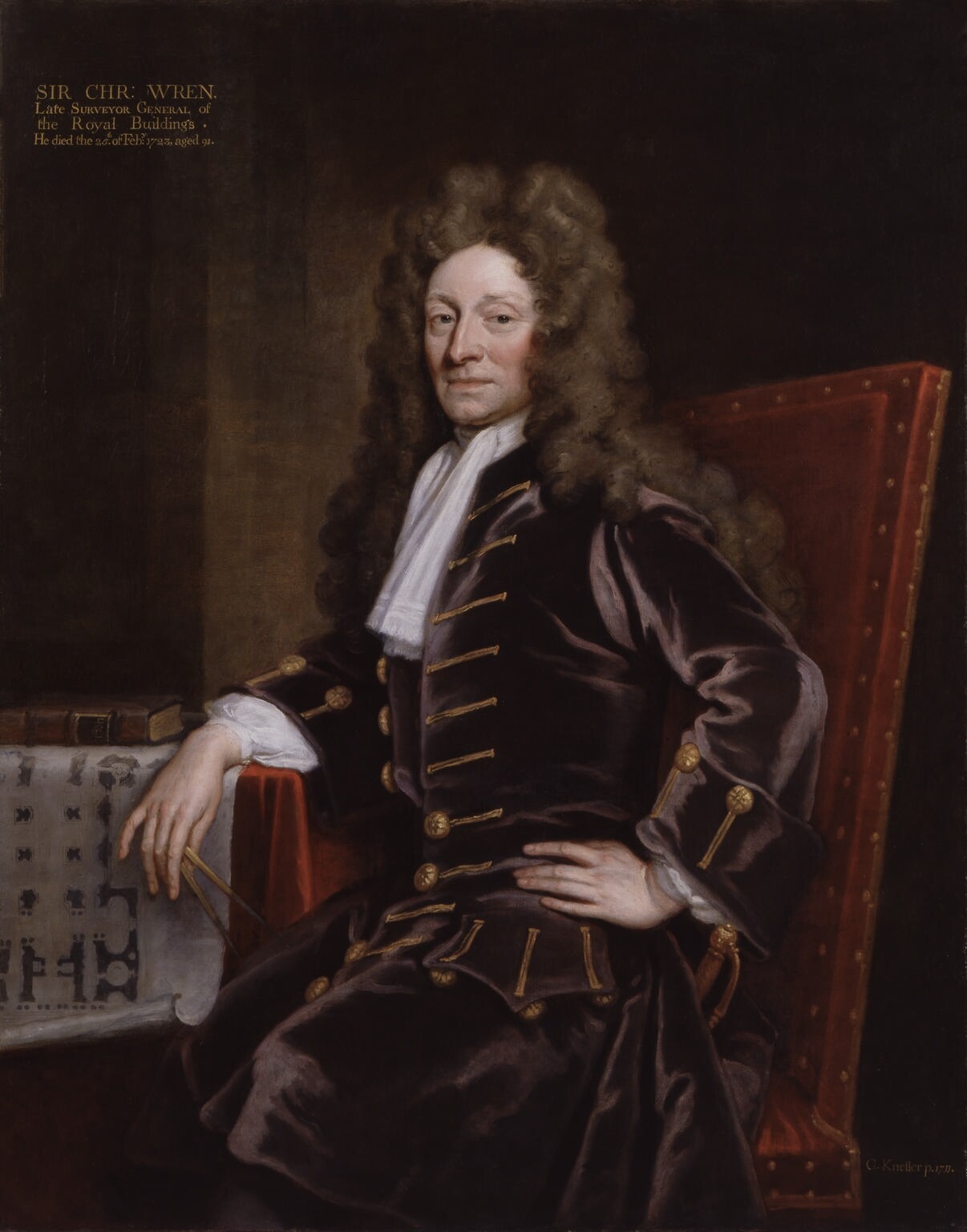
Christopher Wren is a name that holds significant weight in the annals of architecture and science. Born on October 20, 1632, in East Knoyle, Wiltshire, England, Wren’s legacy as one of the most influential architects of the 17th century remains unparalleled. He is best known for his pivotal role in the reconstruction of London following the Great Fire of 1666, particularly for designing the iconic St. Paul’s Cathedral. Wren’s life, however, is marked by much more than his architectural achievements. He was a polymath, a professor of astronomy, a founding member of the Royal Society, and a figure whose influence spanned across the realms of science and art.
Early Life and Education
Christopher Wren was born into a family with strong ties to the Church of England. His father, Christopher Wren Sr., was the Dean of Windsor, a position that brought the family into close contact with the royal court. This proximity to the monarchy would later play a significant role in Wren’s career. The political upheavals of the time, particularly during the Commonwealth period under Oliver Cromwell, led to some difficulties for the Wren family, but they managed to maintain their social standing.
Wren’s early education was rigorous and comprehensive. He attended Westminster School, one of the leading schools in England, where he developed a strong foundation in classical studies. He then proceeded to Wadham College, Oxford, a place that would foster his intellectual growth and where he would begin to make a name for himself in scientific circles.
At Oxford, Wren’s interests in mathematics and astronomy flourished. He was admitted to All Souls College, Oxford, where he would later become a professor of astronomy. His academic career was distinguished, and his reputation as a brilliant scientist grew rapidly. In 1657, Wren was appointed as the Gresham Professor of Astronomy in London, and four years later, he took up the prestigious Savilian Chair of Astronomy at Oxford.
Scientific Achievements and Contributions
Christopher Wren’s contributions to science were not limited to architecture. His work in astronomy and mathematics was highly regarded by his contemporaries. He was a founding member of the Royal Society, an institution that remains one of the most important scientific organizations in the world. The Royal Society was established in 1660, and Wren served as its president from 1680 to 1682.
Wren’s scientific work earned him the respect of many of the leading intellectuals of his time, including Sir Isaac Newton. Newton, known for his critical and often uncharitable views of his peers, acknowledged Wren’s brilliance as a scientist. Wren’s work in astronomy included the design of instruments for the observation of celestial bodies, and his mathematical studies contributed to the advancement of knowledge in various scientific fields.
Despite his achievements in science, it is Wren’s architectural legacy that has left the most enduring mark on history.
Architectural Legacy: Rebuilding London
The Great Fire of London in 1666 was a catastrophic event that destroyed much of the city, including 87 churches and numerous other buildings. The fire presented an unprecedented opportunity for Christopher Wren to apply his architectural skills on a grand scale. Appointed as the King’s Surveyor of Works, Wren was given the monumental task of redesigning and rebuilding the city.
The centerpiece of Wren’s architectural legacy is undoubtedly St. Paul’s Cathedral. The original St. Paul’s had been severely damaged in the fire, and Wren was commissioned to design a new cathedral. The design and construction of St. Paul’s would occupy Wren for the next 35 years, from 1675 to 1710. The result was a masterpiece of Baroque architecture, blending classical elements with innovative design. The cathedral’s dome, inspired by St. Peter’s Basilica in Rome, became an iconic symbol of London and remains one of the largest in the world.
St. Paul’s Cathedral is not just an architectural triumph; it also holds deep symbolic significance. It represented the resilience of London and its people, rising from the ashes of the Great Fire to create something even more magnificent. Wren faced significant opposition during the construction, particularly from those who preferred a more traditional Gothic style. However, his vision prevailed, and the cathedral stands today as a testament to his genius.
In addition to St. Paul’s, Wren was responsible for designing and overseeing the construction of numerous other buildings in London. He rebuilt 51 churches, many of which still stand today, including St. Bride’s, St. Mary-le-Bow, and St. Stephen Walbrook. Each of these churches bears Wren’s distinct architectural style, characterized by elegant proportions, careful attention to detail, and a harmonious blend of form and function.
Wren also played a key role in the design of other significant buildings in London, including the Royal Observatory in Greenwich, which would become the foundation of modern astronomy and navigation. The observatory, designed with the help of Wren’s colleague Robert Hooke, is famous for being the location of the Prime Meridian, the reference point for Greenwich Mean Time.
Later Life and Honors
As Wren’s architectural career flourished, so did his recognition by the crown and the wider society. In 1673, Wren was knighted by King Charles II, a reflection of his contributions to the nation. He also served as a Member of Parliament on several occasions between 1685 and 1705, though his political career was less distinguished than his architectural and scientific work.
Despite his success, Wren faced challenges and controversies. The length of time it took to complete St. Paul’s Cathedral drew criticism, as did the cost overruns associated with the project. However, these challenges did little to diminish Wren’s reputation. By the time of his death on February 25, 1723, he was widely regarded as one of the greatest architects of his time.
Wren was buried in the crypt of St. Paul’s Cathedral, a fitting resting place for the man who had devoted much of his life to its creation. His tomb bears an inscription in Latin that reads: “Lector, si monumentum requiris, circumspice,” which translates to “Reader, if you seek his monument, look around you.” This simple yet profound epitaph encapsulates Wren’s enduring legacy; his work is his monument, visible in the skyline of London and in the numerous buildings that bear his distinctive touch.
Wren’s Influence on Architecture and Culture
Christopher Wren’s influence extends far beyond the buildings he designed. His work helped shape the architectural landscape of London, and his innovations in design and construction techniques set new standards in the field. Wren’s approach to architecture was rooted in the principles of classical design, but he was also a forward-thinking innovator who was not afraid to incorporate new ideas and technologies.
One of Wren’s most significant contributions to architecture was his use of structural ironwork, which allowed for greater flexibility in design and construction. This innovation paved the way for the development of modern architectural techniques. Wren’s work also influenced the development of the Georgian style, which would dominate British architecture in the 18th century.
Beyond architecture, Wren’s contributions to science and the intellectual life of his time were equally important. As a founding member of the Royal Society, Wren helped foster an environment of inquiry and discovery that would lead to significant advancements in science and technology. His interdisciplinary approach, combining science, mathematics, and architecture, exemplified the Renaissance ideal of the polymath and left a lasting impact on subsequent generations of architects and scientists.
Wren’s legacy is also reflected in the many institutions and buildings named in his honor. The Wren Library at Trinity College, Cambridge, is one of the most famous, housing an extensive collection of rare books and manuscripts. The library itself is a masterpiece of design, with its grand, light-filled interior exemplifying Wren’s skill in creating spaces that are both functional and aesthetically pleasing.
Personal Life and Historical Context
Christopher Wren’s life spanned a period of significant political and social change in England. Born during the reign of Charles I, Wren lived through the English Civil War, the Commonwealth period under Oliver Cromwell, the Restoration of the monarchy under Charles II, and the subsequent Glorious Revolution. These events shaped the world in which Wren lived and worked, influencing his career and his contributions to the nation.
Wren’s personal life was marked by both success and tragedy. He married twice; his first wife, Faith Coghill, died young, leaving him a widower with a young son. Wren remarried in 1677 to Jane Fitzwilliam, with whom he had two children. Tragically, Jane also died young, leaving Wren to raise his children alone. Despite these personal losses, Wren remained dedicated to his work, finding solace in his architectural and scientific pursuits.
In the broader historical context, Wren’s work can be seen as part of the larger movement of the English Baroque, a style characterized by grandeur, drama, and an emphasis on symmetry and proportion. Wren’s interpretation of the Baroque was more restrained than that of his continental counterparts, reflecting the English preference for elegance and refinement over the more extravagant expressions of the style seen in places like Italy and France.
Christopher Wren’s Enduring Legacy
Today, nearly 300 years after his death, Christopher Wren’s legacy continues to be felt. His buildings remain some of the most visited and admired in the world, attracting millions of tourists each year. St. Paul’s Cathedral, in particular, stands as a symbol of London and of the resilience of its people.
Wren’s influence is also evident in the continued study and appreciation of his work. Architects and historians alike continue to draw inspiration from his designs, and his contributions to science and architecture are still celebrated in academic circles.
In conclusion, Christopher Wren was a man of extraordinary talent and vision. His contributions to architecture, science, and the intellectual life of his time have left an indelible mark on history. Whether through the soaring dome of St. Paul’s Cathedral, the innovative designs of London’s churches, or his work with the Royal Society, Wren’s legacy is one of brilliance and enduring influence. As we look around at the monuments he left behind, we are reminded of the profound impact one individual can have on the world.


