
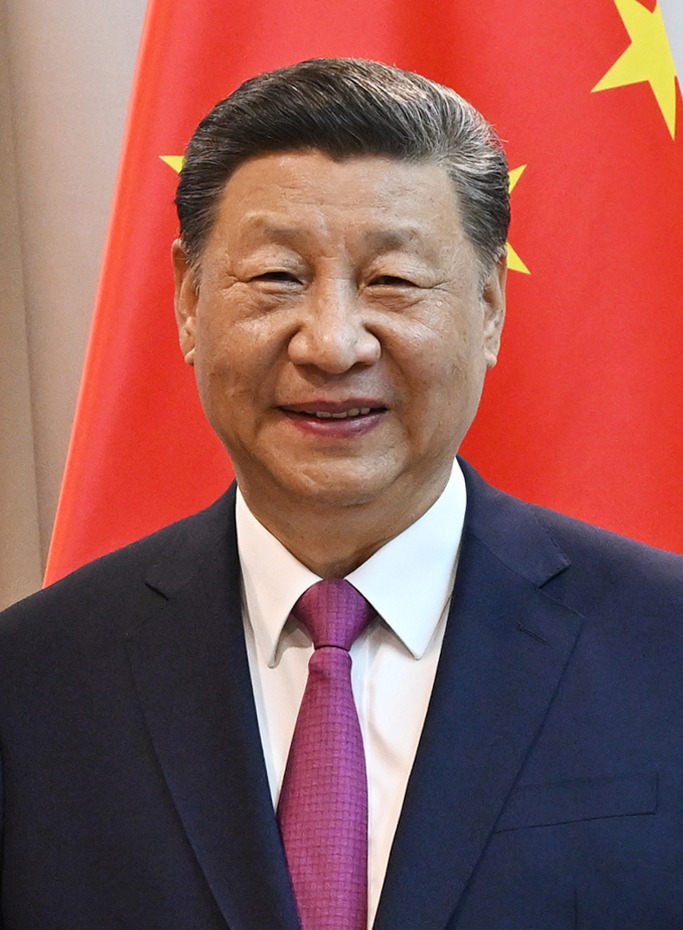
Xi Jinping, born on June 15, 1953, in Beijing, is one of the most influential political figures of the 21st century. As the current General Secretary of the Communist Party of China (CPC), the President of the People’s Republic of China, and the Chairman of the Central Military Commission, Xi holds the highest offices in the country, effectively making him China’s paramount leader. His rise to power, marked by strategic maneuvering and a consolidation of authority, has redefined China’s political landscape and its role on the global stage.
Early Life and Political Roots
Xi Jinping was born into a prominent Chinese political family. His father, Xi Zhongxun, was a revolutionary hero and a high-ranking official in the Communist Party, holding positions such as head of propaganda and vice-premier. However, during the Cultural Revolution, Xi Jinping’s family fell out of favor, leading to the elder Xi’s purge. This period was a tumultuous time for the young Xi Jinping, who was sent to the countryside in Yanchuan County, Shaanxi Province, to live in exile and work in rural areas as part of Mao Zedong’s campaign to “re-educate” urban youth.
These formative years in the countryside profoundly influenced Xi Jinping, instilling in him a deep understanding of rural China and a resilience that would later define his political career. Despite these hardships, Xi was determined to pursue higher education and eventually succeeded in enrolling at Tsinghua University, where he studied chemical engineering. It was during his time at Tsinghua that Xi joined the Communist Party of China, beginning his ascent through the ranks of the party.
Climbing the Political Ladder
After graduation, Xi Jinping embarked on a political career that saw him steadily climb the ranks within the Communist Party. His early roles included serving as a party official in various capacities in different provinces, where he gained a reputation for being a pragmatic and effective administrator. His governance in the provinces of Hebei, Fujian, and Zhejiang particularly stood out, showcasing his ability to tackle corruption and drive economic growth.
In 1999, Xi became the governor of Fujian, where he focused on economic development and environmental conservation. His tenure in Fujian also marked the beginning of his anti-corruption initiatives, which he would later expand on a national scale. By 2002, Xi had risen to the position of party secretary in Zhejiang Province, one of China’s most economically dynamic regions. Here, he continued to push for economic reforms and attracted significant foreign investment, further solidifying his reputation as a capable leader.
Xi Jinping’s political career took a decisive turn in 2007 when he was appointed as the party secretary of Shanghai, China’s financial hub. Although his tenure in Shanghai was brief, it was highly impactful, and his ability to manage the city’s complex political environment caught the attention of the party’s top leadership. Later that year, Xi was appointed to the Politburo Standing Committee, the apex of power in the Communist Party, marking his entry into China’s highest echelons of power.
Rise to National Leadership
In 2008, Xi Jinping was officially designated as the successor to then-President Hu Jintao when he was appointed as Vice President of China and Vice Chairman of the Central Military Commission. This move set the stage for his eventual rise to the presidency. Xi’s role as Vice President saw him take on significant responsibilities, including managing China’s Olympic Games preparations and representing China on the international stage.
Xi’s ascent to the top was completed in 2012 when he was appointed General Secretary of the Communist Party of China, the most powerful position in the country. In March 2013, he was formally elected as President of the People’s Republic of China, and soon after, he became the Chairman of the Central Military Commission, consolidating his control over the country’s armed forces.
Consolidation of Power
Xi Jinping’s tenure has been marked by a significant consolidation of power, making him one of the most powerful leaders in China since Mao Zedong. Unlike his predecessors, who adhered to the two-term limit, Xi has effectively removed this restriction, paving the way for him to remain in power indefinitely. This was achieved through a constitutional amendment in 2018, which abolished the term limits for the presidency.
Xi’s consolidation of power has been accompanied by a sweeping anti-corruption campaign that has seen the downfall of numerous high-ranking officials, including potential rivals. This campaign, while ostensibly aimed at rooting out corruption, has also served to eliminate political opposition and solidify Xi’s control over the party and the state. Critics argue that this has led to the emergence of a “democratura,” a blend of democracy and dictatorship, where the facade of democratic processes masks the concentration of power in the hands of one individual.
Domestic Policies and Vision for China
Xi Jinping’s domestic policies have been characterized by a focus on strengthening the Communist Party’s control over all aspects of Chinese society, from the economy to culture. Under his leadership, China has seen an increase in state control over the economy, a trend that contrasts with the market-oriented reforms of his predecessors. Xi’s administration has emphasized the importance of maintaining stability and has taken a hardline approach to dissent, implementing stringent measures to suppress any form of opposition.
A key component of Xi’s vision for China is the concept of the “Chinese Dream,” which he first articulated shortly after taking office. This vision encompasses the rejuvenation of the Chinese nation, aiming to restore China to its historical position as a global power. It also includes goals such as poverty alleviation, economic modernization, and military strengthening. The Chinese Dream is central to Xi’s domestic agenda and has been used to rally support for his policies and reforms.
International Relations and Global Impact
Xi Jinping’s leadership has also had a profound impact on China’s foreign policy. Under his guidance, China has adopted a more assertive stance on the global stage, seeking to expand its influence through initiatives like the Belt and Road Initiative (BRI). Launched in 2013, the BRI aims to build infrastructure and trade networks connecting Asia, Europe, and Africa, reflecting China’s ambitions to shape global trade and economic patterns.
However, Xi’s assertiveness has also led to tensions with other global powers, particularly the United States. The trade war with the U.S., initiated during Donald Trump’s presidency, marked a significant shift in Sino-American relations, with both countries imposing tariffs on each other’s goods. While Xi initially responded with strong rhetoric, the economic fallout from the trade war led to a more cautious approach, with China eventually seeking to negotiate a truce to mitigate the damage.
Xi’s leadership has also seen the rise of what some have termed a “cult of personality,” drawing comparisons to Mao Zedong. The Communist Party has increasingly promoted Xi’s image as the embodiment of Chinese culture and values, with his ideology being enshrined in the party’s constitution. In 2021, the party officially declared Xi’s ideology as a core component of Chinese socialism, equating it with the contributions of Mao Zedong and Deng Xiaoping.
Handling of the COVID-19 Pandemic
Xi Jinping’s leadership during the COVID-19 pandemic has further solidified his position within China. The Chinese government’s early response to the outbreak in Wuhan, including strict lockdowns and mass testing, was initially criticized for its harshness but ultimately credited with controlling the virus’s spread more effectively than in many other countries. China’s rapid economic recovery post-pandemic also bolstered Xi’s standing domestically and internationally.
The pandemic response has also been used to justify further tightening of state control, with increased surveillance and censorship aimed at preventing dissent and maintaining public order. These measures have drawn criticism from human rights organizations, but they have also reinforced the image of Xi Jinping as a strong leader capable of navigating crises.
Personal Life and Public Image
Xi Jinping’s personal life has been the subject of much interest, both in China and abroad. He was first married to Ke Lingling, the daughter of the Chinese ambassador to the United Kingdom, but the marriage ended in divorce due to incompatibility. In 1987, Xi married Peng Liyuan, a famous folk singer who has since played a prominent role as China’s First Lady. The couple has one daughter, Xi Mingze, who studied at Harvard University under an assumed name to protect her privacy.
Despite his immense power, Xi Jinping was relatively unknown to the wider Chinese public until the early 2000s. However, his image has since been carefully managed by the state, portraying him as a man of the people, with a deep connection to the rural population. This image has been reinforced by stories of his hardships during the Cultural Revolution, as well as his regular appearances in media showing him interacting with ordinary citizens.
Legacy and Future Prospects
Xi Jinping’s legacy is still in the making, but there is no doubt that he has already left an indelible mark on China and the world. His centralization of power, combined with his vision for China’s rejuvenation, has set the country on a path that will have significant implications for global politics in the coming decades. Whether Xi’s policies will lead to long-term stability and prosperity for China remains to be seen, but his influence on the nation’s direction is undeniable.
As Xi enters his third term, his future moves will be closely watched by both allies and adversaries. The abolition of term limits has raised questions about the future of China’s leadership succession, with some speculating that Xi may seek to remain in power for life. His leadership will continue to shape China’s domestic and international policies, with potential consequences for the global order.
In conclusion, Xi Jinping’s rise from a youth in rural exile to the most powerful man in China is a testament to his political acumen and determination. His tenure as China’s leader has been marked by significant changes in both domestic governance and foreign relations, making him one of the most consequential figures in contemporary world history.


