
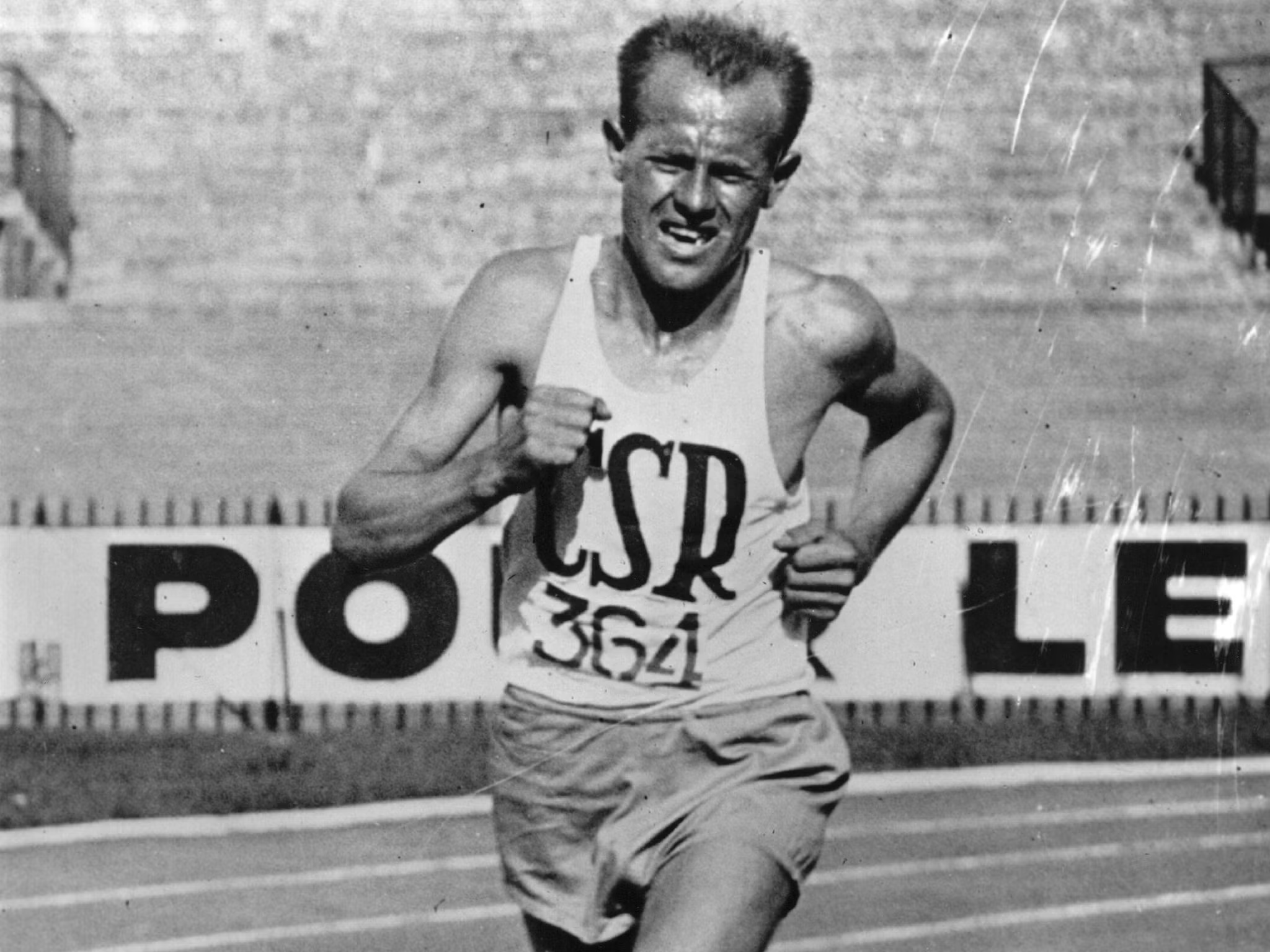
Emil Zatopek, often referred to as the “Czech Locomotive,” was one of the greatest long-distance runners in history. Born on September 19, 1922, in Kopřivnice, Czechoslovakia (now the Czech Republic), Zatopek’s remarkable achievements in athletics, especially at the Olympic Games, have immortalized him as a legend in the world of sports. His unconventional running style and relentless training methods set him apart, making him a symbol of endurance and determination.
Early Life and Introduction to Running
Emil Zatopek was born into a humble family in the Moravian region of Czechoslovakia. He was one of six children in a family that faced financial difficulties, with his father working as a shoemaker. As a young boy, Zatopek showed no particular interest in sports. In fact, his entry into the world of running was somewhat accidental.
At the age of 16, while working at a Bata shoe factory in Zlín, Zatopek was encouraged to participate in a local race organized by the factory. Despite his initial reluctance, he decided to compete and surprisingly finished second, despite having no formal training. This unexpected result sparked his interest in running, and he began to train more seriously, even though he continued to work full-time at the factory.
During World War II, Zatopek’s training intensified. He joined the Czech Army, which allowed him to dedicate more time to his running. It was during this period that he developed his famous training regimen, which included long runs in heavy army boots and grueling interval workouts that would become the foundation of his success.
The Rise of a Legend: Early Competitions and Olympic Success
Zatopek’s talent became evident on the international stage at the European Athletics Championships in Oslo in 1946, where he finished fifth in the 5,000 meters. This performance was just a prelude to his future dominance in long-distance running. His breakthrough came at the 1948 London Olympics, where he won the gold medal in the 10,000 meters and the silver medal in the 5,000 meters. His victory in the 10,000 meters was particularly impressive, as he finished nearly a minute ahead of the second-place runner.
Zatopek’s running style was unorthodox, to say the least. He ran with his head tilted back, his elbows close to his body, and a grimace of pain on his face. This style, far from the smooth and efficient form of other runners, led many to underestimate him. However, his tenacity and strength allowed him to outlast his competitors, even when it seemed that he was struggling.
The London Olympics marked the beginning of a period of dominance for Zatopek. Over the next several years, he set multiple world records and remained virtually unbeatable in long-distance events. From 1949 to 1954, he remained undefeated in the 10,000 meters, winning 38 consecutive races.
The 1952 Helsinki Olympics: A Historic Triple Gold
Zatopek’s most legendary performance came at the 1952 Helsinki Olympics, where he achieved what many consider one of the greatest feats in the history of athletics. In just over a week, he won three gold medals in the 5,000 meters, 10,000 meters, and the marathon. Remarkably, the marathon was the first he had ever run.
In the marathon, Zatopek employed a simple yet effective strategy: he followed the pace of the British world record holder, Jim Peters. As the race progressed, Zatopek famously asked Peters if the pace was too fast, to which Peters, trying to bluff, said it was. Zatopek replied, “Okay, then I’ll go faster,” and proceeded to accelerate, eventually leaving Peters and the rest of the field behind. Zatopek finished the race alone, entering the stadium to thunderous applause from the crowd, securing his place in Olympic history.
This triple victory was unprecedented and has never been matched in the history of the Olympics. Zatopek’s achievement earned him the nickname “the Czech Locomotive,” a testament to his relentless pace and endurance.
Innovations in Training: Interval Training Pioneer
One of Zatopek’s most significant contributions to athletics was his pioneering use of interval training, a method that involves short bursts of intense effort followed by periods of rest or lower intensity. This approach was revolutionary at the time and laid the foundation for modern endurance training.
Zatopek’s training sessions were famously intense. He often ran 400-meter intervals—sometimes hundreds in a single session—on various surfaces, including sand and snow. He also ran with weights and trained in heavy boots, believing that these methods would make him stronger and more resilient. His dedication to training was legendary, and his methods have influenced generations of athletes across all sports.
Later Career and Struggles with the Communist Regime
As Zatopek’s athletic career continued, his fame grew, but so did the challenges he faced, particularly under the repressive Communist regime in Czechoslovakia. Despite being a member of the Communist Party, Zatopek was known for his independent thinking and his support for fellow athletes who were excluded from competition due to political reasons.
At the 1956 Melbourne Olympics, Zatopek, then 34 years old, competed in the marathon despite being well past his prime and suffering from an injury. Although he finished in sixth place, his determination to compete and complete the race further cemented his status as a sports legend.
After his athletic career ended, Zatopek became a vocal critic of the Communist government, especially during the Prague Spring of 1968, a period of political liberalization in Czechoslovakia. He supported the reformist leader Alexander Dubček and was one of the signatories of the “Two Thousand Words” manifesto, which called for greater political freedom.
When the Soviet Union invaded Czechoslovakia to suppress the Prague Spring, Zatopek’s outspoken support for Dubček led to severe consequences. He was expelled from the Communist Party, stripped of his military rank, and forced into menial jobs, including working as a laborer in a uranium mine and later as a night watchman. These years were difficult for Zatopek, but he remained steadfast in his beliefs.
Later Life, Legacy, and Recognition
Despite the hardships he faced, Zatopek’s spirit remained unbroken. In the late 1970s, he was allowed to return to Prague and work as a translator and consultant for the Ministry of Sport. However, it wasn’t until the fall of the Communist regime in 1989 that Zatopek was fully rehabilitated and recognized for his contributions to athletics and his courage in standing up to political oppression.
In the years following the Velvet Revolution, Zatopek received numerous honors, both in his native Czech Republic and internationally. He was celebrated not only for his athletic achievements but also for his integrity, humility, and resilience.
Emil Zatopek passed away on November 21, 2000, in Prague, at the age of 78. His death was mourned by the global sports community, and his legacy as one of the greatest athletes of all time was firmly cemented. In 2002, a bronze statue of Zatopek was unveiled in the gardens of the Olympic Museum in Lausanne, Switzerland, honoring his contributions to the world of athletics.
Zatopek’s influence extends far beyond his record-breaking performances. His innovative training methods, particularly interval training, have become a staple in the training regimens of athletes worldwide. His philosophy of pushing beyond the limits, encapsulated in his famous quote, “If you want to win something, run 100 meters. If you want to experience something, run a marathon,” continues to inspire runners and athletes across the globe.
Conclusion
Emil Zatopek’s life and career embody the spirit of perseverance, innovation, and courage. From his humble beginnings in Czechoslovakia to his historic victories on the Olympic stage, Zatopek’s journey is a testament to what can be achieved through determination and hard work. His legacy as “the Czech Locomotive” endures, not only in the records he set and the medals he won but also in the hearts of those who continue to be inspired by his story. Zatopek’s contributions to athletics and his stand for justice and human dignity make him a true legend in every sense of the word.


