
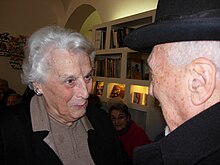
Tullia Zevi, born Tullia Calabi on February 2, 1919, in Milan, Italy, was an influential Italian journalist, writer, and leader within the Jewish community. Her life, spanning nearly a century, was marked by significant contributions to journalism, Jewish cultural life, and interfaith dialogue. Zevi’s journey from a young girl in pre-war Italy to a prominent figure in European and global Jewish circles is a testament to her resilience, intellect, and unwavering commitment to justice and human rights.
Early Life and Education
Tullia Calabi was born into a cultured and affluent Jewish family in Milan. Her father was a well-respected lawyer, and her upbringing was steeped in intellectual and cultural pursuits. Zevi’s early education was rooted in classical studies, which provided her with a strong foundation in the humanities. She attended the University of Milan, where she studied philosophy, but her academic journey was abruptly interrupted by the enactment of the Italian racial laws in 1938.
The racial laws, which discriminated against Jews in all aspects of life, including education and employment, forced the Calabi family to flee Italy. Tullia and her family sought refuge in Switzerland, where she continued her studies at the Sorbonne in Paris. However, the escalating threat of Nazi Germany prompted the family to relocate once again, this time to the United States. They made the journey on the last ship to leave France before the German occupation.
Life in the United States: Musical Pursuits and Anti-Fascist Activism
In the United States, Tullia Zevi enrolled at the Juilliard School of Music in New York, where she studied harp. She also attended Radcliffe College in Cambridge, Massachusetts. Zevi’s musical talents led her to perform with the Boston Youth Orchestra and the New York City Symphony, showcasing her versatility and passion for the arts.
During her time in New York, Zevi became actively involved in anti-fascist circles. It was within these intellectual and political communities that she began her journalism career, almost by accident, working for a local Italian-American radio station. Her experiences in the United States, particularly her exposure to diverse ideas and cultures, would profoundly shape her later work as a journalist and cultural leader.
Return to Italy and Entry into Journalism
The end of World War II marked a new chapter in Tullia Zevi’s life. She returned to Italy in the mid-1940s, now married to Bruno Zevi, a prominent architect and art critic. The couple had married in New York in 1940, in a ceremony held at the Spanish Synagogue, and their return to Italy was driven by a desire to contribute to the reconstruction of their homeland after the devastation of the war.
In Italy, Tullia Zevi transitioned from music to journalism, a profession she described as “cotto e mangiato” (cooked and eaten), implying it was something she adopted out of necessity but quickly grew to excel in. Her early journalistic work included reporting on the Nuremberg Trials, where she provided insights into the prosecution of Nazi war criminals. This experience solidified her commitment to human rights and the pursuit of justice, themes that would continue to resonate throughout her career.
Leadership in the Jewish Community
Tullia Zevi’s influence extended far beyond journalism. In 1978, she was elected vice president of the Italian Jewish Community, a position she held for five years before being elected president in 1983. She was the first and only woman to hold this prestigious position, reflecting her pioneering spirit and the respect she commanded within the community.
As president of the Italian Jewish Community, Zevi played a crucial role in fostering dialogue between Jewish and non-Jewish communities in Italy and Europe. She was a strong advocate for interfaith understanding and worked tirelessly to combat anti-Semitism and promote Jewish culture and education. Her leadership extended to the international stage as well; she served as the president of the European Jewish Congress and was a member of the Executive of the European Congress of Jewish Communities.
Zevi’s tenure as president was marked by her efforts to modernize the Jewish community in Italy, ensuring that it remained vibrant and relevant in a rapidly changing world. She also sought to strengthen the ties between the Jewish diaspora and Israel, advocating for a deeper connection to Jewish heritage and identity.
International Recognition and Honors
Tullia Zevi’s contributions to journalism, culture, and human rights did not go unnoticed. She worked as a correspondent for several major publications, including the Israeli newspaper “Maariv” and the London-based “Jewish Chronicle.” From 1948 to 1963, she was a correspondent for the “Jewish Telegraphic Agency,” and from 1946 to 1976, she reported for the “Religious News Service” in New York. Her writing was characterized by a deep commitment to truth and an unwavering dedication to the principles of justice and equality.
In 1988, Zevi was appointed president of the Commission for Intercultural and Interfaith Relations of the European Jewish Congress. This role underscored her lifelong dedication to promoting understanding and cooperation between different cultural and religious groups.
Zevi’s achievements were recognized with numerous awards and honors throughout her life. In November 1992, she was nominated as Italy’s candidate for the European Woman of the Year award. The following month, President Oscar Luigi Scalfaro awarded her the title of Cavaliere di Gran Croce, Italy’s highest honor, in recognition of her outstanding contributions to the nation.
Her accolades continued with the 1993 “8 March: Woman in School, Culture, and Society” award from the Roman cultural association “Il Margine” and the “Woman of Courage 1993” award from the National Association of Women Electors. In March 1994, the Italian Ministry of Cultural Heritage presented her with the Gold Medal for her contributions to education, art, and culture.
Zevi’s legacy was further cemented in 1997 when she received the “Firenze – Donna” award for her international achievements. In 1998, she was elected a member of the Commission for Interculturalism of the Ministry of Education and served on the Parliamentary Commission of Inquiry into the conduct of the Italian contingent during the humanitarian mission in Somalia from 1993 to 1994.
Later Life and Publications
Tullia Zevi continued to be an active and influential voice well into her later years. In 1998, she was elected a member of the Italian Commission for UNESCO, reflecting her ongoing commitment to cultural preservation and education.
In 2007, Zevi published a book titled “Ti racconto la mia storia. Dialogo tra nonna e nipote sull’ebraismo” (Let Me Tell You My Story: A Dialogue Between Grandmother and Grandchild on Judaism). The book, structured as a conversation between Zevi and her granddaughter, offers insights into Jewish history, culture, and identity, as well as Zevi’s personal experiences and reflections. It serves as both a memoir and a teaching tool, aimed at passing on Jewish traditions and values to future generations.
Zevi’s later years were marked by continued involvement in cultural and educational initiatives, ensuring that her work would have a lasting impact. Her death on January 22, 2011, just shy of her 92nd birthday, marked the end of an era, but her legacy lives on through her contributions to journalism, Jewish life, and intercultural dialogue.
Legacy and Impact
Tullia Zevi’s life and work have left an indelible mark on Italian society and the global Jewish community. Her leadership within the Italian Jewish Community, her pioneering work as a journalist, and her tireless advocacy for human rights and intercultural understanding have inspired countless individuals and continue to resonate today.
Zevi’s legacy is multifaceted. As a journalist, she broke barriers and provided a voice for the marginalized, using her platform to shed light on issues of justice and human dignity. As a leader, she guided the Italian Jewish Community through times of change, ensuring its resilience and relevance in the modern world. As an educator and author, she passed on her knowledge and values to future generations, leaving behind a body of work that continues to educate and inspire.
In a world that is often divided by differences, Tullia Zevi’s life serves as a powerful reminder of the importance of dialogue, understanding, and the pursuit of justice. Her contributions to journalism, culture, and human rights are a testament to her vision of a world where all people, regardless of their background, can live with dignity and respect.
Conclusion
Tullia Zevi’s journey from a young girl in Milan to one of the most influential figures in Italian and Jewish cultural life is a story of resilience, courage, and unwavering commitment to the principles of justice and human rights. Her work as a journalist, community leader, and advocate for intercultural dialogue has left a lasting legacy that continues to inspire and guide future generations.
Zevi’s life is a testament to the power of words and the impact of leadership rooted in integrity and compassion. Her contributions have not only shaped the Jewish community in Italy but have also had a profound impact on the broader cultural and social landscape. As we reflect on her life and achievements, we are reminded of the enduring importance of standing up for what is right and the power of one individual to make a difference in the world.


