
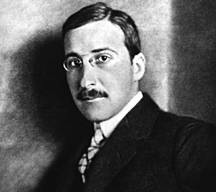
Stefan Zweig was a renowned Austrian writer, playwright, and biographer, born on November 28, 1881, in Vienna, then the capital of the Austro-Hungarian Empire. His life, career, and eventual tragic end are intertwined with the tumultuous events of the early 20th century, including both World Wars, which significantly shaped his works and worldview.
Early Life and Education
Stefan Zweig was born into an affluent Jewish family, with his father, Moritz Zweig, being a wealthy industrialist, and his mother, Ida Brettauer, hailing from a family of Italian bankers. His privileged upbringing in Vienna exposed him to the vibrant intellectual and artistic scene of the city, although Zweig himself found formal education monotonous and uninspiring.
Despite his disinterest in school, Zweig was an avid reader and writer from a young age. His early literary influences included notable figures such as Rainer Maria Rilke and Hugo von Hofmannsthal. In 1900, Zweig enrolled at the University of Vienna to study philosophy but soon transferred to Berlin, where he continued his education. During his university years, he published his first book of poetry, “Silberne Saiten” (Silver Strings), in 1901, which marked the beginning of his prolific writing career.
The European Experience and Rise to Fame
After completing his studies with a thesis on Hippolyte Taine, a French critic and historian, in 1904, Zweig began to travel extensively across Europe. His travels took him to Paris, London, and other cultural hubs, where he had the opportunity to meet and interact with influential literary figures like Hermann Hesse, Georges Duhamel, and Emile Verhaeren.
Zweig’s reputation as a writer grew as he contributed essays, short stories, and articles to the Viennese newspaper Neue Freie Presse. He also began translating works by prominent authors such as Paul Verlaine and Camille Lemonnier, further expanding his literary horizons. In 1906, he published “Die frühen Kränze” (Early Wreaths), a collection of poetry, followed by the drama “Tersites” in 1907.
The years leading up to World War I were particularly productive for Zweig. He traveled to Asia and America, gaining new perspectives that influenced his later works. During this period, he developed a close friendship with the French writer Romain Rolland and met Friderike Maria von Winternitz, who would later become his wife.
World War I and its Aftermath
The outbreak of World War I in 1914 had a profound impact on Zweig. Initially, he returned to Vienna, but as the war progressed, he moved to neutral Switzerland, where he connected with other intellectuals, including Ferruccio Busoni and James Joyce. His experiences during the war led him to adopt a more pacifist stance, which would be reflected in his later works.
In the post-war years, Zweig continued to write prolifically, producing some of his most famous works. His play “Jeremias,” written in response to the horrors of the war, and the biographical collection “Drei Meister” (Three Masters), which featured biographies of Dostoevsky, Dickens, and Balzac, were particularly well-received. Zweig’s ability to capture the human experience in his writings earned him widespread acclaim and solidified his status as a leading literary figure.
The Peak of Success in the 1920s
The 1920s marked the height of Zweig’s literary career. After marrying Friderike in 1920, the couple settled in Salzburg, Austria, where Zweig enjoyed immense success. His novellas “Brief einer Unbekannten” (Letter from an Unknown Woman) and “Amok” became bestsellers, and he continued to explore historical themes in works like “Der Kampf mit dem Dämon” (The Struggle with the Demon), which delved into the lives of Hölderlin, Kleist, and Nietzsche.
Zweig’s biographical works also garnered significant attention during this period. His biographies of historical figures such as Joseph Fouché and Marie Antoinette provided readers with detailed insights into the political and social contexts of their times. The biography of Marie Antoinette, published in 1932, is considered one of his most significant literary achievements.
The Darkening Horizon: The Rise of Nazism
The rise of Nazism in the 1930s brought a dark turn to Zweig’s life. In 1933, his works were among those burned by the Nazis, a fate shared by other prominent intellectuals like Thomas Mann, Albert Einstein, and Sigmund Freud. The increasing persecution of Jews in Austria and Germany prompted Zweig to leave his homeland in 1934, initially moving to London.
The political climate in Europe continued to deteriorate, and in 1938, after the annexation of Austria by Nazi Germany, Zweig applied for British citizenship. That same year, he divorced Friderike and married Lotte Altmann, a much younger woman who had been his secretary. With Lotte, Zweig left Europe for good in 1940, moving to New York and later to Brazil.
Final Years and Tragic End
Zweig’s final years were marked by a deep sense of despair and hopelessness. Although he continued to write, including his famous memoir “Die Welt von Gestern” (The World of Yesterday), he struggled with the loss of his European homeland and the rise of totalitarianism. In 1941, Zweig and Lotte settled in Petrópolis, Brazil, a small town near Rio de Janeiro.
On February 23, 1942, at the age of 60, Stefan Zweig and Lotte Altmann tragically ended their lives by ingesting a fatal dose of barbiturates. Their bodies were found lying side by side in bed, with a farewell note in Portuguese, in which Zweig expressed his hope that his friends would see the dawn after the long night that had engulfed the world.
Zweig’s suicide shocked the literary world and remains a poignant reminder of the profound impact that the political and social upheavals of the 20th century had on individuals, particularly those who, like Zweig, were deeply sensitive to the human condition.
Legacy and Impact
Stefan Zweig’s works have left a lasting legacy in the world of literature. His ability to delve into the psychological depths of his characters, his keen observations of society, and his profound humanism have made his writings timeless. His biographies, novellas, and essays continue to be read and appreciated by readers worldwide.
Zweig’s life and works also serve as a powerful testament to the cultural and intellectual vibrancy of pre-World War II Europe. His friendships with other literary giants, his travels, and his experiences during the war years provided him with a unique perspective that he masterfully conveyed in his writings.
Today, Zweig is remembered not only for his literary contributions but also for his advocacy of peace and understanding in a world that was increasingly divided by hatred and violence. His tragic end underscores the deep personal toll that the events of his time took on him, making his life story as compelling and significant as the characters he so vividly brought to life in his works.
In summary, Stefan Zweig was a literary genius whose life and works were profoundly shaped by the historical context in which he lived. From his early years in Vienna to his tragic end in Brazil, Zweig’s journey through the cultural and political upheavals of the 20th century offers valuable insights into the human experience. His writings remain a testament to his enduring impact on literature and his unwavering commitment to the ideals of peace, understanding, and humanism.


