
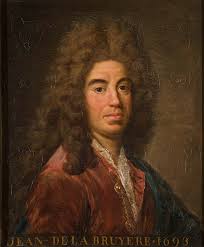
Jean de La Bruyère is a name that resonates with scholars, literary enthusiasts, and historians alike. Born on August 16, 1645, in Paris, La Bruyère lived through one of the most transformative periods in French history. His life and work are often overshadowed by the grander figures of his time, such as Molière and Racine, but La Bruyère carved a niche for himself as a moralist, writer, and critic, whose keen observations on human behavior continue to be relevant today.
Early Life and Background
Jean de La Bruyère was born into a bourgeois family, a background that provided him with a unique perspective on the class dynamics of his time. Unlike many of his contemporaries who hailed from noble families, La Bruyère’s middle-class origins allowed him to observe the aristocracy with a critical eye, which later became a hallmark of his work.
His early life, however, remains largely undocumented, a common fate for those not born into nobility. What is known is that La Bruyère received a solid education, likely at a Jesuit school, which was typical for boys of his social standing. This education laid the groundwork for his later work, giving him the tools to engage with the intellectual and literary movements of his time.
Career and Introduction to the Aristocracy
In 1684, La Bruyère’s life took a significant turn when he was appointed as a tutor to the Duke of Bourbon, the grandson of the powerful Louis II de Bourbon, Prince of Condé. This position brought him into close contact with the French nobility, exposing him to the intricacies of court life and the behavior of the elite.
It was this experience that provided the material for his most famous work, “Les Caractères” (The Characters). Published in 1688, “Les Caractères” was originally intended as a translation of the ancient Greek philosopher Theophrastus’s work on character types. However, La Bruyère’s original contributions to the text—his observations on contemporary French society—are what truly set the work apart.
“Les Caractères”: A Masterpiece of Satire and Observation
“Les Caractères” is a collection of short, incisive essays that dissect the behavior, manners, and morals of the French aristocracy. La Bruyère’s style is sharp, witty, and often biting, as he uses satire to expose the vanities and follies of the nobility. The work was an instant success, widely read and discussed in intellectual circles across France.
One of the reasons for the enduring appeal of “Les Caractères” is its timelessness. While La Bruyère was writing about the specific social context of late 17th-century France, his observations on human nature are universal. The characters he describes—the hypocrite, the miser, the flatterer—are archetypes that can be found in any society, at any time.
La Bruyère’s work is also notable for its lack of a systematic structure. Unlike many of his contemporaries, who sought to impose order and coherence on their work, La Bruyère’s “Les Caractères” is deliberately fragmented. This reflects his belief that human nature is too complex and contradictory to be neatly categorized.
The Querelle des Anciens et des Modernes
La Bruyère’s career as a writer coincided with one of the most significant intellectual debates of the time: the Querelle des Anciens et des Modernes (The Quarrel of the Ancients and the Moderns). This debate, which began in the late 17th century, pitted those who believed that the works of classical antiquity represented the pinnacle of human achievement (the Ancients) against those who argued that modern writers and thinkers had surpassed the ancients (the Moderns).
La Bruyère firmly sided with the Ancients, believing that the works of classical authors such as Homer, Virgil, and Theophrastus were unsurpassed models of literary excellence. His position in this debate is evident in “Les Caractères,” where he frequently references classical authors and adopts a style that is heavily influenced by the moralists of antiquity.
However, La Bruyère was not a dogmatic traditionalist. While he revered the works of the Ancients, he was also aware of the evolving nature of language and literature. His own writing style, characterized by its sharp wit and satirical edge, was a product of the modern world, reflecting the changing tastes and sensibilities of his time.
La Bruyère’s Contribution to Literary Criticism
Beyond his role as a satirist and moralist, Jean de La Bruyère made significant contributions to the field of literary criticism. His critical approach was rooted in a belief in the moral purpose of literature. For La Bruyère, literature was not just a form of entertainment but a tool for moral instruction. He believed that writers had a duty to expose vice and folly and to promote virtuous behavior.
This belief is evident in “Les Caractères,” where La Bruyère’s satire is always underpinned by a strong moral foundation. His critiques of the aristocracy are not just about their superficial behavior but about the deeper moral failings that he believed were corrupting French society.
La Bruyère’s approach to literary criticism was also notable for its emphasis on clarity and precision. He was a proponent of what we might today call “plain language”—a style that avoids unnecessary ornamentation and strives for clear, direct communication. This was in contrast to the more elaborate and ornate styles that were popular in some literary circles at the time.
The Later Years and the Controversy Over Quietism
In the later years of his life, Jean de La Bruyère became involved in one of the most significant religious controversies of his time: the debate over Quietism. Quietism was a mystical doctrine that emphasized passivity and the surrender of the self to God. It was promoted by figures such as Madame Guyon and François Fénelon, but it was also met with strong opposition from the Catholic Church, particularly from Bishop Jacques-Bénigne Bossuet.
La Bruyère sided with Bossuet in this debate, opposing Quietism as a dangerous heresy. He began work on a series of dialogues on the subject, but these were left unfinished at the time of his death in 1696.
Death and Legacy
Jean de La Bruyère died on May 10, 1696, in Versailles. His death marked the end of a career that, while not as illustrious as some of his contemporaries, had a lasting impact on French literature and thought.
La Bruyère’s legacy is one of sharp observation, moral clarity, and a commitment to exposing the truth about human nature. His work continues to be studied and appreciated, not just for its literary merit but for the insights it offers into the society of his time.
The Timeless Relevance of Jean de La Bruyère
In many ways, Jean de La Bruyère was ahead of his time. His observations on the follies of the aristocracy, the dangers of vanity, and the complexities of human nature are just as relevant today as they were in the 17th century. His work serves as a reminder that, while the world may change, human nature remains fundamentally the same.
La Bruyère’s ability to capture the essence of human behavior in such a concise and insightful way is what makes his work enduringly relevant. Whether read as a historical document or a timeless piece of literature, “Les Caractères” offers valuable lessons for anyone interested in understanding the human condition.
Conclusion
Jean de La Bruyère may not have achieved the same level of fame as some of his contemporaries, but his work has had a lasting impact on French literature and thought. His sharp observations, moral clarity, and commitment to truth continue to resonate with readers today. “Les Caractères” remains a seminal work in the history of French literature, offering insights into both the society of La Bruyère’s time and the timeless nature of human behavior.
By exploring the life and work of Jean de La Bruyère, we gain not only a deeper understanding of 17th-century French society but also a greater appreciation for the complexities of human nature—a subject that remains as relevant today as it was over three centuries ago.


