
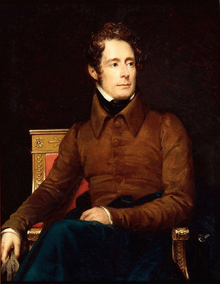
Alphonse Marie Louis de Prat de Lamartine, born on October 21, 1790, in Mâcon, Burgundy, is a towering figure in French literature and politics. His life, marked by a deep commitment to literature and political engagement, spans some of the most transformative years in French history. Known for his lyrical poetry and significant contributions to the Romantic movement, Lamartine’s work also reflects his dedication to public service and his unyielding passion for justice and humanity.
Early Life and Education
Alphonse de Lamartine was born into a family with noble lineage but modest means. His father, Pierre de Lamartine, was a member of the small nobility, loyal to the Bourbon monarchy. Growing up in the family’s country estate in Milly, Lamartine was surrounded by nature, which would later deeply influence his poetic imagination. The rural landscape of Burgundy, with its serene beauty and pastoral charm, became a recurring motif in his poetry.
From an early age, Lamartine showed a strong interest in literature. His education was marked by a focus on the classics, with Latin poets like Virgil and Horace leaving a profound impact on him. This classical training, combined with his early exposure to the works of François-René de Chateaubriand, one of the forerunners of the Romantic movement in France, laid the foundation for his literary career.
Despite his literary inclinations, Lamartine was expected to pursue a military career, as was typical for young men of his social class. However, his father, who harbored deep distrust for Napoleon’s regime, was reluctant to see his son serve the Empire. Instead, Lamartine was sent to Italy in 1811, where he spent time with his relatives in Livorno, Pisa, and Naples. This sojourn in Italy was formative, exposing him to the rich cultural heritage of the Renaissance and igniting his lifelong love for the Mediterranean.
Romantic Poet and Literary Fame
Lamartine’s literary debut came with the publication of Méditations poétiques in 1820, a collection of poems that would establish him as one of the leading voices of the French Romantic movement. The Méditations were a radical departure from the rigid forms and themes of neoclassicism, embracing instead a more personal and emotional expression of the poet’s inner world. The poems, infused with melancholy and a deep sense of spirituality, were inspired by Lamartine’s love for Julie Charles, a woman he had met in 1816 and who had died shortly afterward.
The publication of Méditations poétiques was a literary sensation. Lamartine’s ability to capture the profound emotions of love, loss, and the sublime beauty of nature resonated with the growing Romantic sensibility of the time. The success of this collection was followed by Nouvelles Méditations poétiques (1823) and Harmonies poétiques et religieuses (1830), both of which further cemented his reputation as a leading Romantic poet.
Lamartine’s poetry is characterized by its lyrical quality, its exploration of existential themes, and its profound connection to nature. He sought to express the ineffable, to capture the fleeting moments of beauty and emotion that define the human experience. His work was deeply introspective, often reflecting his own spiritual struggles and his search for meaning in a rapidly changing world.
Political Engagement and Diplomatic Career
While Lamartine is best known for his literary contributions, his life was also marked by a deep commitment to political and social causes. His political career began in earnest after the July Revolution of 1830, which saw the overthrow of the Bourbon monarchy and the establishment of the July Monarchy under Louis-Philippe. Lamartine, who had long harbored republican sympathies, was elected as a deputy in 1834.
Lamartine’s political philosophy was rooted in his belief in human dignity, justice, and the power of reason. He was a staunch advocate for liberal democracy and human rights, and he used his position in the Chamber of Deputies to champion these causes. His eloquence and moral authority made him a respected figure in French politics, and he became known for his ability to articulate the aspirations of the French people.
One of the most significant moments in Lamartine’s political career came during the Revolution of 1848, which led to the establishment of the Second French Republic. Lamartine played a key role in the provisional government, serving as the Minister of Foreign Affairs. During this tumultuous period, he was instrumental in preventing France from descending into civil war and in shaping the new republic’s foreign policy.
However, Lamartine’s political career was not without its challenges. Despite his efforts, the Republic faced significant internal and external pressures, and Lamartine himself struggled to balance his ideals with the realities of governance. His refusal to use force to suppress the June Days uprising, a workers’ revolt, alienated many of his supporters and ultimately led to his political downfall. The rise of Louis-Napoleon Bonaparte (later Napoleon III) marked the end of Lamartine’s political influence, and he retired from public life in the early 1850s.
Later Life and Literary Contributions
After his withdrawal from politics, Lamartine dedicated himself to literature and historical writing. The years following his political career were marked by prolific literary activity, though they were also tinged with personal sorrow and financial difficulties. The death of his beloved daughter Julia in 1832 and his wife Mary Ann in 1863 left Lamartine deeply bereaved, and his later years were shadowed by declining health and financial struggles.
Despite these hardships, Lamartine produced a significant body of work during this period, much of it autobiographical in nature. His writings from this time include Raphael: Pages de la Vingtième Année (1849), a deeply personal narrative that reflects on his youthful experiences and unfulfilled loves, and Graziella (1852), a novel based on his early romantic encounters in Naples. These works are characterized by their introspective quality and their exploration of the themes of memory, loss, and the passage of time.
In addition to his autobiographical works, Lamartine also wrote several historical studies, including Histoire de la Restauration (1854), Histoire de la Turquie (1854), and Histoire de la Russie (1855). These works reflect Lamartine’s broad intellectual interests and his commitment to understanding and interpreting the historical forces that shaped the modern world.
Lamartine’s later writings, though less celebrated than his early poetry, are significant for their insight into the human condition and their reflection on the social and political changes of the 19th century. His Cours familier de littérature (1856), a massive 28-volume work, offers a comprehensive overview of literary history and criticism, demonstrating Lamartine’s deep engagement with the literary traditions of both France and Europe.
Legacy and Influence
Alphonse de Lamartine’s legacy is multifaceted, encompassing his contributions to literature, politics, and social thought. As a poet, Lamartine is remembered as one of the pioneers of the Romantic movement in France. His lyrical expressions of love, nature, and the divine had a profound influence on subsequent generations of poets and writers, both in France and beyond. His work paved the way for later Romantic poets such as Victor Hugo and Alfred de Musset, who expanded on the themes and stylistic innovations introduced by Lamartine.
In the realm of politics, Lamartine’s legacy is more complex. While he is celebrated for his role in the Revolution of 1848 and his advocacy for democratic ideals, his political career was ultimately marked by disappointment and failure. Nevertheless, his commitment to justice, human rights, and the principles of liberal democracy remains a source of inspiration for those who continue to fight for these values.
Lamartine’s influence also extends to the broader cultural and intellectual life of the 19th century. His work as a historian and literary critic helped to shape the intellectual landscape of his time, and his writings continue to be studied for their insights into the social, political, and cultural currents of the era.
Final Years and Death
The final years of Lamartine’s life were marked by personal and financial difficulties. His literary success had not translated into financial security, and he struggled to maintain his estate at Saint-Point. In 1863, Lamartine suffered a devastating stroke that left him partially paralyzed and unable to speak. The French government, recognizing his contributions to the nation, granted him a pension, and the city of Paris provided him with a residence in Passy.
Alphonse de Lamartine died on February 28, 1869, in Paris. His death marked the end of an era in French literature and politics. He was buried in the family vault at Saint-Point, where his legacy continues to be honored.
Conclusion
Alphonse de Lamartine was a man of immense talent and profound vision. His life, spanning the tumultuous years of the early 19th century, was marked by both personal triumph and tragedy. As a poet, he gave voice to the deepest emotions of the human heart, capturing the beauty and sorrow of life in verses that continue to resonate with readers today. As a politician, he fought for the ideals of liberty, equality, and fraternity, even as he struggled with the challenges of political life.
Lamartine’s legacy is one of enduring significance. His contributions to the Romantic movement helped to shape the course of French literature, while his political ideals continue to inspire those who seek to build a more just and equitable world. In the end, Alphonse de Lamartine stands as a testament to the power of words and ideas to change the world.


