
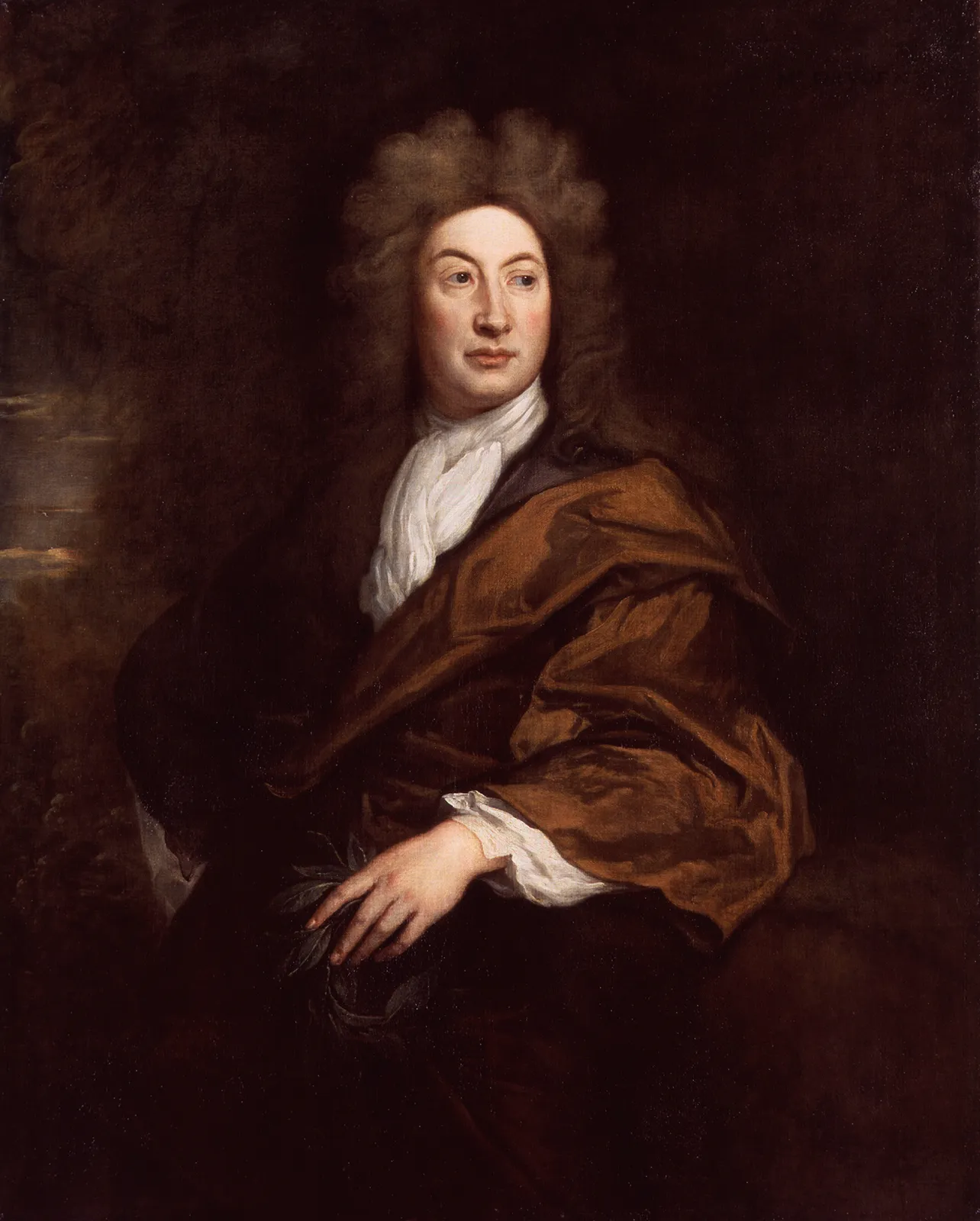
John Dryden, born on August 19, 1631, in Aldwincle, Northamptonshire, England, is a towering figure in the landscape of English literature. A poet, playwright, literary critic, and translator, Dryden’s contributions to English letters were profound and far-reaching, marking him as one of the most influential writers of the Restoration era. His life and works provide a window into the cultural and political dynamics of 17th-century England, reflecting the complexities of the period through his poetry, plays, and essays.
Early Life and Education: Foundations of a Literary Giant
John Dryden was the eldest of fourteen children born to Erasmus and Mary Dryden, members of the English gentry with Puritan sympathies. He spent his early years in the village of Titchmarsh, where his family’s social standing and religious background played a significant role in shaping his worldview. At the age of 15, Dryden was sent to Westminster School, a prestigious institution where he received a rigorous education under the tutelage of Dr. Richard Busby, a formidable and charismatic headmaster known for his strict discipline.
Westminster School was not merely a place of learning but a breeding ground for loyalty to the monarchy and the Anglican Church, values that were instilled in Dryden from a young age. His education there included a strong focus on rhetoric and dialectics—skills that would later become evident in his literary works. Dryden’s first published poem, an elegy on the death of his schoolmate Lord Henry Hastings, was a reflection of the political tensions of the time, subtly alluding to the execution of King Charles I.
In 1650, Dryden entered Trinity College, Cambridge, where his studies were influenced by the return to the religious and political ethics of his Puritan upbringing. While details of his time at Cambridge are sparse, it is known that Dryden’s academic focus included the classics, rhetoric, and mathematics—disciplines that would serve as a foundation for his later works. The death of his father in 1654 left Dryden with a modest inheritance, insufficient for a comfortable living, compelling him to seek employment in London.
Early Literary Career: From Cromwell to the Restoration
Dryden’s first significant foray into literature came with the publication of his poem “Heroique Stanzas” in 1658, a tribute to Oliver Cromwell following the Lord Protector’s death. The poem, though politically motivated, was a demonstration of Dryden’s skill in panegyric verse, marking him as a poet capable of capturing the sentiments of his age. However, with the Restoration of the monarchy in 1660, Dryden quickly adapted to the changing political landscape, penning “Astraea Redux,” a celebratory poem on the return of King Charles II. This work solidified his reputation as a poet aligned with the monarchy, and he continued to produce panegyrics, including “To His Sacred Majesty: A Panegyric on his Coronation” and “To My Lord Chancellor.”
Dryden’s ability to navigate the shifting political tides of England was a testament to his adaptability and keen awareness of the cultural zeitgeist. His alignment with the monarchy earned him the favor of the court, and in 1662, he was elected to the Royal Society. Despite his initial involvement, Dryden’s interest in the society waned, leading to his expulsion in 1666 for non-payment of dues—a minor setback in an otherwise upward trajectory.
Marriage and Personal Life: Stability Amidst Turbulence
On December 1, 1663, Dryden married Lady Elizabeth Howard, the daughter of Thomas Howard, 1st Earl of Berkshire. The marriage provided Dryden with social stability and connections, though it was not without its challenges. The couple had three sons, and despite the pressures of his literary career, Dryden remained a devoted family man. His marriage to Lady Elizabeth also linked him to the Howard family, one of the most prominent aristocratic families in England, further solidifying his position within the social and political elite.
Theatrical Success: Dominating the Restoration Stage
The restoration of the monarchy also brought the reopening of theaters, which had been closed under the Puritan regime. Dryden seized this opportunity, turning his talents to playwriting. His first play, “The Wild Gallant,” premiered in 1663 but was not a commercial success. However, Dryden was undeterred, and over the next decade, he became one of the most prolific and successful playwrights of his time.
Dryden’s contributions to Restoration theater were significant. He was a master of both comedy and tragedy, with works such as “Marriage A-la-Mode” (1672) showcasing his wit and command of the English language. His tragedies, including “All for Love” (1678), a reimagining of Shakespeare’s “Antony and Cleopatra,” demonstrated his ability to convey deep emotional complexity and heroic themes. By 1668, Dryden had secured a position as one of the leading dramatists of the era, writing for the King’s Company, where he was also a shareholder. The income from his plays became his primary means of support, as he produced three plays a year for several years, an impressive output that solidified his reputation in the London theater scene.
Poetic Achievements: From “Annus Mirabilis” to Poet Laureate
In addition to his success in the theater, Dryden continued to write poetry, with his most notable work of this period being “Annus Mirabilis” (1667). This historical poem, written in quatrains, chronicled the events of 1666, including the English victory over the Dutch fleet and the Great Fire of London. “Annus Mirabilis” was a modern epic that showcased Dryden’s ability to blend historical narrative with poetic form, earning him widespread acclaim.
The success of “Annus Mirabilis” was instrumental in Dryden’s appointment as Poet Laureate of England in 1668, a position he held until 1688. As Poet Laureate, Dryden was not only the official poet of the court but also a prominent public intellectual, whose works reflected and shaped the cultural and political discourse of the time. His laureateship marked the pinnacle of his literary career, as he became the most celebrated poet of his generation.
During this period, Dryden also produced “Of Dramatick Poesie” (1668), a critical essay written in the form of a dialogue. This work is considered one of the most important early works of English literary criticism, as it explored the merits of classical versus modern literature, and the distinct qualities of English and French drama. Dryden’s critical acumen was further demonstrated in his satirical poems, such as “MacFlecknoe” (1682), which targeted the playwright Thomas Shadwell, and “Absalom and Achitophel” (1681), a political allegory that remains one of his most famous works.
Religious and Political Shifts: Conversion and the Glorious Revolution
Dryden’s later years were marked by significant religious and political changes. In 1682, he published “Religio Laici,” a poem defending the Anglican Church, but by 1687, he had converted to Roman Catholicism, a decision that would have profound implications for his career. His conversion was publicly celebrated in the poem “The Hind and the Panther” (1687), an allegory that defended the Catholic Church and criticized its Protestant opponents.
The Glorious Revolution of 1688, which saw the overthrow of the Catholic King James II and the ascension of the Protestant William III and Mary II, drastically altered Dryden’s fortunes. As a supporter of James II, Dryden was stripped of his position as Poet Laureate and replaced by his rival, Thomas Shadwell. This political and religious shift forced Dryden to rely solely on his writing for income, leading him to focus on translations and adaptations of classical works.
Later Works and Legacy: Translation and Influence
Despite the loss of his court position, Dryden continued to produce significant literary works in his later years. He turned to translation as a means of supporting himself, undertaking ambitious projects that further cemented his reputation as one of the leading literary figures of his time. His translations of classical authors such as Horace, Juvenal, Ovid, and Virgil were highly regarded, with his 1697 translation of Virgil’s works being particularly well-received. The publication of “The Works of Virgil” was a major literary event, earning Dryden substantial financial rewards and critical acclaim.
In 1700, Dryden published “Fables Ancient and Modern,” a collection that included translations from Homer, Ovid, Boccaccio, and Chaucer, as well as original poems. The preface to this volume is considered one of the greatest essays of literary criticism in the English language, reflecting Dryden’s deep understanding of classical literature and his ability to adapt it to contemporary tastes.
John Dryden died on May 12, 1700, and was buried in Westminster Abbey, a fitting resting place for a man who had such a profound impact on English literature. His death was mourned by the literary community, with numerous elegies written in his honor, a testament to the esteem in which he was held by his contemporaries.
Posthumous Influence and Reputation
Dryden’s influence on English literature extended well beyond his lifetime. In the 18th century, poets such as Alexander Pope and Samuel Johnson regarded Dryden as a model of poetic excellence, emulating his style and themes in their own work. Pope, in particular, was heavily influenced by Dryden’s satirical verse and his use of heroic couplets, a form that Dryden had popularized.
However, Dryden’s reputation underwent a decline in the 19th century, as Romantic poets and critics, who favored a more emotive and individualistic approach to poetry, dismissed his work as overly formal and lacking in imagination. It was not until the 20th century that Dryden’s contributions were fully reappreciated, with literary figures such as T.S. Eliot recognizing his importance in the development of English poetry and criticism. Eliot famously described Dryden as “the ancestor of nearly all that is best in the poetry of the eighteenth century,” emphasizing the lasting impact of his work on the literary canon.
Conclusion: The Enduring Legacy of John Dryden
John Dryden’s life and work offer a rich tapestry of the literary and cultural history of 17th-century England. His ability to adapt to the changing political and religious landscape of his time, while producing works of enduring significance, marks him as one of the most versatile and influential writers in the English language. From his early panegyrics celebrating the Restoration to his later translations of classical masterpieces, Dryden’s contributions to poetry, drama, and literary criticism remain a cornerstone of English literature.
As a poet, Dryden was unmatched in his mastery of form and his ability to capture the spirit of his age. As a playwright, he helped to shape the theatrical conventions of the Restoration stage. As a critic, he laid the groundwork for modern literary analysis, and as a translator, he made the great works of antiquity accessible to a new generation of readers. John Dryden’s legacy is one of intellectual rigor, artistic innovation, and a profound understanding of the human condition—qualities that continue to resonate with readers and scholars alike.


