
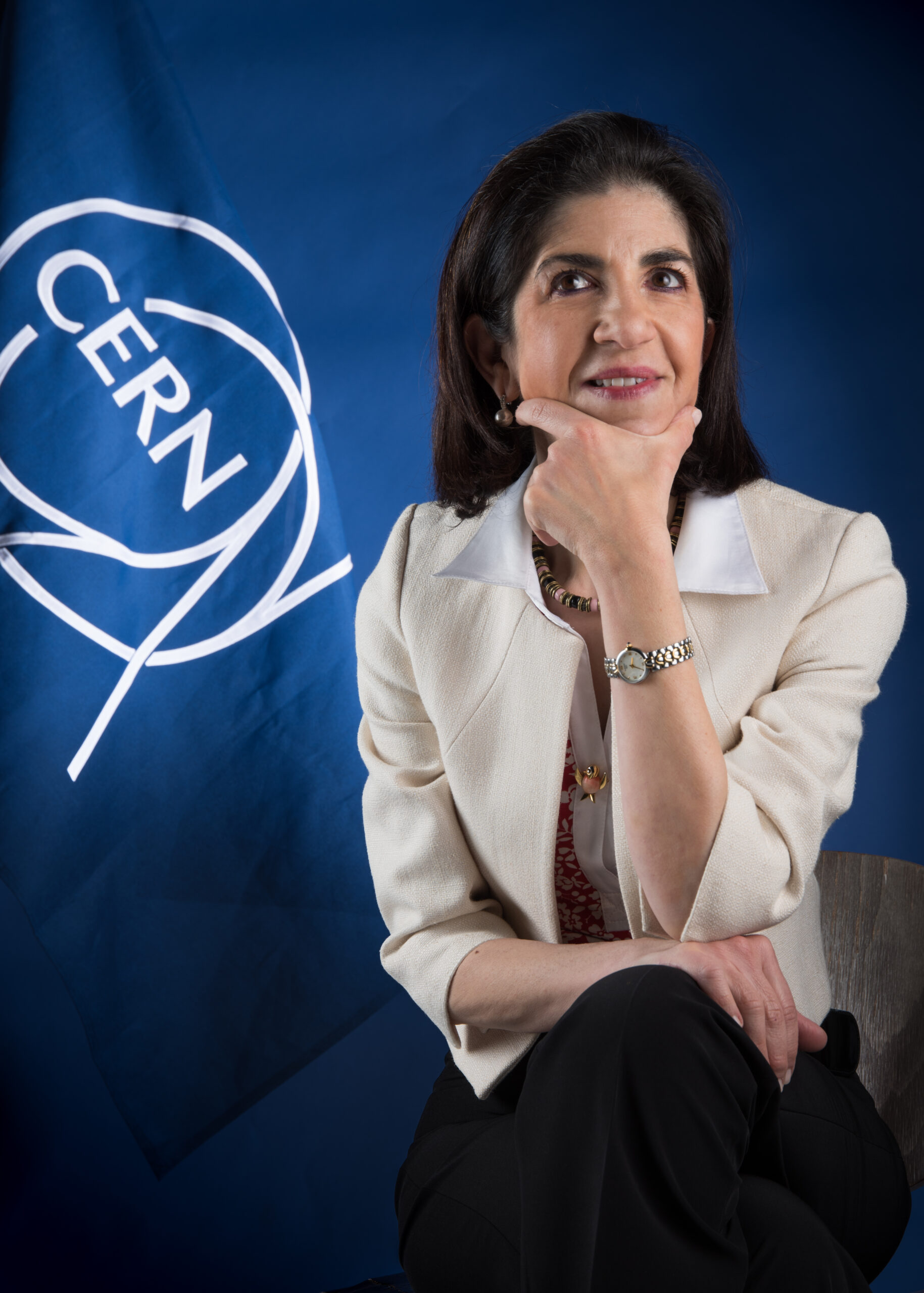
Fabiola Gianotti is an iconic figure in the world of physics, recognized globally for her groundbreaking contributions to particle physics and her historic role as the first female Director-General of CERN, the European Organization for Nuclear Research. Born on October 29, 1960, in Rome, Italy, Gianotti has risen to the pinnacle of scientific achievement, earning accolades and honors that reflect her immense impact on science and society. This article delves into her life, career, and the key moments that have defined her journey.
Early Life and Academic Foundations
Fabiola Gianotti was born into an intellectually stimulating environment. Her mother, a Sicilian scholar of literature, and her father, a geologist from Piedmont, instilled in her a love for knowledge and discovery from a young age. At just seven years old, Gianotti’s family moved from Rome to Milan, where she attended the Tommaseo Middle School and later the Ursuline Classical High School.
Her passion for science, particularly physics, was ignited during her school years. A pivotal moment came when she read the biography of Marie Curie and learned about the photoelectric effect through the work of Albert Einstein. These early influences played a crucial role in shaping her academic and career aspirations.
Gianotti pursued her higher education at the University of Milan, where she majored in Physics with a focus on sub-nuclear physics. She graduated in 1984, and the same year, inspired by Carlo Rubbia’s Nobel Prize in Physics, she decided to embark on a PhD in particle physics. Her doctoral thesis involved the analysis of data from the UA2 experiment, a project that laid the groundwork for her future contributions to the field.
Entry into CERN and Early Contributions
In 1987, Fabiola Gianotti joined CERN, one of the world’s most prestigious research institutions dedicated to the study of nuclear and particle physics. Her early work at CERN involved contributions to several significant experiments, including ALEPH at the Large Electron-Positron Collider (LEP) and UA2 at the Super Proton Synchrotron. These projects were crucial in advancing the understanding of fundamental particles and the forces that govern their interactions.
During the early 1990s, Gianotti began focusing on liquid argon detectors, a technology that would become central to her later work. In 1992, she became involved in the ATLAS experiment, one of the most ambitious scientific projects in history. The ATLAS experiment, which involves thousands of physicists from nearly 40 countries, aims to explore the fundamental particles that make up the universe.
The ATLAS Experiment and Higgs Boson Discovery
Fabiola Gianotti’s work on the ATLAS experiment would become the cornerstone of her scientific career. From 1999 to 2003, she served as the coordinator of the experiment, a role she resumed in 2009 after being elected by her colleagues. Her leadership and scientific expertise were instrumental in the success of the ATLAS experiment, which sought to uncover new particles and phenomena that could explain the fundamental forces of nature.
On July 4, 2012, Gianotti achieved global recognition when she announced the discovery of a particle consistent with the Higgs boson at a press conference at CERN. This discovery was a monumental achievement in physics, confirming a key element of the Standard Model of particle physics. The Higgs boson, often referred to as the “God particle,” is responsible for giving mass to other particles, a discovery that has profound implications for our understanding of the universe.
During the announcement, Gianotti explained the significance of the discovery in a way that captured the imagination of both the scientific community and the general public. She highlighted how some particles, like photons, are massless and travel at the speed of light, while others have mass. The discovery of the Higgs boson provided the missing piece in the puzzle of why some particles have mass and others do not, fundamentally advancing our knowledge of the universe’s underlying structure.
Global Recognition and Honors
Fabiola Gianotti’s contributions to physics have earned her numerous awards and honors. In 2009, she was named a Commander of the Order of Merit of the Italian Republic, recognizing her scientific expertise and her leadership in the ATLAS project. This honor was a testament to her role in elevating the prestige of the Italian scientific community in the field of nuclear physics.
The discovery of the Higgs boson in 2012 catapulted Gianotti to international fame. That year, she was awarded the Grand Officer of the Order of Merit of the Italian Republic, one of the highest honors in Italy. The city of Milan also honored her with the Ambrogino d’Oro, and she received the Fundamental Physics Prize, which is awarded for significant achievements in the field of physics. The prestigious “Time” magazine listed her as one of the top 100 most influential people of the year, placing her fifth on the list.
In 2013, Gianotti left her role as the spokesperson for the ATLAS experiment but continued to make significant contributions to the field of physics. She was appointed Honorary Professor at the University of Edinburgh, reflecting her status as a leading figure in global science.
One of the most memorable moments of her career occurred when she was invited by Peter Higgs, the theoretical physicist who predicted the existence of the Higgs boson, to accompany him to the Nobel Prize ceremony in 2013. This invitation was a significant recognition of her contributions to the discovery that earned Higgs the Nobel Prize in Physics.
Becoming the First Female Director-General of CERN
In November 2014, Fabiola Gianotti made history when she was elected by CERN’s Council as the first female Director-General in the organization’s history. This appointment was formalized in December 2014, and her five-year term began on January 1, 2016. Gianotti’s election as Director-General was a landmark achievement, not only for her personally but also for women in science worldwide.
Her leadership at CERN marked a new era for the organization. Under her direction, CERN continued to be at the forefront of scientific discovery, pushing the boundaries of what is known about the universe. Gianotti’s tenure was characterized by her commitment to scientific excellence, international collaboration, and the promotion of women in science.
In November 2019, Gianotti was reappointed as CERN’s Director-General, making her the first person to hold the position for a second term. This unprecedented reappointment underscored her effectiveness as a leader and her continued relevance in the global scientific community.
Advocacy for Science and Women in STEM
Beyond her scientific achievements, Fabiola Gianotti has been a powerful advocate for science and the role of women in STEM (Science, Technology, Engineering, and Mathematics). Her position as the first female Director-General of CERN has made her a role model for young women aspiring to careers in science. Gianotti has consistently emphasized the importance of diversity in scientific research and has worked to create an inclusive environment at CERN.
She has also been vocal about the need for more public understanding and support for scientific research. Gianotti believes that science is not just the domain of experts but something that should be accessible to everyone. She has participated in numerous public lectures, interviews, and educational initiatives aimed at bridging the gap between the scientific community and the general public.
Gianotti’s commitment to science communication is reflected in her efforts to explain complex scientific concepts in an accessible way. She understands the importance of engaging the public with science, particularly in an era where scientific literacy is crucial for informed decision-making on global issues such as climate change, health, and technology.
Personal Life and Legacy
Fabiola Gianotti is known for her humility and dedication to her work. Despite her global recognition and numerous awards, she remains grounded and focused on the pursuit of knowledge. Her personal life is characterized by a deep commitment to her family and a love for the arts, particularly music. Gianotti is a classically trained pianist, and she often speaks about the parallels between music and science, both of which require creativity, discipline, and a passion for discovery.
Gianotti’s legacy is one of trailblazing achievements and a relentless pursuit of scientific truth. She has broken barriers not only in her scientific field but also in the broader context of gender equality in STEM. Her leadership at CERN and her contributions to the discovery of the Higgs boson have solidified her place in history as one of the most influential scientists of her generation.
Conclusion
Fabiola Gianotti’s life and career are a testament to the power of curiosity, dedication, and intellectual rigor. From her early fascination with physics to her historic role as the first female Director-General of CERN, Gianotti has made an indelible mark on the world of science. Her work has not only expanded our understanding of the universe but has also inspired countless young women to pursue careers in science and technology.
As she continues to lead CERN into the future, Fabiola Gianotti’s influence on science and society will undoubtedly grow. Her legacy will be remembered not only for her scientific contributions but also for her leadership, advocacy for women in science, and her commitment to making science accessible to all.


