
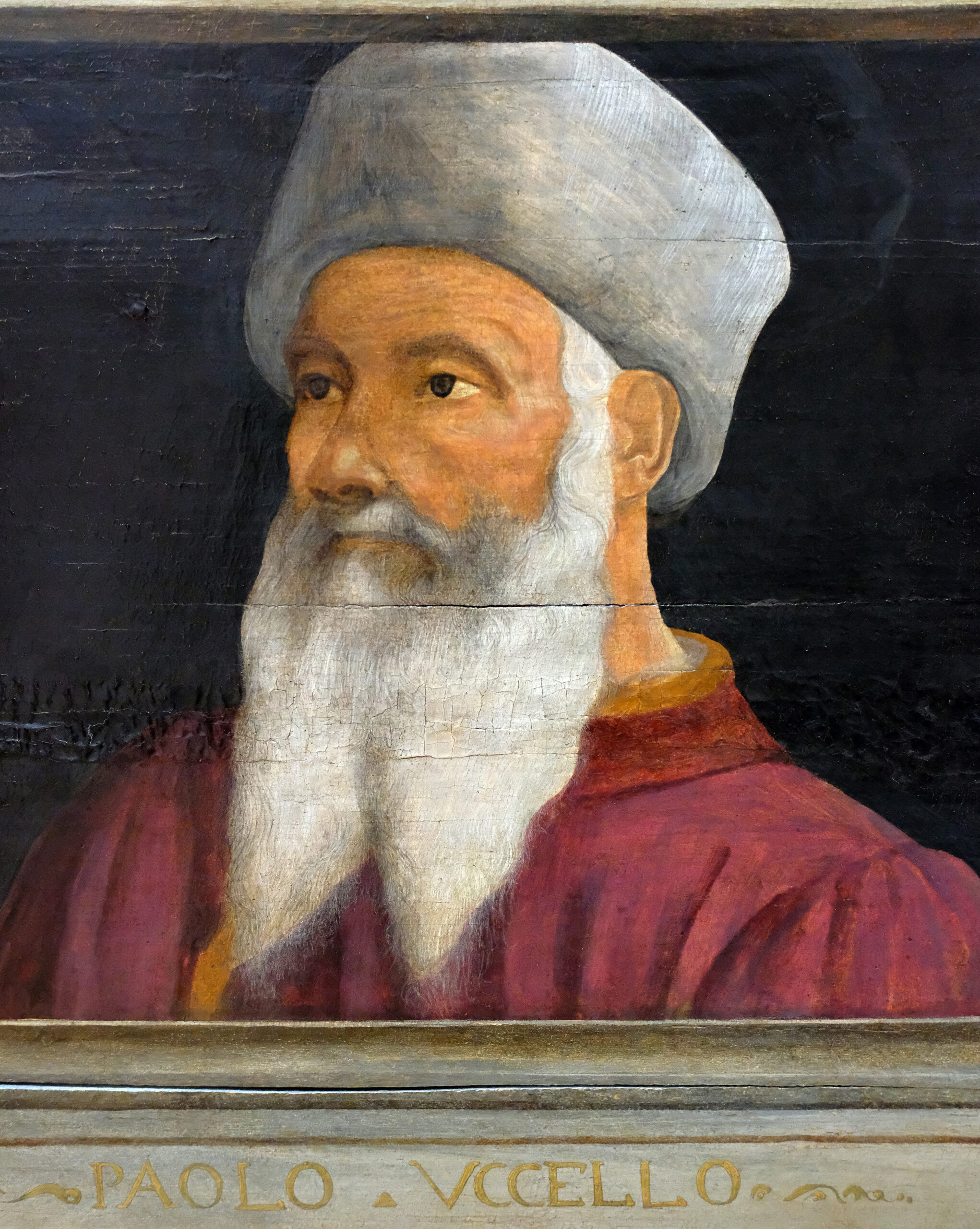
Paolo Uccello, born Paolo di Dono on June 15, 1397, in Florence, Italy, stands as one of the most intriguing figures of the early Italian Renaissance. Often overshadowed by contemporaries like Masaccio and Donatello, Uccello’s unique approach to perspective and his fascination with geometric forms have cemented his legacy in the annals of art history. Known for his nickname “Paolo degli Uccelli” or “Paolo of the Birds” due to his penchant for incorporating birds into his work, Uccello’s contributions to the development of visual perspective were pioneering, influencing the course of Western art.
Early Life and Training
Paolo Uccello was born into a modest family in Florence, although some sources claim his birthplace might be Pratovecchio in Casentino. His early artistic inclinations were nurtured in the workshop of Gherardo Starnina, a Florentine painter known for his vibrant colors and dynamic compositions. According to Giorgio Vasari, a renowned biographer of Renaissance artists, Uccello also trained under Antonio Veneziano. By 1407, Uccello had joined the workshop of Lorenzo Ghiberti, a master goldsmith and sculptor, where he worked as an assistant on the intricate bronze doors of the Florence Baptistery. This period exposed him to the technical rigor and artistic innovation that would later shape his career.
Artistic Journey and Style
Uccello’s early works were marked by his distinct use of perspective, a technique that was still in its infancy during the early 15th century. He was fascinated by the mathematical principles underlying perspective, and his experimentation with foreshortening and vanishing points set him apart from his contemporaries. This obsession is evident in his famous series of three paintings depicting the “Battle of San Romano,” which showcase a meticulous attention to geometric composition and spatial depth. These paintings, housed in the Uffizi Gallery in Florence, the Louvre in Paris, and the National Gallery in London, are celebrated for their dynamic arrangement of figures and the innovative use of perspective to create a sense of movement and chaos.
In the 1420s, Uccello moved to Venice, where he worked on mosaics and intarsia (wood inlay) designs for the Basilica of San Marco. Although these works have not survived, his stay in Venice is significant as it reflects his ongoing quest to master the interplay of light, shadow, and form. This period also hints at his exposure to the works of other Gothic painters like Pisanello and Gentile da Fabriano, whose influence can be seen in Uccello’s meticulous attention to detail and his use of vivid, almost otherworldly color palettes.
Major Works and Commissions
Upon returning to Florence in 1431, Uccello began working on frescoes for Santa Maria Novella, depicting scenes from the Book of Genesis. These works, while somewhat traditional in their narrative approach, exhibit his growing mastery of perspective, especially in the architectural elements and landscapes that frame the biblical scenes.
In the mid-1430s, Uccello was commissioned to paint the frescoes for the Cappella dell’Assunta in the Duomo of Prato. This series, illustrating various saints and episodes from the life of the Virgin Mary, further demonstrates his ability to blend Gothic stylistic elements with his novel use of perspective, resulting in a unique visual style that was both retrospective and avant-garde.
One of his most famous commissions came in the 1440s, when Uccello was asked by the Florentine government to create a series of three paintings commemorating the victory of the Florentine forces over the Sienese at the Battle of San Romano in 1432. These paintings are notable not only for their historical significance but also for their artistic innovation. Uccello’s use of broken lances, scattered armor, and receding horsemen creates a dynamic rhythm that leads the viewer’s eye across the canvas, enhancing the narrative impact of the scenes. The meticulous attention to detail, particularly in the rendering of the horses and the fallen soldiers, reflects his deep understanding of geometry and foreshortening, which were revolutionary techniques at the time.
Influence and Later Life
By the 1450s, Uccello’s style had matured, characterized by a dramatic use of perspective and a highly personal, almost mystical, interpretation of space. His approach was somewhat out of step with the naturalism that was becoming popular among his contemporaries, leading to a decline in his popularity towards the latter part of his life. However, he continued to receive commissions, including one from Donatello, who invited him to Padua in 1445 to paint frescoes in the Palazzo Vitalini.
In 1452, Uccello married Tommasa Malifici, with whom he had two daughters. His later years were marked by a quieter life, but he continued to work on various projects, including a series of frescoes in Urbino depicting the Miracle of the Profaned Host. These works, produced between 1465 and 1468, are notable for their dark, dramatic color schemes and their integration of Gothic and Renaissance elements, underscoring Uccello’s status as a transitional figure in the history of art.
Death and Legacy
Paolo Uccello passed away on December 10, 1475, in Florence, at the age of 78. Despite his relative obscurity at the time of his death, his work was rediscovered and celebrated by later generations of artists and historians, particularly during the 19th century. Today, Uccello is recognized as a pioneer of perspective and a master of visual storytelling, whose innovative techniques laid the groundwork for the development of Renaissance art.
His contributions to the understanding and application of perspective in painting were monumental. Uccello’s relentless experimentation with spatial dynamics and his fascination with the geometry of form have made him an enduring figure in the study of art history. His works serve as a testament to the transformative power of visual perspective, bridging the gap between the medieval and the modern.
The Nuances of Uccello’s Artistic Philosophy
Understanding Paolo Uccello’s work requires an appreciation of the broader cultural and intellectual shifts occurring in Italy during his lifetime. The early Renaissance was a period of burgeoning humanism, where the emphasis on human experience and empirical observation began to challenge the medieval worldview dominated by religious dogma. Uccello’s fascination with perspective was more than a mere technical exploration; it was a philosophical inquiry into the nature of visual perception and reality itself.
Unlike many of his contemporaries who focused on creating lifelike representations of the human form, Uccello was interested in the abstract principles that underlie visual experience. This is evident in his somewhat stiff and formal figure compositions, which prioritize spatial coherence and geometric harmony over naturalistic depiction. His work reflects a tension between the Gothic traditions he inherited and the new Renaissance ideals of proportion and perspective, making him a unique figure who straddled two worlds.
The Historical Context of Uccello’s Fame
Paolo Uccello’s career unfolded during a time of significant change and innovation in Florence. The city was not just a political and economic hub but also a crucible for artistic experimentation and intellectual exchange. Florence in the early 15th century was a place where ideas about art, science, and philosophy intersected, creating an environment that was ripe for the kind of radical exploration that Uccello embodied.
While Uccello’s contemporaries, such as Donatello and Brunelleschi, were celebrated for their contributions to the new Renaissance style, Uccello’s work was often viewed with a mix of admiration and puzzlement. His relentless pursuit of perspective was seen as an eccentric fixation, one that set him apart from other artists who were more attuned to the humanist spirit of the age. This divergence contributed to his marginalization in the art world of his time, even as it ensured his posthumous recognition as a visionary.
Re-evaluation of Uccello in Modern Times
The modern reassessment of Paolo Uccello’s work highlights his role as a bridge between two epochs. Scholars and art historians now view his unique approach to composition and perspective as a critical link in the chain of art history, one that connects the symbolic, hierarchical spaces of Gothic art with the rational, measured spaces of the Renaissance. His paintings, with their meticulous grids and dramatic foreshortening, anticipate the mathematical precision and empirical observation that would come to define the High Renaissance.
In recent years, exhibitions and retrospectives have sought to shine a light on Uccello’s contributions, positioning him as a key figure in the development of Western art. These efforts have helped to restore Uccello’s reputation as a master of perspective and an innovator whose work deserves to be studied alongside that of more famous contemporaries.
Conclusion
Paolo Uccello remains a fascinating figure in the history of art—a pioneer whose work challenges and delights in equal measure. His life and career reflect the complexities of an artist working at a time of great transition, a period that saw the birth of new artistic conventions and the reimagining of old ones. Through his innovative use of perspective and his commitment to exploring the mathematical principles underlying visual representation, Uccello laid the groundwork for future generations of artists to explore the limits of their craft. In doing so, he secured his place as one of the true visionaries of the Renaissance.


